Posts Tagged ‘Viola’
Early Season at Echo Basin

From the meadow as we approached the wetland, we could see snow remaining on the north-facing slopes of the basin.
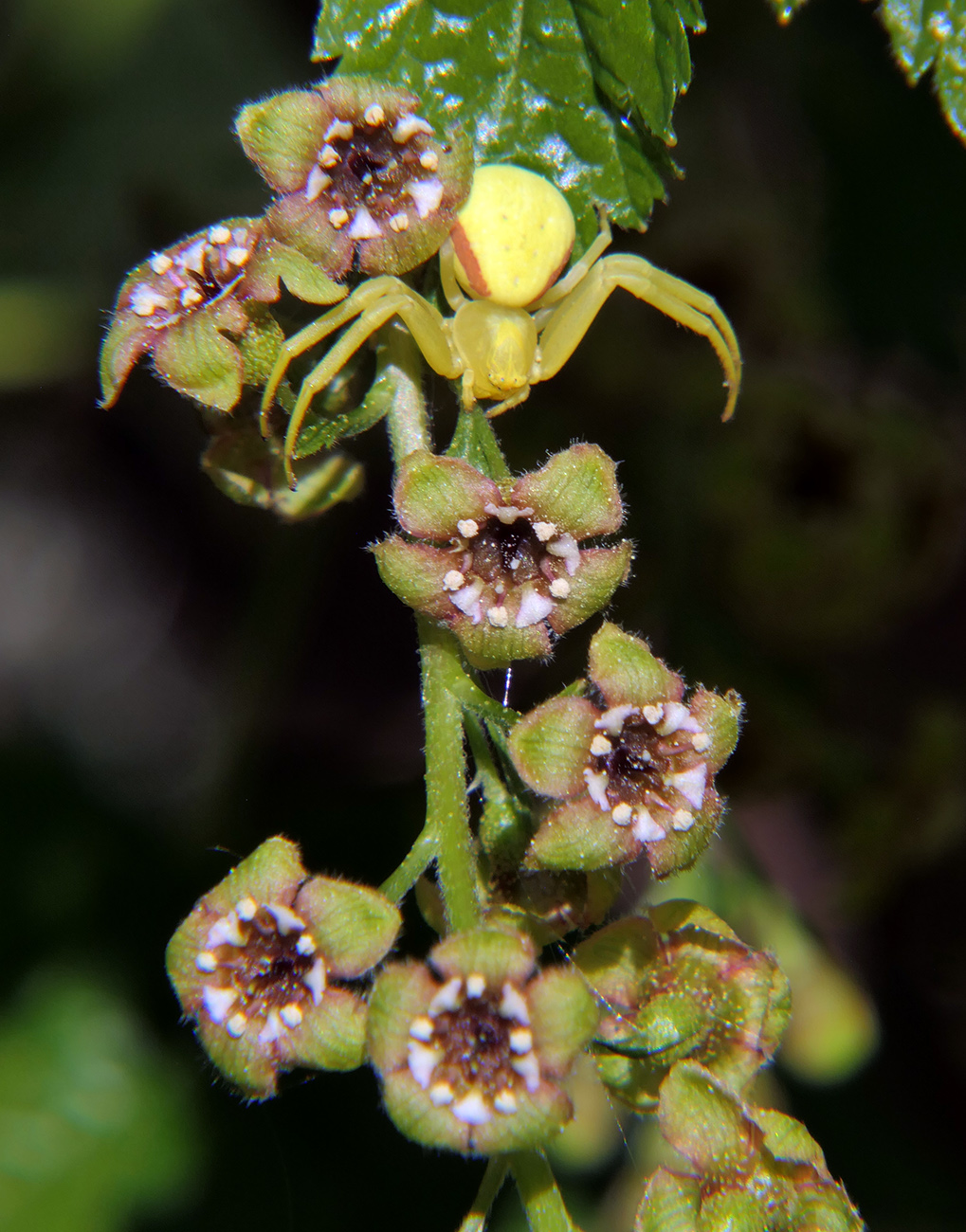
A crab spider strikes a scary pose on the inflorescence of stink currant (Ribes bracteosum).
Echo Basin, just east of Cone Peak, is one of my go-to places in late summer since its wetland and creek retain moisture for a long time, and there are lots of late-blooming wildflowers. It’s also a fairly easy trail with plenty of shade, making for a pleasant hike on a hot day. I realized last October when I went seed collecting (see Berry Collecting at Echo Basin) that it had been many years (20!) since I’d been there to see the early part of the season. When a short but unpleasant heat wave hit us in early June, I decided Echo Basin was the perfect destination for Saturday, June 7th. It wasn’t supposed to be the worst day of heat (although it was 93° when we drove through McKenzie Bridge on the way home), but it was still too hot for anything strenuous. Read the rest of this entry »
Searching for Steer’s Head at Bristow Prairie

Getting to see the unusual flowers of steer’s head is a special treat for early birds.

After looking at so many steer’s head over the course of the day, Denny decided to dig up one and see what the roots looked like. I’d never seen the tiny offset bulbs before. It explains why we saw so many individual smaller leaves next to larger plants.
Back in early May, Denny Albert had contacted me about steer’s head (Dicentra uniflora). He was planning to look for it in the Warner Mountains in northeastern California. I mentioned that there were many places to see this exquisite snowmelt species in the Western Cascades—much closer to home. The tough thing is that it gets overtopped by much larger species and disappears not long after the snow melts. Getting to a site after the snow has melted from the road access but before it is completely gone from the meadows requires excellent timing and good luck. I’d had very good luck in 2022 and seen tons of steer’s head on June 20th at Bristow Prairie (see Changing Waves of Flowers on Two Trips to Bristow Prairie). In early June, I heard from Chad Sageser that he’d just finished cutting all the many fallen trees along the road to Bristow Prairie (thank you!!), so I decided to jump on it and asked Denny and Nancy Bray to come along for a trip the following day, June 3rd. In spite of the last minute invitation, Denny was able to come for his first visit to one of my favorite spots in hopes of seeing steer’s head in the Western Cascades. Read the rest of this entry »
Berry Collecting at Echo Basin

When I reached the open meadows, I was mesmerized by unusual ethereal clouds that seemed to be forming just on the other side of the ridge and drifting not far above me. They dissipated a short distance away to the east. I don’t think I’ve ever seen any like them before, so I photographed them for at least 15 minutes. I would love to know what kind of conditions would create such delicate patterns.

The creek is lined with devil’s club (Oplopanax horribilis), which was taking on some yellow fall coloring.
On October 8th, I headed to Echo Basin, hoping to avoid the smoke still present in the Cascades. Thankfully, I was far enough north to get past most of the remaining fires and had a very pleasant day. There were loads of ripe berries of attractive woodland species, so my timing was perfect for collecting some to seed in areas of my forest that have recently been cleared of blackberries. I was able to collect fruits of false Solomon’s seal (Maianthemum racemosum), starry false Solomon’s seal (M. stellatum), Hooker’s fairy bells (Prosartes hookeri), and baneberry (Actaea rubra). All of these already grow on my property but not abundantly enough to help fill 3 or 4 acres of mostly cleared forest. I also collected some bunchberry (Cornus unalaschkensis) and queen’s cup (Clintonia uniflora), although I haven’t had much luck with them in the past. They’re too beautiful not to give them another try. As I’m working on the Phrymaceae treatment for Volume 3 of the Flora of Oregon, I had hoped to see some remaining monkeyflower (Erythranthe spp.) plants to look at seeds and leaves, but only one species—primrose monkeyflower (E. primuloides) remained. It was really unfortunate that so much of the Western Cascades was closed due to fires this summer, but luckily this area was spared. Echo Basin has a long season of interest. Here are some photos of this wonderful hike in the fall. Read the rest of this entry »
First Botanizing Trip of 2024
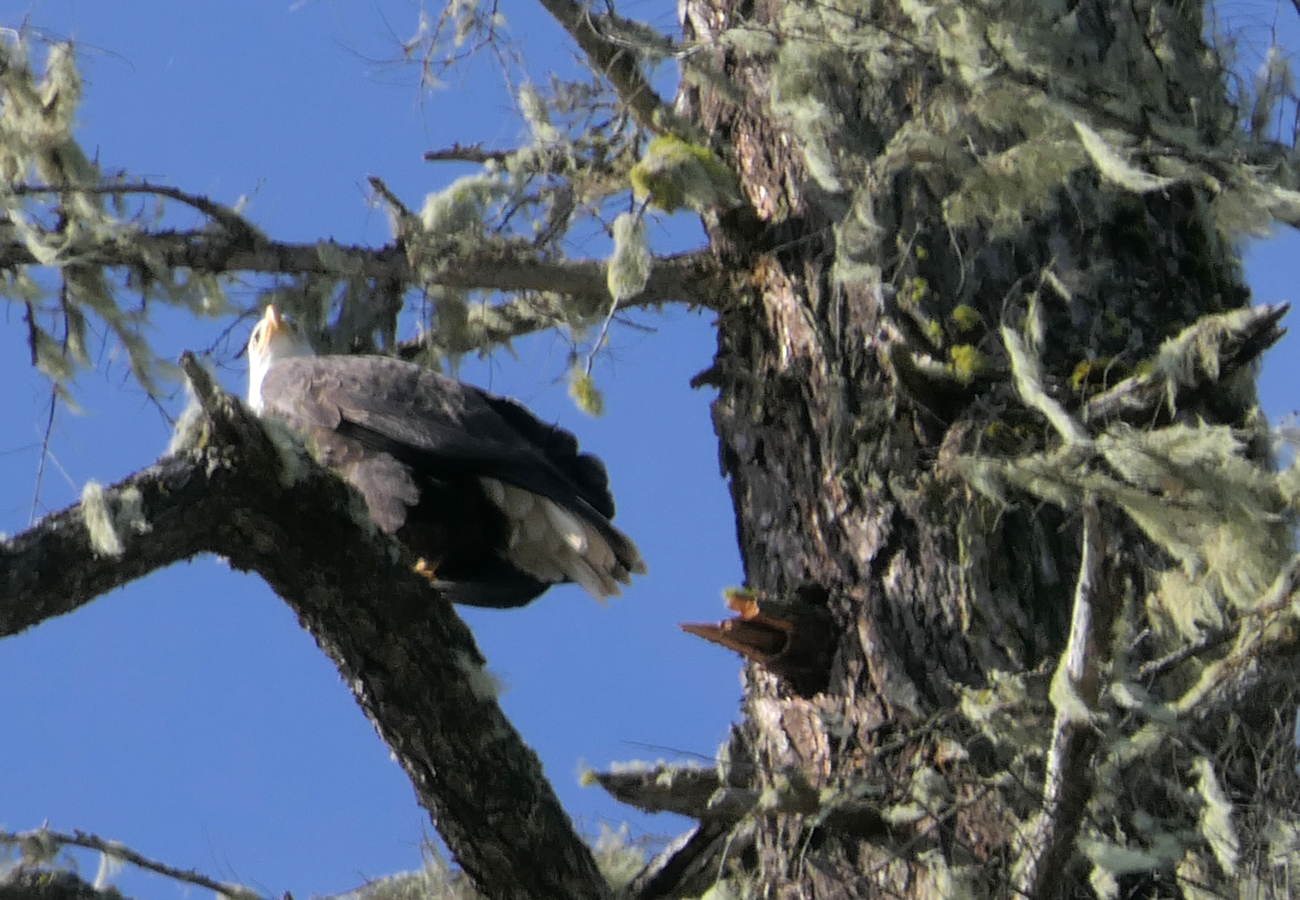
While looking at the flowers on the cliffs, Lauren spotted a bald eagle sitting in a dead tree above us!
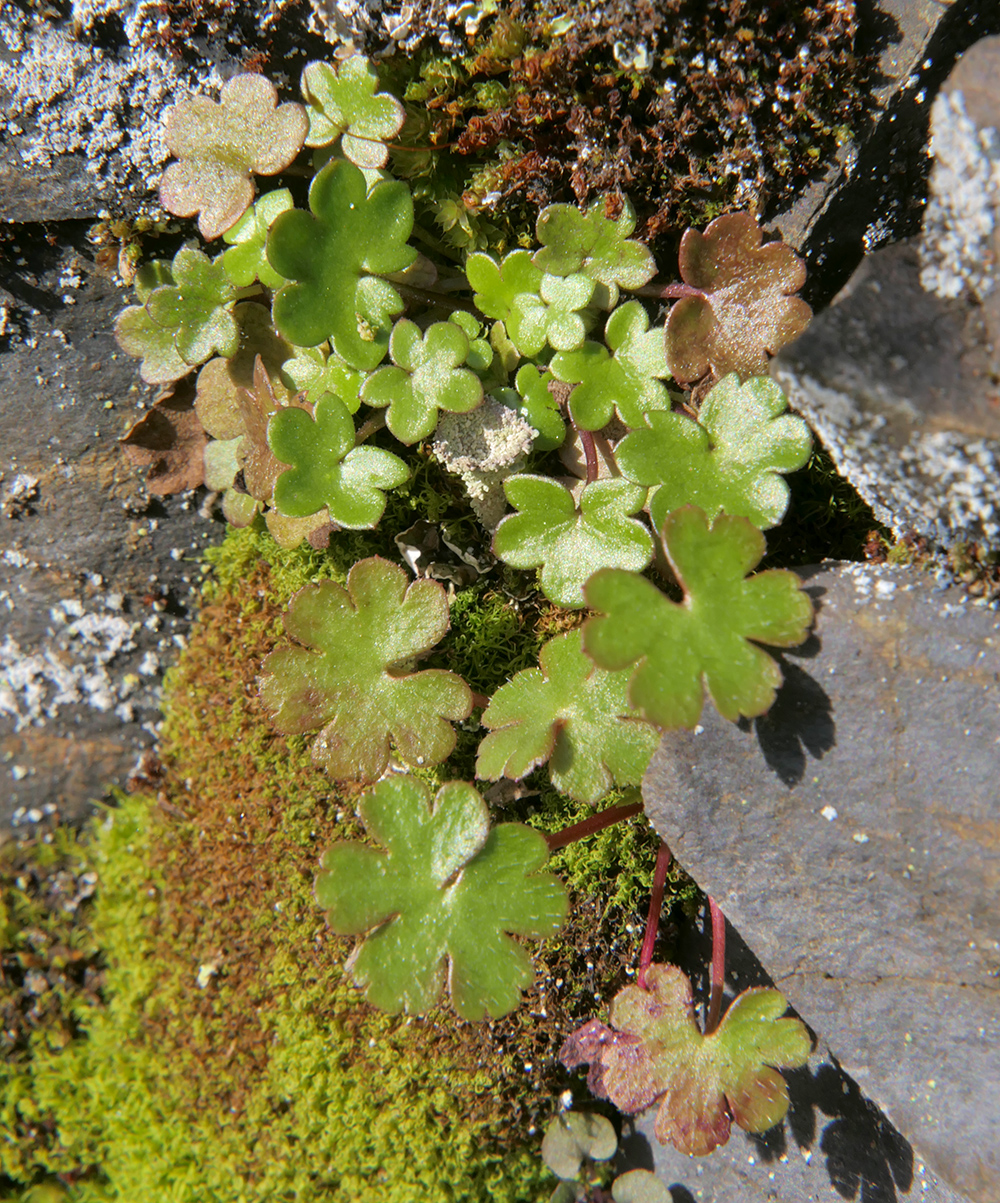
Sadly, the population of shining geranium (Geranium lucidum) at the base of the cliffs near milepost 7 is starting to spread up onto the rocks despite attempts to remove it. Here you can see how similar the geranium leaves (bottom) are to the lovely native California mistmaiden (Romanzoffia californica, top) that grows abundantly there. I tried to at least pull out the ones on the cliff so no one else would accidentally pull the mistmaiden. We looked carefully at the leaves and noted good distinguishing marks are the small tips on the lobes of the glabrous mistmaiden leaves vs. rounded lobes on the slightly hairy leaves of the geranium.
As is my tradition, my first botanizing of the year was to Hills Creek Reservoir south of Oakridge on March 17th. It’s such a relaxing way to start the year. I was joined by fellow Native Plant Society of Oregon (NPSO) members Nancy Bray and Lauren Meyer. We made a number of stops along Road 21 as far as Big Pine Opening across from the bridge that leads to Coal Creek and Staley Creek roads. It didn’t seem worth going any farther as there were still patches of snow in the ditches. Lots of snow up higher as well. It was a lovely warm day, however, and we enjoyed the beautiful gold stars (Crocidium multicaule) and other early flowers. And while not abundant, we did see four species of butterflies: California tortoiseshells, unidentified blues, an anglewing, and a mourning cloak. Seeing butterflies always starts my spring fever. Here are some photos of our (mostly) pleasant day. Read the rest of this entry »
2022 Botanizing and Butterflying Season has Begun!

The first California tortoiseshell to land on my hand

This very odd filbert (Corylus cornuta var. californica) catkin caught my eye near the river. Normally the female flowers with their red-violet stigmas are in a small cluster that is separate from the long, dangling male catkin. But this inflorescence had several females mixed in with the males. What happened here?
While it wasn’t a terribly difficult winter weatherwise (though not nearly enough rain), it is always a joy to see the first flowers of late winter and spring. And with them, the reappearance of the first butterflies. On Tuesdays, I often have meetings for my job with OregonFlora, but this past week, my meeting was postponed for a day. That turned out to be very fortunate as Tuesday, March 22, was the most beautiful day of the week: clear and sunny and the first day of the year to reach 70°. I took advantage of it to head out on what has become my annual first botanizing trip of the year out to Hills Creek Reservoir and the Rigdon area along Road 21. I stopped at all my usual haunts. First along the reservoir to see the gold stars (Crocidium multicaule) blooming. It hasn’t been wet enough for an outstanding year, but they are still such a welcome sight. The paintbrushes (Castilleja) are sending up new leaves that are noticeably reddish. The Sierra gooseberry (Ribes roezlii) was just barely in bloom.
NPSO Field Trip to Moon Point

Relaxing by the lookout. The foliage of beargrass (Xerophyllum tenax) is really soft comfortable to sit and lie on.

Heading down the overgrown trail. The tall foliage on the left is alpine knotweed (Aconogonon phytolaccifolium).
On July 10, eleven (vaccinated) nature lovers gathered at the Middle Fork Ranger Station in Westfir for a field trip to Moon Point sponsored by the Native Plant Society. Jenny Moore, district botanist, was the official leader of the trip, but since she hadn’t been to Moon Point before our pre-hike a month earlier (see Early Bloomers at Moon Point), she asked me to co-lead. What with the pandemic, it was the first field trip I’d led in quite a while.
We had a lovely day up at Moon Point. The plants had grown like crazy since our earlier trip, so the trail looked very different. While a number of flowers were past peak with this summer’s heat and drought, there were still some showy species like skyrocket (Ipomopsis aggregata) and mountain owl’s clover (Orthocarpus imbricatus) in good bloom as well as inconspicuous ones like blunt-sepaled starwort (Stellaria obtusa). There were plenty enough flowers to attract quite an array of insects. Everyone was really inquisitive and as interested in all the butterflies and other insects as they were in flowers. We went all the way out to the point at the end of the trail, and on the way back most people bushwhacked with us over to the lake. Read the rest of this entry »
A Soggy Day on Tire Mountain

Great camas (Camassia leichtlinii) and harsh paintbrush (Castilleja hispida) were a beautiful combination in the large dike meadow.

Chocolate lilies (Fritillaria affinis) were one of the highlights of the day. They were hard to spot at first, but once the sun came out, they weren’t so inconspicuous.
Last weekend, May 22, I was invited to join Molly Juillerat and her dog Loki again, this time with some of her vaccinated friends: Michelle, Annie, Judy, and Julie. Three of them had never been to Tire Mountain but had heard how great the flowers are. It was a damp and cloudy day—not the kind I normally venture out in—but it was great to meet some new plant-loving women, now that we can start to return to normal activities (at least outdoors). We were pretty chilled for most of the day, but it was hard to be too upset about how wet everything was after I’ve spent almost every day of the last couple of incredibly dry months wishing it would rain.
It was still early, so the sweeps of colorful annuals hadn’t started yet—although the rosy plectritis (Plectritis congesta) was in bud and was probably the most asked-about species all day. Brightly colored harsh paintbrush (Castilleja hispida) and barestem lomatium (Lomatium nudicaule) were like bright lights in the gloom. The other lomatiums (L. utriculatum, L. hallii, and L. dissectum) were also flowering. The fawn-lilies (Erythronium oregonum) were at peak bloom but rather droopy from the rain. And, probably the most iconic flower on the mountain, the deltoid balsamroot (Balsamorhiza deltoidea) was also coming into bloom. Definitely worth coming out, even on a damp and gray day! Read the rest of this entry »
Snow Almost Gone, Flowering Has Begun at Patterson

Springtime means skunk cabbage and mountain buttercups blooming in the lovely wetland at the bottom of the large meadow on the south side of Patterson Mountain.
Still anxious to see early mountain flowers, yesterday, May 23, I headed up to Patterson Mountain. In spite of it being my 29th trip up there, I took a wrong turn on the way up. Last year they started heavy thinning of the surrounding forest, and the main Patterson Mountain Road 5840 is hardly recognizable with the reopening of many old side roads. At one point, both sides of a “Y” in the road look equally well used and the road sign for the side road is in the middle. Hopefully, I’ll remember from now on that the right turn to take is the right turn! Read the rest of this entry »
Milkweed is Up and Dippers are Out

One of the milkweeds was close to the cliff edge above the quarry. Thank goodness for the long zoom on my camera so I could take the photo from a safe distance from the edge.
On Monday, May 4, I headed out to the Rigdon area southeast of Oakridge to check on the purple or heartleaf milkweed (Asclepias cordifolia). At home, my little seedlings had been germinating, and some of last year’s seedlings were reemerging, so I was pretty sure the milkweed would be up at Big Pine Opening. I was surprised to see how tall some of the plants were, and several even had a few open flowers. I relocated the “chia pet” milkweed plant(s) from last year (see Three Trips in a Row to Rigdon). It was still growing in the same bizarre manner. I’m really puzzled by this odd plant, but I’ll just have to watch it as it develops. I wonder if it will flower eventually.

Last year’s chia pet-like clump of purple milkweed is up again at Big Pine Opening. Comparing it to last year’s photo, it looks like it has fewer, larger shoots, but it is still way more congested than a normal plant.
Big Pine Opening is an open slope at the intersection of Road 21 and gravel Road 2135. On the side facing the gravel road, the hillside was been carved out for a quarry. Unfortunately, the milkweed only grows on the top of the slope on the side above the old quarry. After seeing milkweed growing in the relics of a quarry at “Maple Creek Meadow” (see Surveying Milkweed at “Maple Creek Meadow”), I’d wondered whether the milkweed might be able to grow in the quarry itself at Big Pine Opening. After checking out the milkweed at the top, I went back down to the road and walked partway up the talus in the quarry—I wasn’t up to the difficult task of going high up the loose rock, but, with my binoculars, I was able to spot two patches growing in the gravel along the north side, in the partial shade of a couple of young ponderosa pine. There appeared to be at least a dozen plants large enough to be in bud. One more plant was growing in the main slope. I’m not sure if I can get close enough to the plants for a good count, but I’m just pleased the population is expanding into the quarry side. I suspect there might have been more milkweed on that side before the quarry was created, so maybe they are repopulating below where they once grew. Read the rest of this entry »
Exploring Shy Creek Meadows Area

A view of the snow on Diamond Peak and the Calapooyas from the manzanita-covered main Shy Creek Meadow
On April 4, I brought John Koenig and Sheila Klest to see the area I’m calling Shy Creek Meadows, several meadows along abandoned forest road 034 near Coal Creek in the Rigdon area of Lane County that I first visited last fall (see Further Low-Elevation Meadow Exploration). While we didn’t find any purple milkweed (Asclepias cordifolia), we had a great day. Here are some photographic highlights. Read the rest of this entry »