Posts Tagged ‘Sanicula’
Lack of Snowpack at Bristow Prairie Leads to Very Early Spring

Looking over at all the open rocky areas on Staley Ridge makes me wonder how many unusual species must grow over there, but they are tantalizingly out of reach. The old Dome Rock trail runs across the ridge, but most of those cliffs are too far below the top and too far above Coal Creek Road. It’s upsetting not to see any snow along the ridge in early May, however. The highest point along the ridge is over 6000′.
In 2015, the stretches of above-average winter temperatures prevented the buildup of the snowpack in the Western Cascades of Lane County and surrounding areas. Any snow that did fall was melted by rain or sun. This lack of accumulation poses no threat at low elevations, where plants are adapted to rainy winters, or in the High Cascades, which remain cold enough for winter precipitation to fall mostly as snow. But it can have a major effect on the phenology of plants at moderate elevations. Read the rest of this entry »
More Exploring in the Rigdon Area

Here’s a view to the east from the easternmost meadow on the ridge. While there is snow on Diamond Peak, there is frightening little snow anywhere else. I caught a glimpse of Bristow Prairie while looking to the south. Although it is just above 5000′, it was almost melted out. I usually can’t even get up there until early June because of the snowpack. You can also see how much of the forest has been burned at high intensity here in the last few years. It’s really heart-breaking. The nearby logging doesn’t make me happy either.

I had just finished telling my friends we should keep our eyes out for Moss’s elfins along the reservoir cliffs where broad-leaved stonecrop (Sedum spathulifolium) grows when one appeared—my first of the year. It enjoyed nectaring on the abundant gold stars. (click image to see a larger photo where the color isn’t washed out—what’s up WordPress!)
On March 18, Sarah Erskine, Max Kant, and I went for a botanizing trip to the Hills Creek Reservoir and Rigdon area of southeastern Lane County. Although I’d just been there on my previous trip (see 2026 Botanizing Season Begins), I wanted to do some more exploring. I also wanted to show Sarah and Max some of my favorite hidden spots. We repeated the same stops I’d made along the cliffs by the reservoir and then headed to “Many Creeks Meadow.” We spent a while checking out the early flowers, including chickweed monkeyflower (Erythranthe alsinoides), meadow nemophila (Nemophila peduculata), Shelton’s violet (Viola sheltonii), and gold stars (Crocidium multicaule). Larger perennials were also appearing. Pacific hound’s tongue (Adelinia grandis) was up, and chocolate lily (Fritillaria affinis) and Oregon fawn-lily leaves were emerging, but there was no sign of the abundant Oregon geranium (Geranium oreganum) or chocolate tips (Lomatium dissectum) yet. Read the rest of this entry »
Searching for Steer’s Head at Bristow Prairie

Getting to see the unusual flowers of steer’s head is a special treat for early birds.

After looking at so many steer’s head over the course of the day, Denny decided to dig up one and see what the roots looked like. I’d never seen the tiny offset bulbs before. It explains why we saw so many individual smaller leaves next to larger plants.
Back in early May, Denny Albert had contacted me about steer’s head (Dicentra uniflora). He was planning to look for it in the Warner Mountains in northeastern California. I mentioned that there were many places to see this exquisite snowmelt species in the Western Cascades—much closer to home. The tough thing is that it gets overtopped by much larger species and disappears not long after the snow melts. Getting to a site after the snow has melted from the road access but before it is completely gone from the meadows requires excellent timing and good luck. I’d had very good luck in 2022 and seen tons of steer’s head on June 20th at Bristow Prairie (see Changing Waves of Flowers on Two Trips to Bristow Prairie). In early June, I heard from Chad Sageser that he’d just finished cutting all the many fallen trees along the road to Bristow Prairie (thank you!!), so I decided to jump on it and asked Denny and Nancy Bray to come along for a trip the following day, June 3rd. In spite of the last minute invitation, Denny was able to come for his first visit to one of my favorite spots in hopes of seeing steer’s head in the Western Cascades. Read the rest of this entry »
First Trip of the Year to Bearbones Mountain
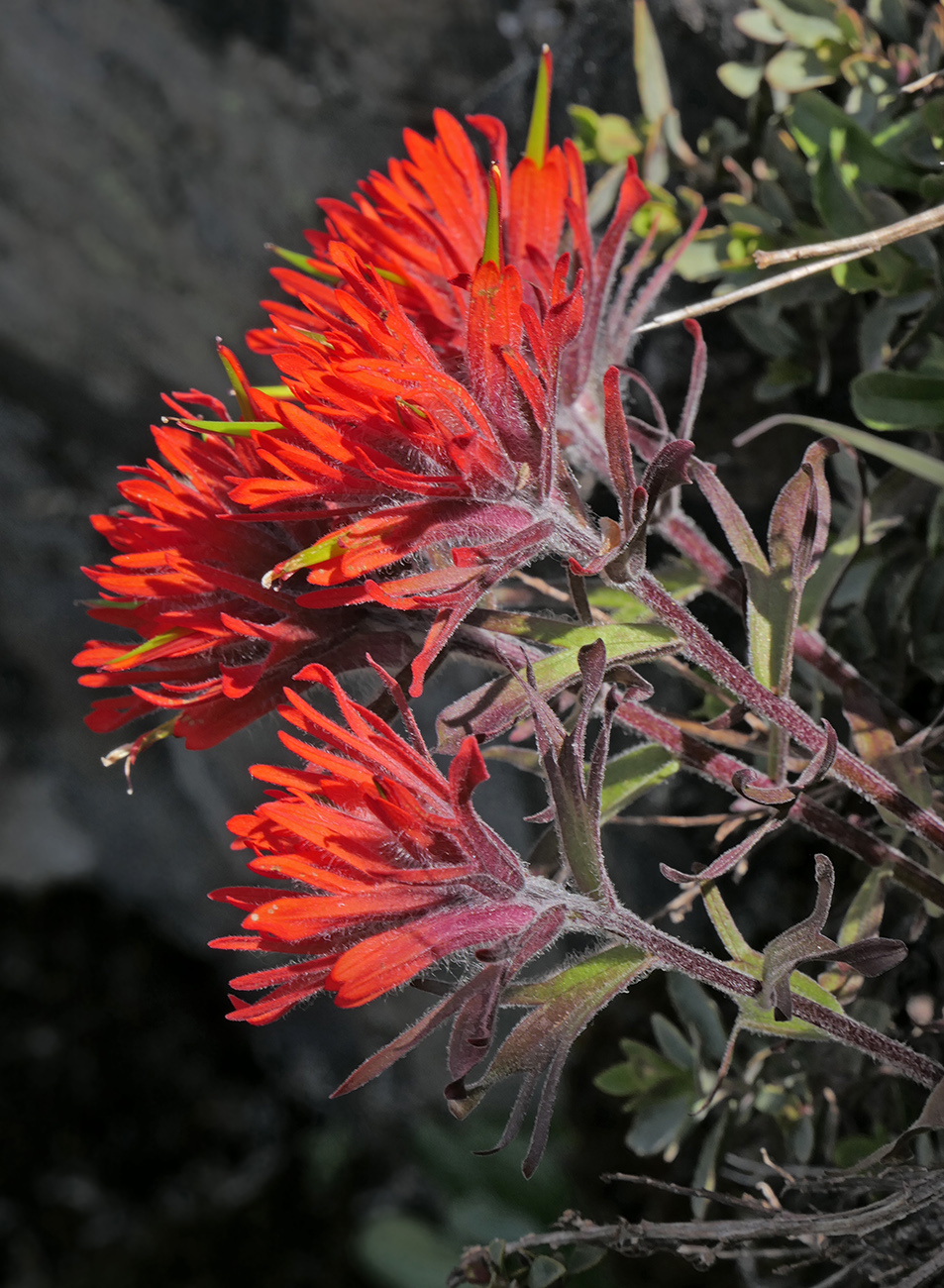
I was able to get close to some beautiful cliff paintbrush (Castilleja rupicola) on my way up the north side of the summit. Most of the other plants I saw were out of reach.
I recently heard from Chad Sageser that he had cleared the roads (2127 and 5850) to Bearbones Mountain of fallen trees. What a hero! With all the interesting early plants on this old lookout site, I decided to head up there as soon as possible. On May 31, I drove up there by myself. I’d missed the earliest flowers—only a couple of glacier lilies (Erythronium grandiflorum) were still blooming—but the rest of the flowers were beautiful, and there was more spring phacelia (Phacelia verna) than I’d ever seen before. I was a bit tired, so I didn’t make it as far down the side ridge as I usually go. I also wanted to save a little energy for a quick but steep trip up to the top of Big Pine Opening (the big open slope along Road 21 at the intersection of Rd 2135) at the end of the day. This is the lowest site of purple milkweed (Asclepias cordifolia) we know of in the Middle Fork district, so I wanted to see how far along the bloom was. Here are some highlights.
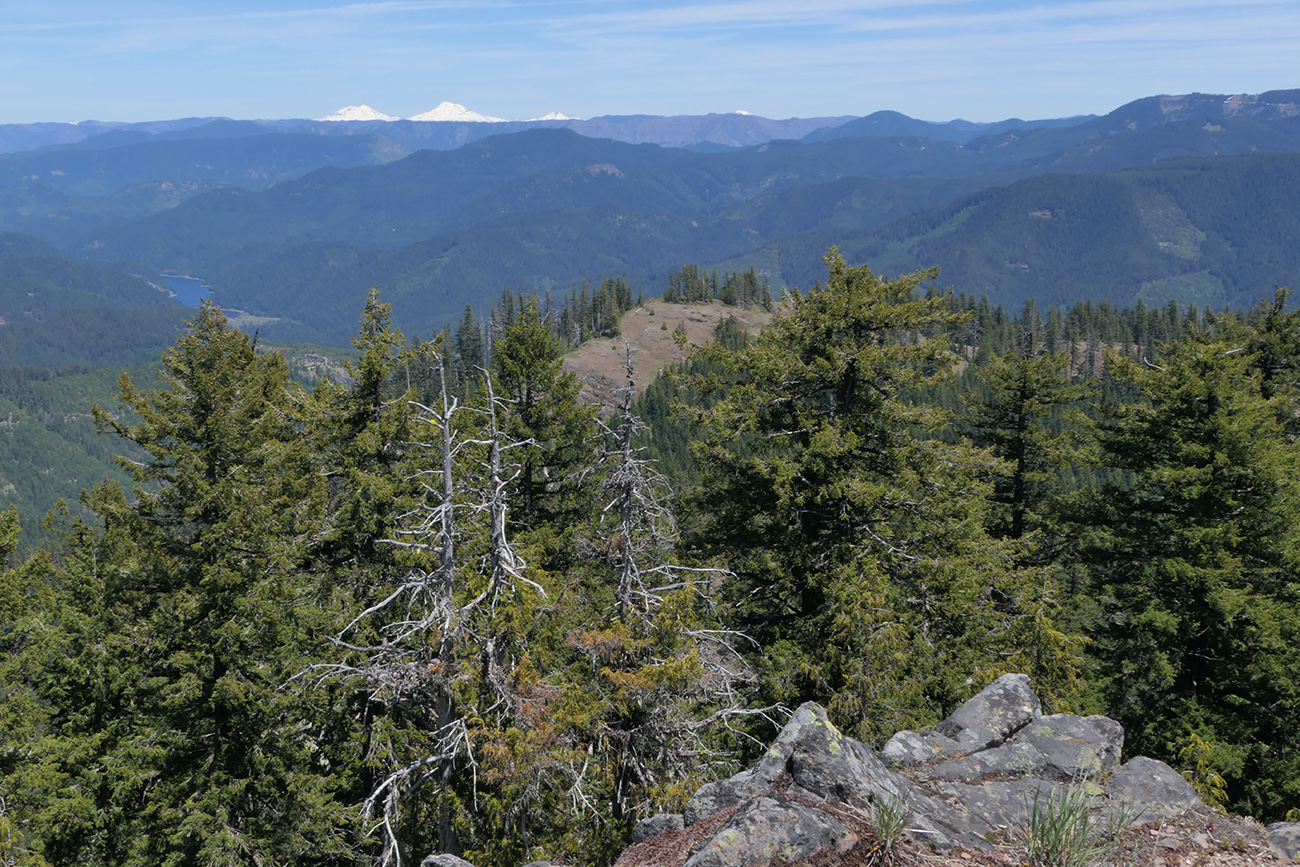
Looking to the northeast from the summit, you can see the snowy Three Sisters in the distance. You can also see the extensive damage of the 2022 Cedar Creek Fire, which burned from Waldo Lake all the way to west of Blair Lake. The nearby ridge I named Bearscat Ridge, but I haven’t been back up there since 2007.
Beginning of the Blooming Season at Bearbones

We had beautiful weather and terrific views. Looking west from the old lookout site on the summit, we could see plenty of snow still on Bohemia Mountain and Fairview Peak, both around 6000′, over 1000′ above our elevation on Bearbones. The little open area in the distance in the middle of the photo is Heavenly Bluff.
On Friday, May 19, Kris Ellsbree and I attempted to get to what I call “Heavenly Bluff” to see the early flowering Siskiyou fritillary (Fritillaria glauca). We drove up Road 2127, south of Hills Creek Reservoir. Like a number of other roads in the area, this seems to have deteriorated quite a bit in the last couple of years. We also had to cross two patches of snow. I had my doubts we could make it all the way to Heavenly Bluff this early, especially this year, so I wasn’t surprised to get stopped by a very large tree fallen across the road (which had already been removed by the time I called the Middle Fork Ranger District office on Tuesday, but they said there was snow blocking the road a mile farther up the road, so we wouldn’t have made it anyway). Luckily, we were only a half mile from the Bearbones Mountain trailhead, which was my backup plan and a lovely spot in its own right. It was very early in the season on Bearbones, with a relatively small number of species in bloom, but we had a successful and enjoyable day. Here are some photographic highlights. Read the rest of this entry »
Exploring the Meadows by Hills Creek Dam
A couple of weeks ago, Sabine Dutoit and I spent a little while along Kitson Springs Road 23, just east of the dam on Hills Creek Reservoir (see Late Start to a New Year of Botanizing). I hadn’t ever been to several meadows hidden from the road, so I decided that would be a good trip to do May 8 after getting a late start getting out in the morning—no gravel driving and relatively close to home.

From the meadows above Road 23, there’s a wonderful view to the south of a very full (!) Hills Creek Reservoir.
Abbott Butte in Glorious Bloom

Balsamroot (Balsamorhiza deltoidea) lights up the meadow below the lookout.
My van was packed for an overnight camping trip, but I literally didn’t decide where I was going until breakfast. There are so many places I want to go, and so little time every summer, and it can be hard to hit the bloom just when I want it. This year’s deep snowpack has further complicated decision making, something I’m not good at anyway. But I’m so glad that on July 15 I opted to go to Abbott Butte, one of my favorite hikes in the Rogue-Umpqua Divide—or anywhere, for that matter. I got the confirmation from the Forest Service that I could get to the trailhead, but there might be patchy snow. That was just what I wanted because my goal was to see the snowmelt species up there. The late-melting heavy snow actually is a boon in some ways. While there were patches of snow scattered along the trail, parts of the area were quite far along. In a drier year, I might have had to go twice, several weeks apart, to see all the different plants I saw in bloom. Read the rest of this entry »