Posts Tagged ‘reptile’
Collecting for the Annual Wildflower Show

There was plenty of water in Staley Creek, fueled by melting snow from the Calapooya Mountains above. After such a dry spring, however, the rocks and meadow areas were quite dry. Still, the rosy plectritis (Plectritis congesta) was blooming well, and we saw other annuals like the large-flowered blue-eyed Mary (Collinsia grandiflora) to its left.
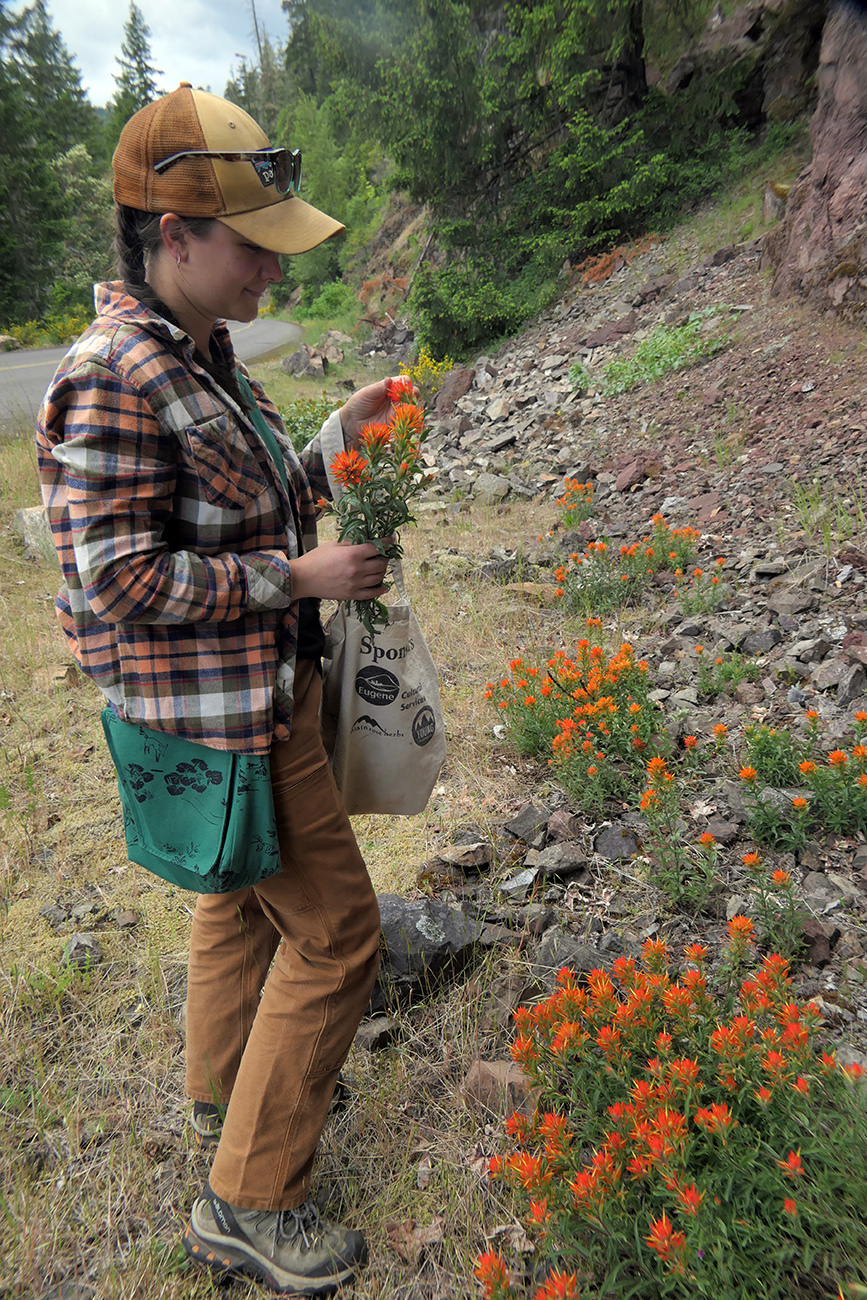
Leela collected a few of the abundant paintbrush along the side of Hills Creek Reservoir. We looked at the wide degree of variation between plants. While most are undoubtedly the common harsh paintbrush (Castilleja hispida) with its wide well-lobed leaf blades, there were quite a number with narrower leaves and no lobes at all. They also had pointier calyx teeth than typical C. hispida. These may be hybrids of frosted paintbrush (C. pruinosa), more common in the area at higher elevations.
The 46th Annual Mount Pisgah Arboretum Wildflower Festival was on May 18th this year. On Friday, May 16th, I accompanied Leela Hickman on a trip to the Rigdon area south of Oakridge to collect for the wildflower show, a joint project of the Emerald Chapter of the Native Plant Society of Oregon and the botany department at Lane Community College. With the current state of chaos in the government, Leela is now the only botanist in the Middle Fork District of the Willamette National Forest. In fact, she’s one of only a few botanists left in Willamette National Forest. It’s a sorry state of affairs, but don’t get me started….
It was a very pleasant day, though somewhat cloudy, so there weren’t many butterflies. We found a number of interesting plants I hoped might be in bloom that weren’t normally displayed at the show, including Marshall’s saxifrage (Micranthes marshallii), Rattan’s blue-eyed Mary (Collinsia rattanii), Howell’s violet (Viola howellii), many-stemmed sedge (Carex multicaulis), field pussytoes (Antennaria howellii), and the easily overlooked slender woolly-heads (Psilocarphus tenellus). I also got to show Leela some special spots in the district. She was all prepared with containers, water, and a cooler to store them in so they would still look good a couple of days later. Read the rest of this entry »
Last Day of Summer at Lopez Lake

Lopez Lake has a lot of interesting and uncommon aquatic plants. Near the inlet of the lake, you can see the large, spreading leaves of alpine pondweed (Potamogeton alpinus), the narrow, upright leaves of small bur-reed (Sparganium natans), and the delicate, feathery, trailing stems of lesser bladderwort (Utricularia minor). Earlier in the season, the surface of the wider part of the lake is decorated with the showy white flowers of arumleaf arrowhead (Sagittaria cuneata).

The pretty pool of pond lilies (Nuphar polysepala) at Zen Meadow was almost completely dried out. The large fruits were ripening. I’d never looked closely at the capsules or seeds before.
On September 22, I accompanied Alan Butler and Dave Predeek for a trip to the Lopez Lake area, southeast of Oakridge. Neither of them had been there before, so I wanted to show them the lake and some of the other interesting sites along Road 5884. It was officially the last day of summer, but it seemed like a beautiful fall day to me. It was only my fifth trip to Lopez Lake over the course of 11 years, and it was the latest in the year I’d been there. Things were much drier than on my past trips—not surprising considering how long it had been since we’d had real rain, and there were very few flowers left, but it was an interesting trip nonetheless. We headed all the way up the road to the talus slope first, and then stopped at the small hidden wetland John Koenig and I named “Zen Meadow” before walking down to Lopez Lake. On our way back, we checked out another hidden wetland and—new for me—a hidden lake. Here are some photographic highlights of our terrific trip. Read the rest of this entry »
Reptiles and Insects Enjoy Spring in Rigdon Area

Coltsfoot (Petasites frigidus) was still in bloom along the Middle Fork of the Willamette. It was attracting numerous tiny flies as well as a small bee. If you haven’t smelled coltsfoot, try it, it has an unusual and pleasant menthol-like scent. That might help it attract so many pollinators.
My first official spring trip to Rigdon was on April 8, a lovely warm day. With the social distancing required because of the pandemic, I was out by myself, but I was certainly not alone. While it was still early in the season, there were plenty of the usual April flowers but also a few butterflies, bees, and an unexpected number of reptiles. Here are some photo highlights.

Just like last April (see Early Trips to Rigdon), the blooming manzanitas at Sacandaga Bluff were attracting lots of insects to the flowers, most of which had been pierced earlier by some nectar-robbing bee. This makes it easier for the other insects, like this echo azure and bee (Andrena?) to access the nectar.
More Discoveries along the Calapooya Crest

Cascade grass-of-Parnassus (Parnassia cirrata var. intermedia) is one of my favorite wildflowers and a wonderful bonus this late in the season.
Ever since our early June trip to the meadow along Road 3810 on the south side of Loletta Peak (see Another Exciting Day in the Calapooyas: The Sequel), John Koenig and I had been planning to return to see the later blooming plants, especially the Cascade fringed grass-of-Parnassus (Parnassia cirrata) that we found there. Just before we had planned to go, Ed Alverson e-mailed me about the quaking aspen (Populus tremuloides) we had discovered there. He’s been studying the scattered populations on the west side of the Cascades in Oregon and Washington. The timing was perfect, as we were able to take Ed along on August 12 to see the population in what we were now calling “Aspen Meadow.” We had been somewhat concerned with all the fires down in Douglas County, especially the Potter Mountain complex burning just east of Balm Mountain (thankfully not actually on Potter Mountain). But other than some drifting smoke above, we had no problems reaching our destination and enjoying what was an otherwise lovely day. Read the rest of this entry »
New Trail to the Base of Buffalo Peak

How many snakes do you think are here?
Back in January, I heard Bill Sullivan give a talk on new hikes he’s added to the latest version of his Central Oregon Cascades book. My ears perked when he mentioned the Forest Service had added a section to the North Fork trail, off the Aufderheide (Road 19), that passed along the base of the Buffalo Peak. I once climbed up from Road 1939 to the base of this grand rock feature on the north side and found one of my personal favorite plants, Heuchera merriamii, growing on the cliffs. I had wanted to explore the much larger south side that reaches almost to the river, so this new trail was a dream come true.
On Monday (April 7), Sabine and I decided to check out the new trail section. We stopped at the ranger station in Westfir to double check the directions to the trailhead and were given a copy of an area map, showing the trailhead at the end of a spur road off of Road 1939, on the north side of the North Fork of the Middle Fork of the Willamette River. Read the rest of this entry »