Posts Tagged ‘Penstemon’
Butterflies at Patterson Mountain
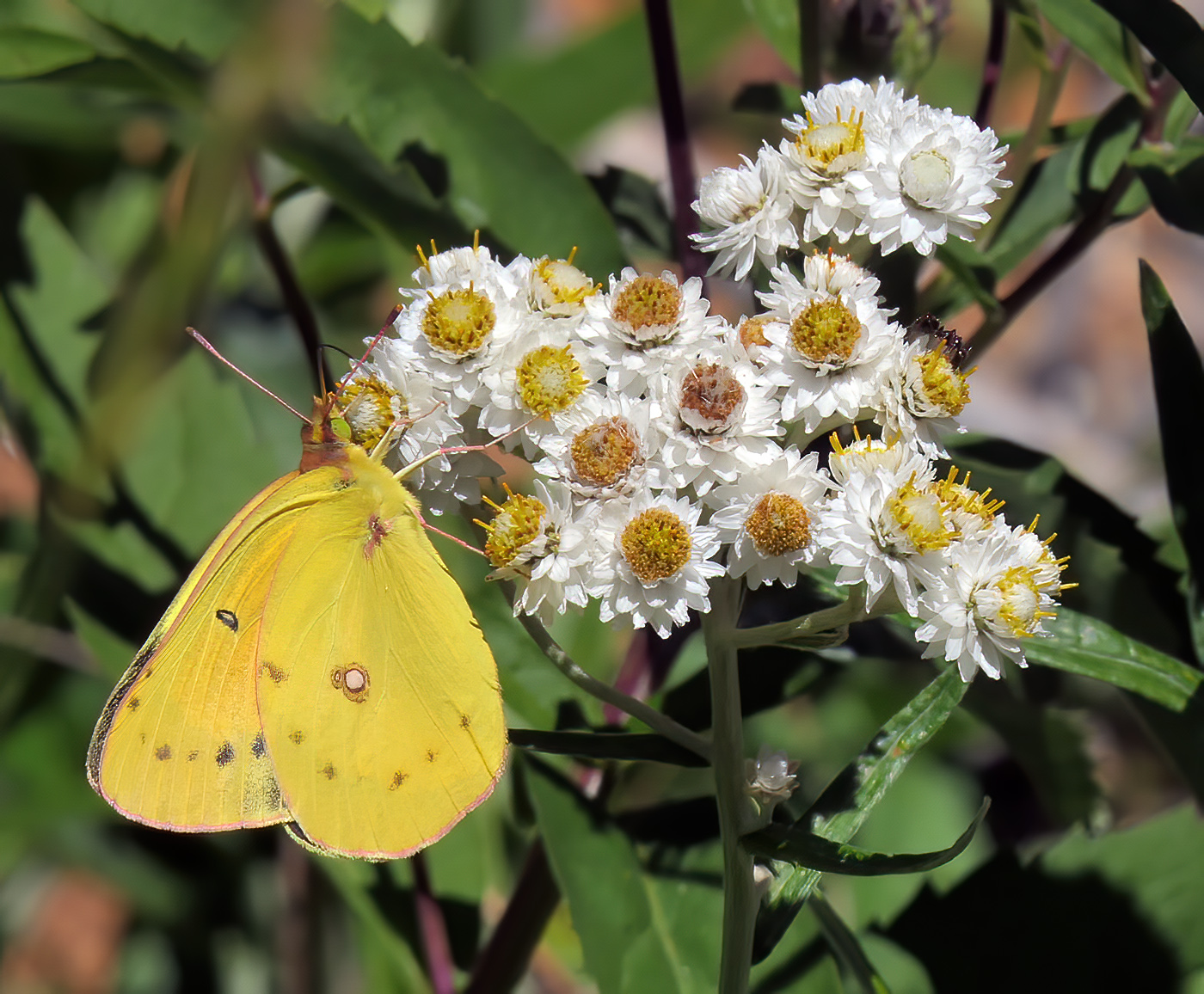
Orange sulphurs hardly ever sit long enough for me to get a good photo, and when they do, they never open their wings. I watched several nectaring on pearly everlasting (Anaphalis margaritacea) in one of the side meadows near the summit. It occurred to me that if I could record a video while they flew, I might actually be able to get a decent look at their bright orange dorsal side. You can see this in the slowed down (~1/7 speed) video below. This sulphur was accompanied by a couple of Edith’s coppers and what looks like some kind of a fly.

A clodius parnassian drinking from a mountain thistle (Cirsium remotifolium)
On July 22, I went up to Patterson Mountain in hopes of collecting seed of one of my favorite native plants, great polemonium (Polemonium carneum). It grows in abundance on the south side of the mountain, well off the trail. There is also a smaller population growing on the edge of the meadow near the Lone Wolf Shelter. My timing was good, and I came home with enough polemonium seed to share. I also found seeds of Scouler’s valerian (Valeriana sitchenis var. scouleri), another native that is growing well for me. Nothing particularly exciting happened, but I did enjoy watching butterflies, so I thought I’d share some photos and a video.
Another Try at Groundhog Mountain
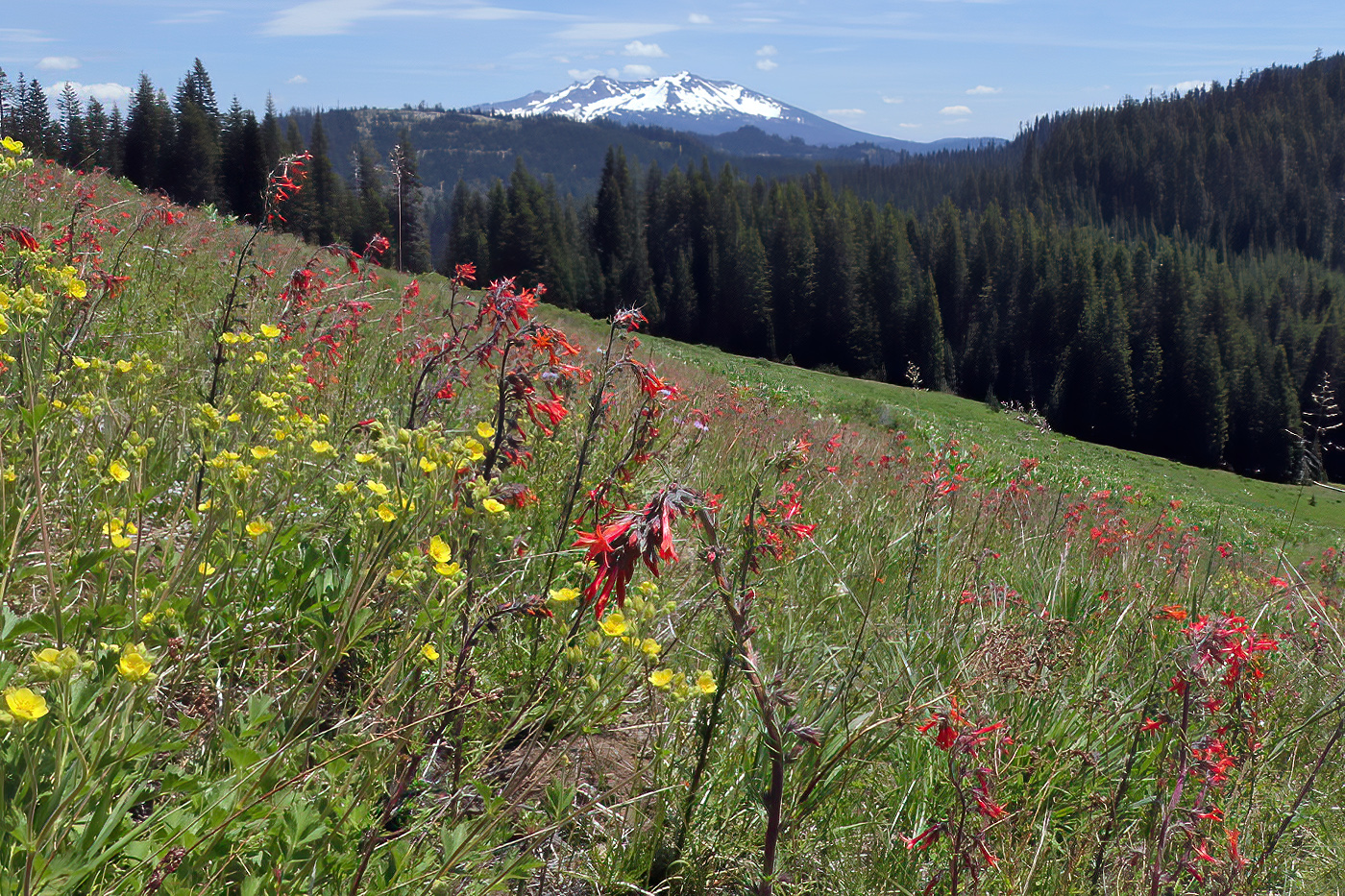
From high up on Little Groundhog meadow where the skyrocket (or scarlet gilia) and sticky cinquefoil were abundant, I got a great view of Diamond Peak to the east.
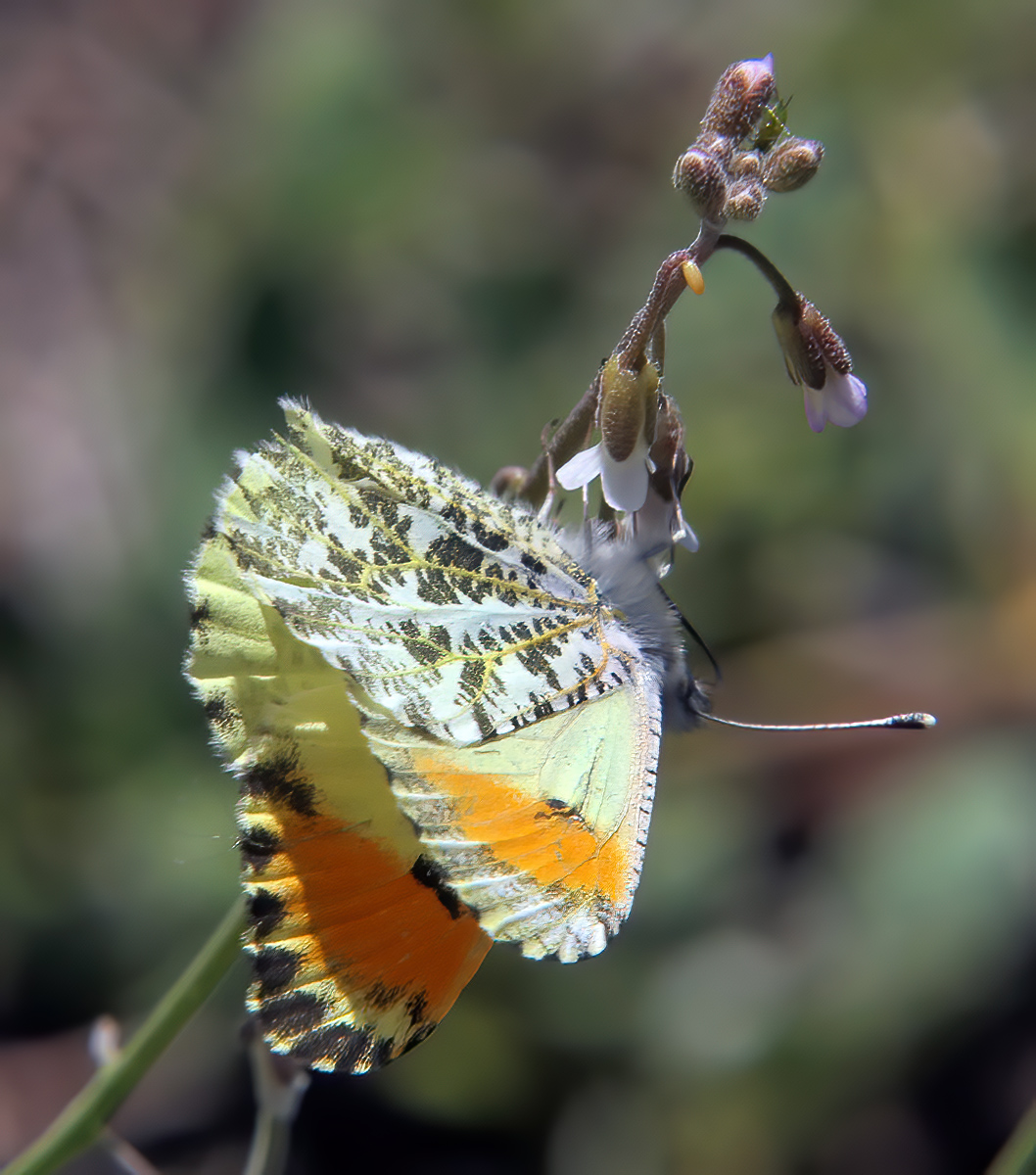
This lovely female Julia’s orangetip was nectaring on a rockcress (Boechera sp.), which might also serves as a host food plant for many whites, including orangetips.
After not reaching the wetlands at Groundhog Mountain the previous week (see Long Overdue Return to Warfield Bog and Hemlock Butte Wetland), Alan Butler, Dave Predeek, Don Wirtala, and I made another attempt on June 25th. This time, we headed in from the west starting on Road 2120, like I’ve been doing for a number of years. The first 4 or 5 miles were in good shape, and I was hopeful for a relatively easy drive up, but then we started to see lots of trees down on the road. Someone had cut some gaps, but we got out a number of times to move branches and small trees off the road. I was going to be leading a field trip for NPSO on July 12th, so I was hoping to make sure the road was clear for passenger cars. After a while, however, it became apparent that there were too many obstructions for me to get my car up this way, let alone to take a group. Having gotten most of the way up, however, Alan didn’t want to turn around and thankfully was able to slowly get his truck over, under, and around dozens of downed trees. Read the rest of this entry »
Varying Flowering Times at Lowder Mountain

Small-flowered penstemon (Penstemon procerus) was blooming profusely on the ridge.

Near the beginning of the trail, there were several pretty clumps of spotted coralroot (Corallorhiza maculata).
On June 12th, Sheila Klest, Nancy Bray, and I hiked up Lowder Mountain. It was a beautiful day, and the only other hikers we saw all day were a couple of gentlemen names Buzz and Steven, who we chatted with as they passed us a number of times—they were hiking while we were going at a much slower botanizing pace.
It was interesting to see how far along the blooming season was in the different habitats. The forest seemed to be at peak bloom with lots of fresh western trillium (Trillium ovatum), fragrant false Solomon’s seal (Maianthemum racemosum), Columbia windflower (Anemone deltoidea), bunchberry (Cornus unalaschkensis), and more. When we reached the ridge where the large area of open rocky slope starts, it was blooming well but quite dry for mid June. Some of the Menzies’ larkspur (Delphinium menziesii) had been flash-dried, most likely during the recent heatwave. The plants were completely dried out with the purple flowers still intact. Those growing in the shade of the woods were still quite fresh. After we had lunch on top of the ridge just above the trail, we went down below the trail to check out the much longer rock garden area, which is usually much seepier. It was bone dry, and the seep-loving annuals and death camas (Toxicoscordion venenosum) were about done. Read the rest of this entry »
Long-awaited Return to McCord Creek Falls
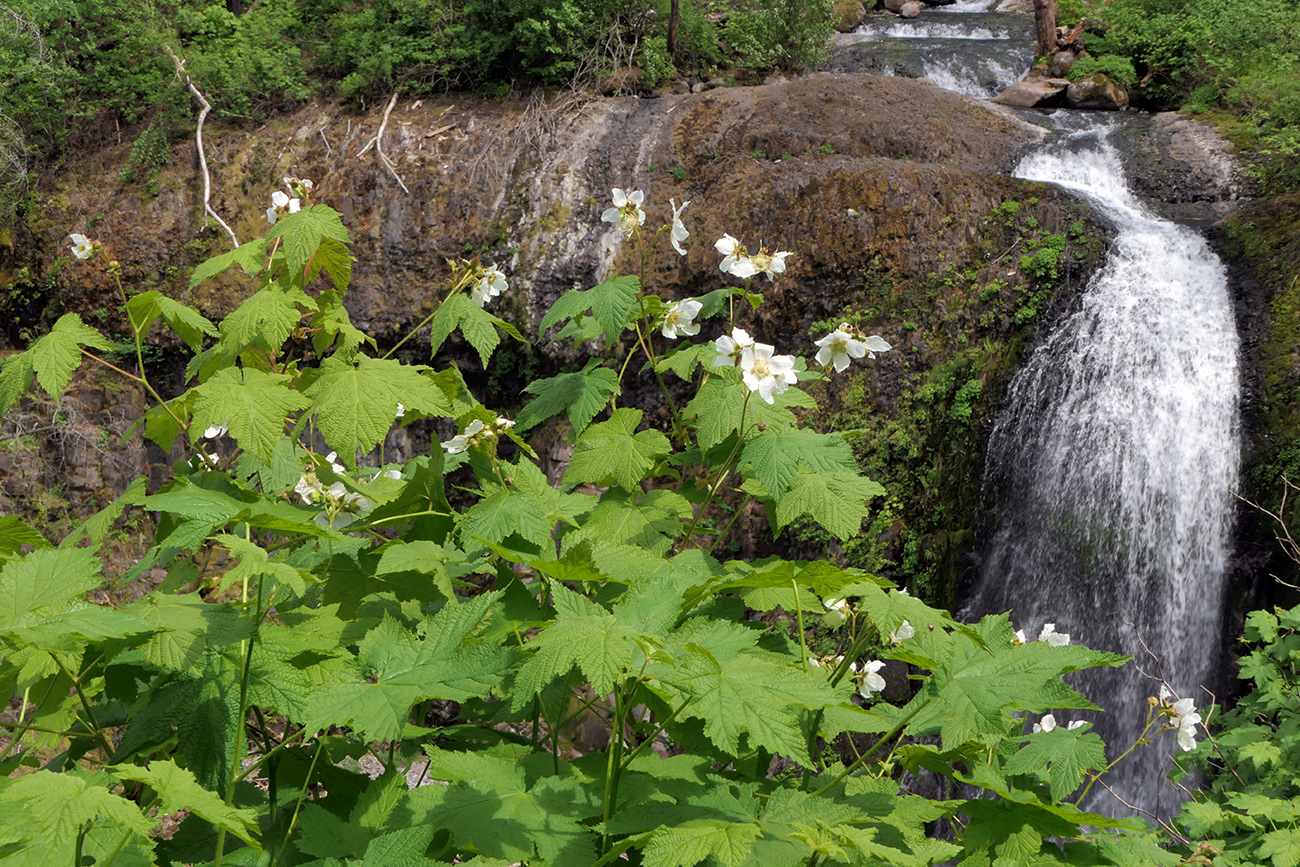
Thimbleberries blooming in front of McCord Creek Falls
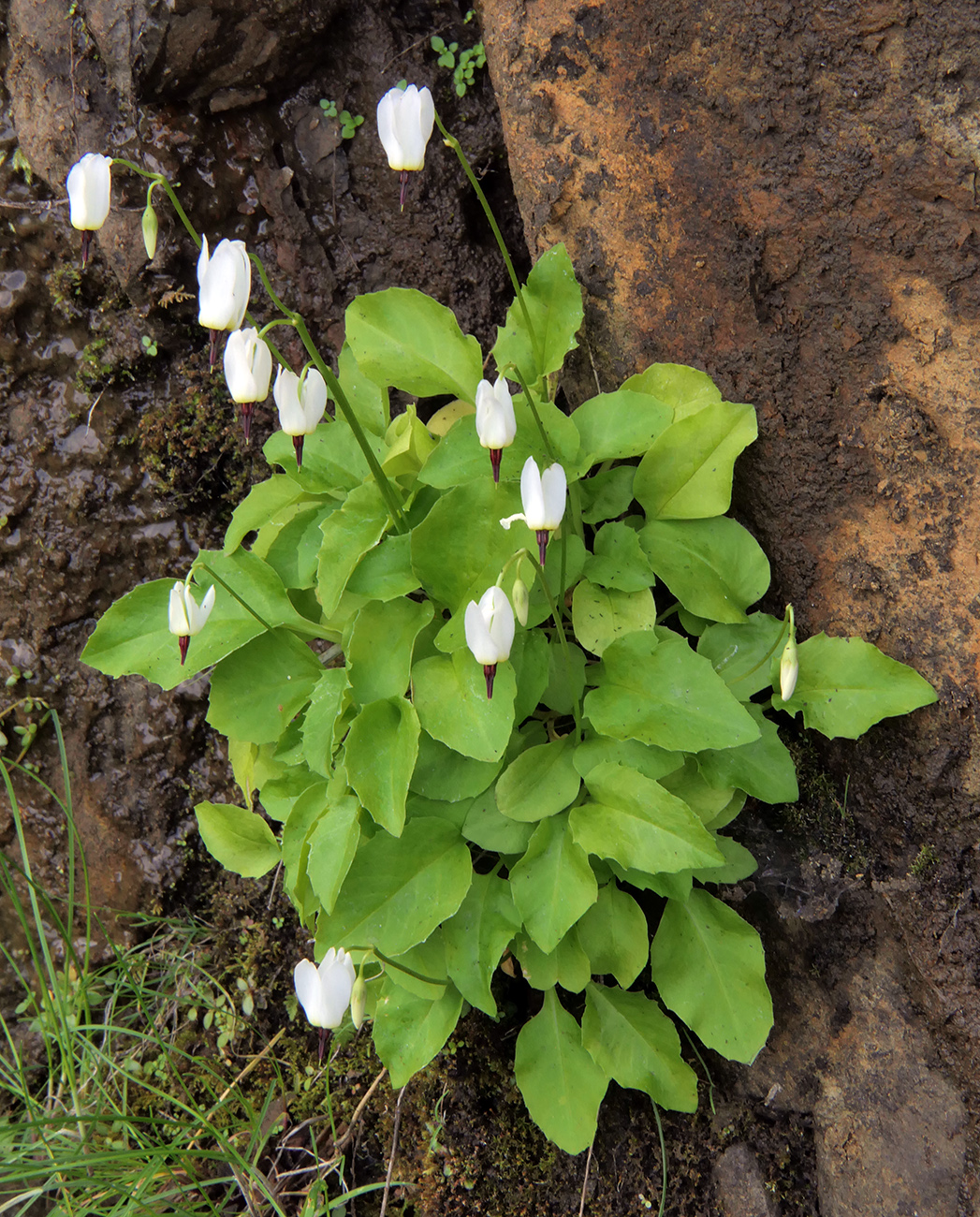
White shootingstar was in perfect bloom in the damp areas of the cliff.
My first visit to McCord Creek Falls was on a trip led by Russ Jolley, the author of the classic field guide, Wildflowers of the Columbia Gorge. It was way back in 1997, on a field trip organized by the now-defunct Emerald Chapter of the North American Rock Garden Society. I immediately fell in love with the place because part of the trail is cut into one of those amazing vertical cliffs that grace the Oregon side of the Columbia River Gorge. While I have a lot of favorites, plants that have adapted to survive the brutal conditions of life in rock crevices have to be my favorite favorites. You have to respect anything that tough. And the contrast of the colorfully flowered and delicate-looking plants with the hard and craggy rocks appeals to the artist in me. Over the next 13 years, I made the long trip north 10 more times. But somehow it just dropped off my radar. I guess I got too busy to drive all the way up there because my last trip there was in 2010 (see Late Bloom at McCord Creek Falls). Read the rest of this entry »
Exploring a New Wetland Near Hills Peak

There’s a good view of the long ridge of Hills Peak from the wetland.

As a result of its proximity to the High Cascades, the soil near Hills Peak has an abundance of pumice. This is the preferred substrate for Hall’s sedge (Carex halliana), which was growing in areas with few other plants.
On the east side of Hills Peak, which is at the east end of the Calapooyas, there’s an 80-acre logged area I’d never checked out before. There were hints of a couple of small ponds in aerial images but nothing that looked terribly interesting, especially when there are so many wonderful places close to the peak that I never have time to check them all out anyway. Every time Google Earth’s images are updated, they look a little different. The angle of lighting was different when I looked at the aerial images of Hills Peak this year. The new view showed what looked like a narrow strip of wetland snaking along the south edge of the disturbed area. Apparently the shadows of the mature forest obscured this in the past. With a major heat wave forecast for at least a week and the temperature “only” in the 90s in the Willamette Valley, I decided to go check it out on July 4th before it was too hot to go out at all. Poking around relatively level wetlands is about the only thing I can handle in heat. Read the rest of this entry »
Friends and Flowers at Bristow Prairie
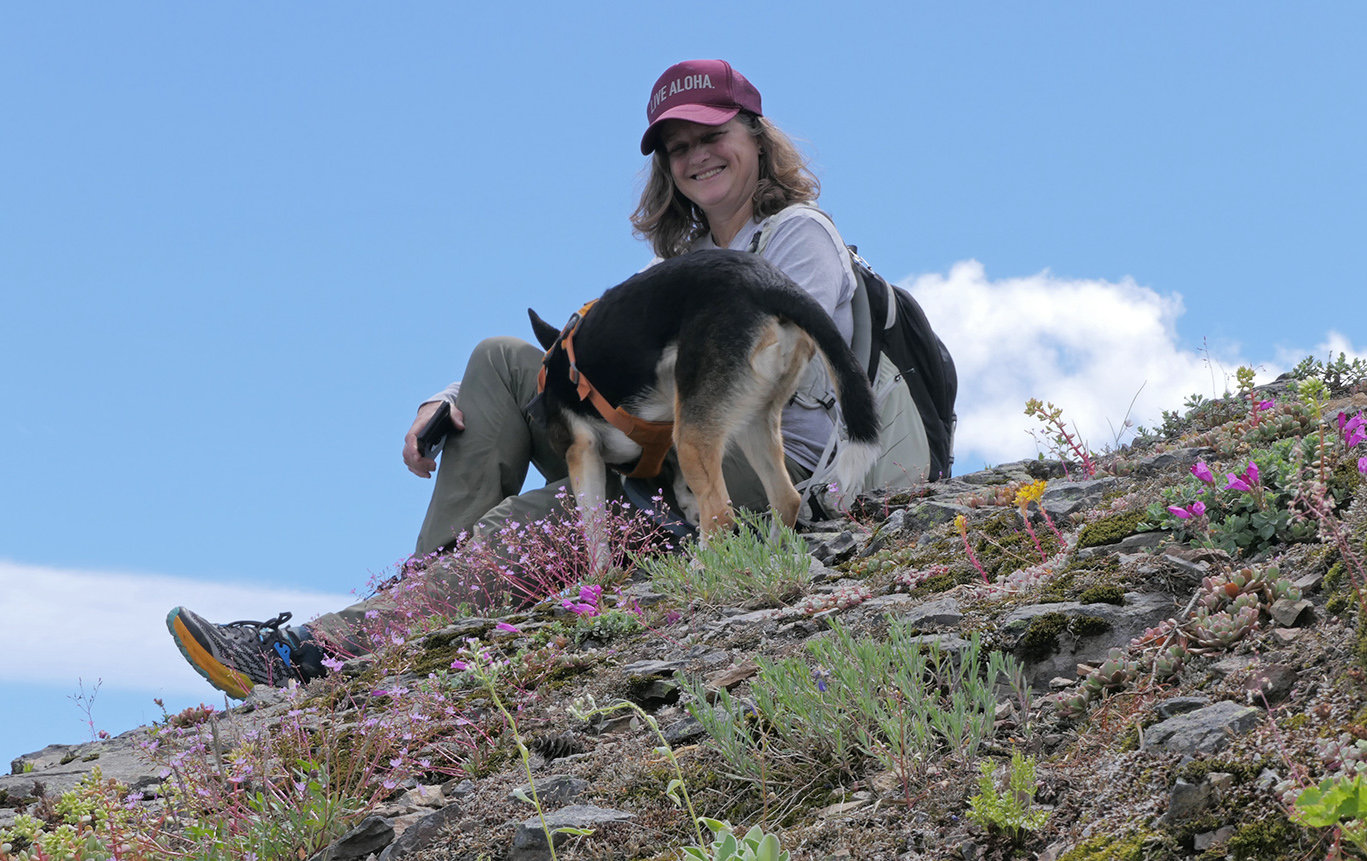
I first started hiking with Molly Juillerat in 2008, soon after she first became the botanist for the Middle Fork District of the Willamette National Forest, what I consider my “home” district since it is the closest to me and where I spend most of my time botanizing. In 2017, she was promoted to deputy ranger and a few years later to ranger in charge of the Middle Fork District. While her job has always kept her busy in the summer—especially these last few years of organizing the response to the large fires in the district—we’ve always tried to get out together at least a couple of times a year. I’ve made it a point to show her and other official botanists any interesting plants I find. With all the duties the Forest Service employees have, they don’t usually have the freedom to poke around cliffs and bogs the way I do, and I want to make sure they know where there are rare and unusual plants that need to be protected. I’ve always enjoyed getting out to these botanically interesting places with Molly and her dogs. Read the rest of this entry »
Beetles and Botany at Bearbones
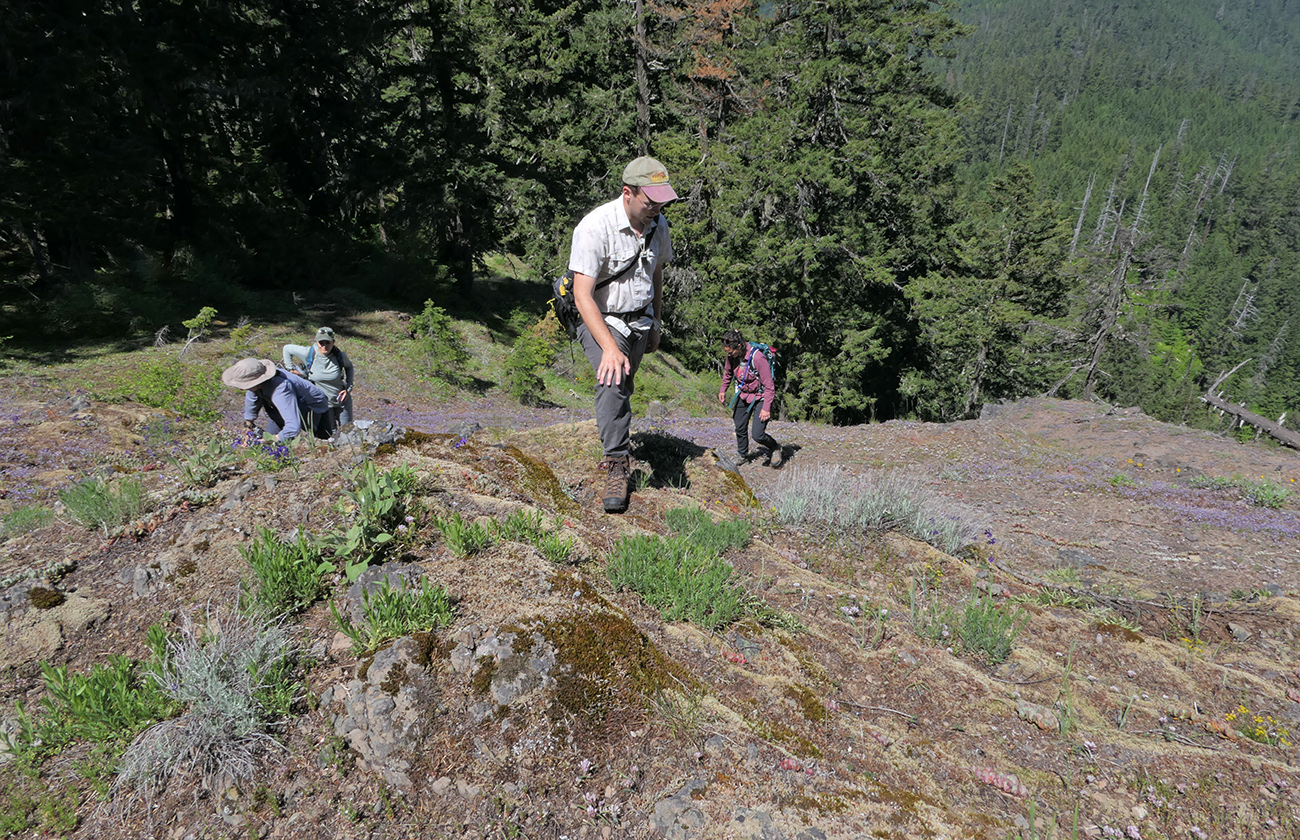
Angela, Leela, Sol, and Lauren exploring the north side of Bearbones Mountain a little below the summit. We were surprised to see rubber rabbitbrush (Ericameria nauseosa) growing in the cooler conditions of the north-facing slope. More common to the south and east, it usually grows in hotter, drier sites. The purple tinge on the slope was a large sweep of large-flowered blue-eyed Mary (Collinsia grandiflora).

Stunning cliff penstemon lights up the rocky ridge. The two rocky slopes in the nearest ridge are Spring Butte. The small prominence behind and to the left is “Mosaic Rock” where I went in May (see Long-awaited Return to Mosaic Rock). The large ridge beyond that is Staley Ridge.
Bearbones Mountain is a former lookout site with a 360° view, and it is a really interesting area botanically, but the trail is little known, rarely used, and hard to find now that the hiker symbol post is gone. I’ve been trying to bring people up there for years to see its hidden treasures. On June 9th, I introduced it to four more botanically minded folks, two of whom work for the Middle Fork district of the Willamette National Forest where it is located but hadn’t been there yet. The flowers were even better than when I’d been there a couple of weeks before (see First Trip of the Year to Bearbones Mountain). The cliff penstemon (Penstemon rupicola) was outstanding, and there were plenty of other beautiful wildflowers to keep everyone satisfied. We also saw interesting insects although I was again disappointed in the relative lack of butterflies. Everyone enjoyed the beautiful weather and great view. It’s a good place to get oriented when you’re in the southeastern part of Lane County. Hopefully my younger friends will bring other flower lovers up here in the future. Read the rest of this entry »
Finally Back to Potter Mountain

On the east side of the ridge, the gravel is filled with marumleaf buckwheat (Eriogonum marifolium). This attracted a lot of pollinators.

A spring white caterpillar has just shed its skin to allow it to grow a bit more. I checked most of the rockcress (Boechera sp.) I saw. I found this caterpillar and another smaller one as soon as we hit the rocky area. I only spotted one egg. In the phlox area, I chased a fast-moving adult white who never let me get close enough for an ID, but it might also have been a spring white.
Several years ago, my husband Jim and I tried to get up to Potter Mountain, but the winter storms had left so many branches on the road that we gave up in frustration. I really wanted him to see the beautiful rocks up there, so I had again planned to go up last year, but then a fire broke out right next to the summit—the Potter Mountain fire. Thwarted again. The third time’s a charm, they say, and we did finally make it up there on July 2. It was a beautiful day—though a bit warm—so we had a great view of the surrounding mountains. We bushwhacked north on the ridge as far as the helicopter landing spot—only about 6/10 of a mile from the road. We’d missed most of the early-season flowers, but there were still plenty of things in bloom and enough butterflies to keep me happy. And since we accessed Potter Mountain via Staley Creek Road 2134 (in good shape, by the way), we were able to cool off at the end of the day with a short stop at the wonderful Staley Creek Gorge. Here are some photographic highlights of our day. Read the rest of this entry »
Exploring Meadows Below Sawtooth Rock

From the south ridge on Mount June last year, we had a good view of Sawtooth Rock at the right end of its large meadow as well as the three smaller openings below that I went to on this trip. The Three Sisters and Mount Bachelor had way more snow than this year almost exactly a year ago on June 22, 2020.
For years I’d wanted to explore all the meadows and rocky openings in the area of Mount June and Sawtooth Rock. I’m pretty sure I’ve checked out all the open areas on Mount June and regularly make a loop down the south ridge and west side when I go up there now (for a look at last year’s trip, see A Rainbow of Flowers at Mount June). I had also once explored several of the small openings just east of Sawtooth Rock Meadow (see More Meadows Near Sawtooth Rock). But I’d never made it down to a string of three rocky openings downhill to the southwest of the main meadow. On June 19, I decided to make that my goal.

At the first rocky opening, the paintbrush was attracting a rufous hummingbird. I tried to be ready to photograph it as it zipped around, but this was the only decent photo I was able to get. Perched as I was on the steep rock, I couldn’t move much, nor could I even see it most of the time, but its hum let me know it was still around. The blue flowers are bluefield gilia (Gilia capitata).
High Season at Lowder Mountain

The rock garden along the ridge in all its peak-season glory: bright purple small-flowered penstemon (Penstemon procerus), pink cliff penstemon (P. rupicola), yellow western groundsel (Senecio integerrimus), and white mountain cat’s ear (Calochortus subalpinus).

These small bees seemed to be particularly interested in the abundant fern-leaved lomatium (Lomatium dissectum).
On July 6, I spent the day on Lowder Mountain. I’d heard that Road 1993 was in good shape (It’s one of the few reliably well-kept roads these days), and I hadn’t been there since I led a hike there when our Native Plant Society chapter hosted our Annual Meeting back in 2016 (see Back to Back Trips to Horsepasture and Lowder Mountains). I drove east under overcast skies but thankfully broke out into full sun on my drive up to the mountain. It was gorgeous all day until around 5pm when the clouds took over again, so I really lucked out. The flowers were beautiful, and I pretty much had the whole mountain to myself. And although I was once again disappointed by the paucity of butterflies, there were oodles of bees to keep me amused. Here are some photographic highlights. Read the rest of this entry »