Posts Tagged ‘Oplopanax’
Early Spring Bloom Begins at Elk Camp and Mistmaiden Meadow
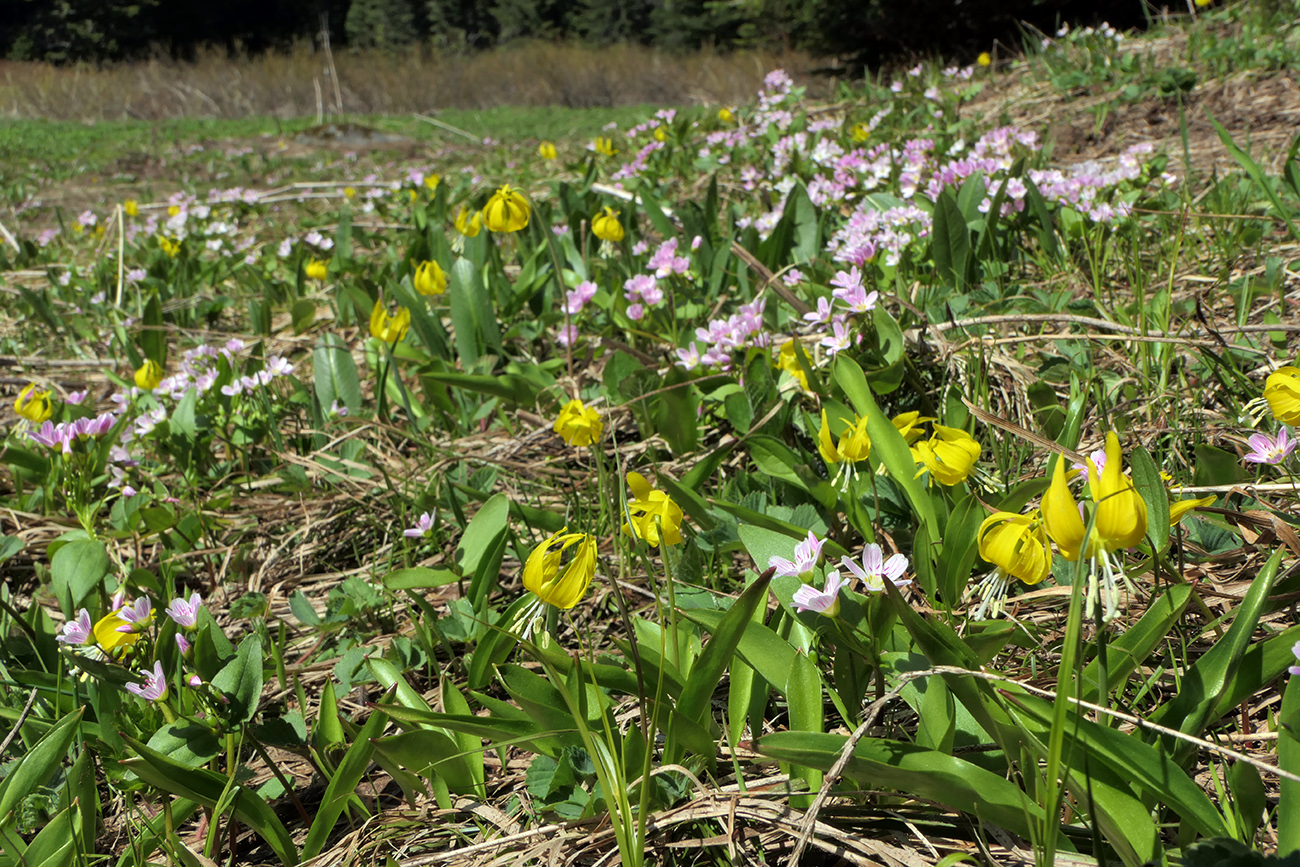
Western springbeauty (Claytonia lanceolata) and glacier lilies (Erythronium grandiflorum) were following the melting snowbanks along the edge of the wetland at Elk Camp. Well worth the many miles of gravel road to see this gorgeous display!
On Saturday, May 24th, I finally got up into the mountains. So far this spring, I’d gone down to the Siskiyous, up to the Columbia Gorge, and made a few trips out to Rigdon. I had yet to get up high or drive on any real gravel roads. As dry as it has been in April and May, I really wanted to go somewhere fresh and moist. Elk Camp is only 4400′, but it feels higher and is level enough to retain lots of snow. I wasn’t sure I would make it there this early in the season, but Mistmaiden Meadow is right on the way, and if I couldn’t even get there, I figured I’d go to Tire Mountain—always a worthwhile trip. I knew that the roads would be clear up to Tire Mountain and Road 1912 as far as the intersection of Road 140 because mountain bikers can get on the extremely popular Alpine Trail there, and the outfit that drives shuttles of bikers up was advertising daily trips there. In fact, I think I saw 5 vans along the road. I normally would have avoided going up there on a weekend—and a holiday weekend at that—but the weather was gorgeous, and I didn’t want to wait any longer. Read the rest of this entry »
Berry Collecting at Echo Basin

When I reached the open meadows, I was mesmerized by unusual ethereal clouds that seemed to be forming just on the other side of the ridge and drifting not far above me. They dissipated a short distance away to the east. I don’t think I’ve ever seen any like them before, so I photographed them for at least 15 minutes. I would love to know what kind of conditions would create such delicate patterns.

The creek is lined with devil’s club (Oplopanax horribilis), which was taking on some yellow fall coloring.
On October 8th, I headed to Echo Basin, hoping to avoid the smoke still present in the Cascades. Thankfully, I was far enough north to get past most of the remaining fires and had a very pleasant day. There were loads of ripe berries of attractive woodland species, so my timing was perfect for collecting some to seed in areas of my forest that have recently been cleared of blackberries. I was able to collect fruits of false Solomon’s seal (Maianthemum racemosum), starry false Solomon’s seal (M. stellatum), Hooker’s fairy bells (Prosartes hookeri), and baneberry (Actaea rubra). All of these already grow on my property but not abundantly enough to help fill 3 or 4 acres of mostly cleared forest. I also collected some bunchberry (Cornus unalaschkensis) and queen’s cup (Clintonia uniflora), although I haven’t had much luck with them in the past. They’re too beautiful not to give them another try. As I’m working on the Phrymaceae treatment for Volume 3 of the Flora of Oregon, I had hoped to see some remaining monkeyflower (Erythranthe spp.) plants to look at seeds and leaves, but only one species—primrose monkeyflower (E. primuloides) remained. It was really unfortunate that so much of the Western Cascades was closed due to fires this summer, but luckily this area was spared. Echo Basin has a long season of interest. Here are some photos of this wonderful hike in the fall. Read the rest of this entry »
The Quest for Enemion Flowers at Table Rock

Clackamas iris (Iris tenuis)
Yesterday (July 29), my husband Jim and I were invited to join Ed Alverson of the Nature Conservancy on a trip north to Table Rock Wilderness to meet up with Daniel Mosquin of the UBC Botanical Garden. I’ve been wanting to get Jim up to see Table Rock’s huge cliff for years, and I couldn’t pass up the chance to head up there with trained botanists, especially if I didn’t have to do the driving. Neither Ed nor Daniel had ever been to Table Rock either. Daniel, whom some of you may recognize from Botany Photo of the Day, was on a mission to photograph the rare Enemion hallii that grows there. He was down in Oregon on other business just for the weekend, so we were crossing our fingers that we could find it in bloom.
Last year (see Rock-hopping at Table Rock Wilderness), it was blooming beautifully on July 22. We were a week later on an even later-blooming year, and I’d seen it blooming well earlier in July on a drier year, so I had high hopes. I started to get a little nervous as we walked along the old road that now serves as the beginning of the trail. The Penstemon serrulatus that was blooming so profusely last year was just beginning. Are we still several weeks later than last year, already a late year? One bonus was that we found the last blooms of another, even rarer plant, Clackamas iris (Iris tenuis), which was completely finished on last year’s trip. This Oregon endemic is found almost entirely in Clackamas County. It reminded me a lot of some Iris japonica I have in my garden, with its wide leaves and spreading habit. It turns out it is the only western American species in the crested iris group (section Lophiris), which includes most of the prettiest irises in my garden including I. gracilipes, I. lacustris, I. cristata, as well as I. japonica. The rest are Asian or eastern North American, so Clackamas iris is a real anomaly.