Posts Tagged ‘Marah’
Mistmaiden Meadow Pretty as a Picture

The rosy plectritis (Plectritis congesta) was kicking in but not quite at peak bloom yet. There was also lots of slender cryptantha (Cryptantha affinis) and coastal manroot (Marah oreganus). The great camas (Camassia leichtlinii) had just barely started.
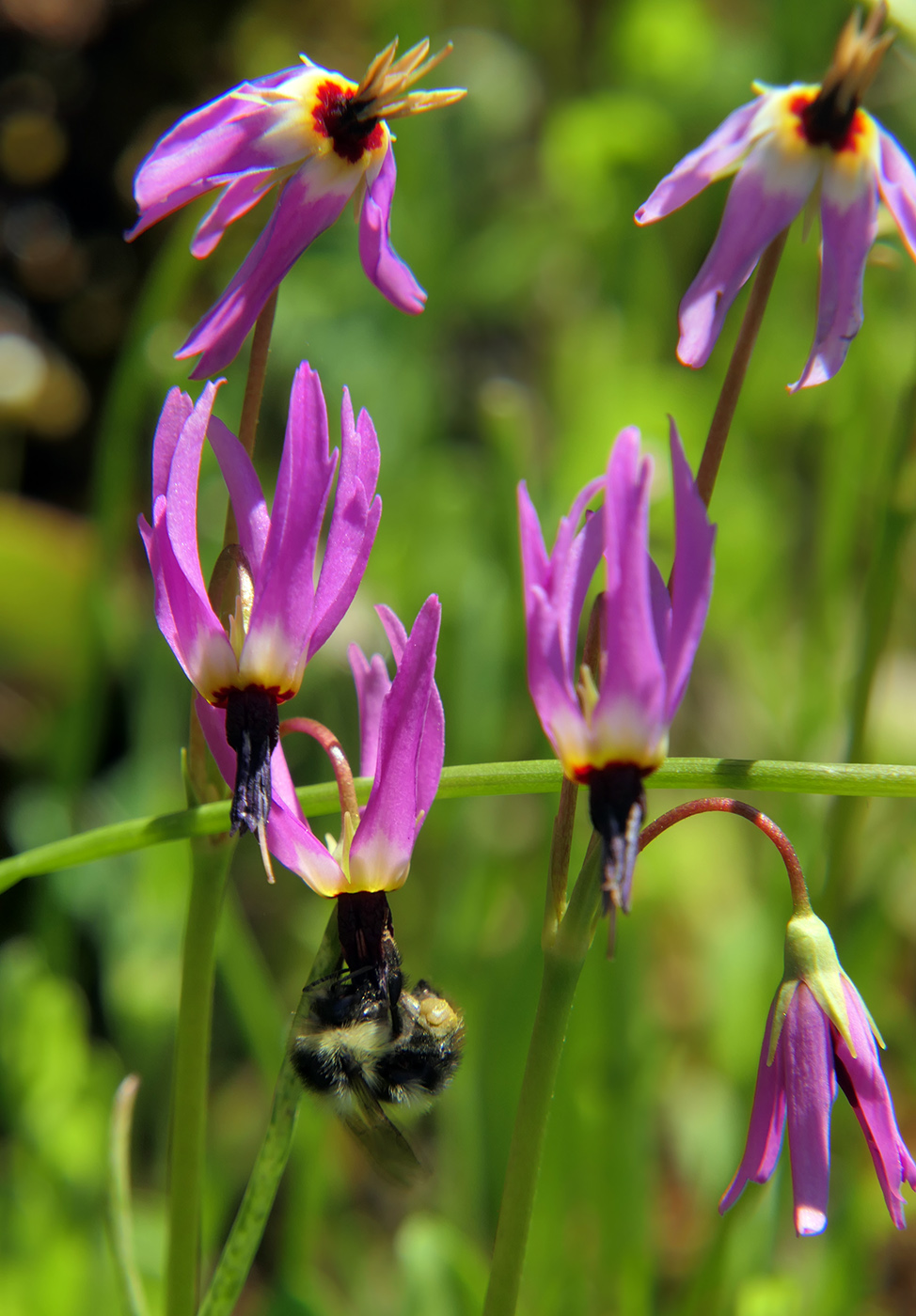
Shooting stars have downward-pointing flowers with reflexed petals in order to accommodate buzz pollination by bumblebees. There were lots of bumblebees taking advantage of the abundance of beautiful shooting star (Dodecatheon pulchellum) throughout the meadow. I was disappointed by the relative lack of butterflies but happy to see some pollinators.
On June 7, I took my husband, Jim, to see “Mistmaiden Meadow” on the west edge of Sourgrass Mountain. Although he’s not particularly interested in plants, we both feel safer if he’s familiar with all the places I visit regularly, in case he ever does have to come to my rescue. There are nice rocks and a view, and it was a lovely day to get out. If he’d stayed home, he would have spent the day doing chores like wood-splitting, so at least it was a nice change of pace.
The slope was still quite moist and lush with lots of colorful flowers. We’d missed the very earliest bloom, but there was still lots of the sweet Thompson’s mistmaiden (Romanzoffia thompsonii) that I named the site after. The very similar Nuttall’s saxifrage (Cascadia nuttallii) was just starting but will soon take over the seepy slopes. It is worth visiting this lovely and quiet spot multiple times during the flowering season. I was able to confirm my mystery cherry from my last trip last year (see Late Season at Mistmaiden Meadow) as choke cherry (Prunus virginiana) and added four other new species to my growing plant list for the site, so it felt successful as well as relaxing. And seeing a bear run across the road in front of us on our way home was like the cherry on top of a sundae—and the most exciting part of the day for Jim! Here are some pretty pictures of our very pleasant day. Read the rest of this entry »
Late Season at Mistmaiden Meadow

Beautiful fall color in the thickets of oval-leaved viburnum that grow on the slopes of Mistmaiden Meadow

In the wetland along Road 140, there were still trillium-leaved wood sorrel (Oxalis trilliifolia) in bloom. Its leaves are similar to the far more common Oregon wood sorrel (O. oregana), but the flowers are in clusters and bloom later, and they grow in very wet spots.
Thank heavens for the wonderful rain on August 31! I had been so worried we’d have to wait until October for some decent rain, like last year. We got 3/4″ of an inch at my house, probably more in the mountains. That was followed by almost a week of cool, cloudy weather, and even a little more rain. It tamped down the fires, reduced the smoke, and made it much easier for the firefighters to contain the fires. In fact, The Forest Service reduced the south end of the closure area near the Bedrock Fire. That meant I could finally return to “Mistmaiden Meadow” near Sourgrass Mountain, where I had hoped to survey throughout the flowering season. My last trip had been on July 7 (see Fourth Trip of the Year to Mistmaiden Meadow), and I’d planned to go back on July 23 until I realized the Bedrock Fire had started the day before. I had missed two whole months, so I was really anxious to get back. On September 6, the first nice day I had free after the welcome cool and rainy weather abated, I headed up there. Read the rest of this entry »
Spring at Heckletooth Mountain

Silver lupine (Lupinus albifrons) is outstanding on the steep, rocky, south-facing slope below the summit.

The paintbrushes on the summit are hard to pin down to species just like they are in many spots in southeastern Lane County. They may be a mix of Castilleja hispida and C. pruinosa. Whatever they are, they are gorgeous!
Spring is a busy season, and I’m already running behind. So I’m just going to post some pretty photos of a lovely trip to Heckletooth Mountain that Sabine and I took a week ago on May 28th. After going there at least once almost every year since 2006, I hadn’t been since 2013, so it was good to get back to this steep but lovely trail. There were still plenty of things just starting, including the grand show of showy tarweed (Madia elegans) and white-flowered threadleaf phacelia (Phacelia linearis). The weather was gorgeous. Everything was really quite perfect except for one major problem. The gravel road to get there is only 1.8 miles, but since my last trip, it had really gone downhill (pun intended—it’s pretty steep!). Some major downpours must have caused the many gullies in the road. Usually those kinds of gullies only last for short distances, but these must have gone on for a mile. And once I started up, I couldn’t turn around or back up over them. No fun! I hadn’t felt like dealing with gravel roads—one of the reasons I decided to go to Heckletooth—so it was quite an unfortunate surprise, and one that will keep me from returning to see the next wave of flowers. Read the rest of this entry »