Posts Tagged ‘Ligusticum’
Long-awaited Return to Abbott Butte
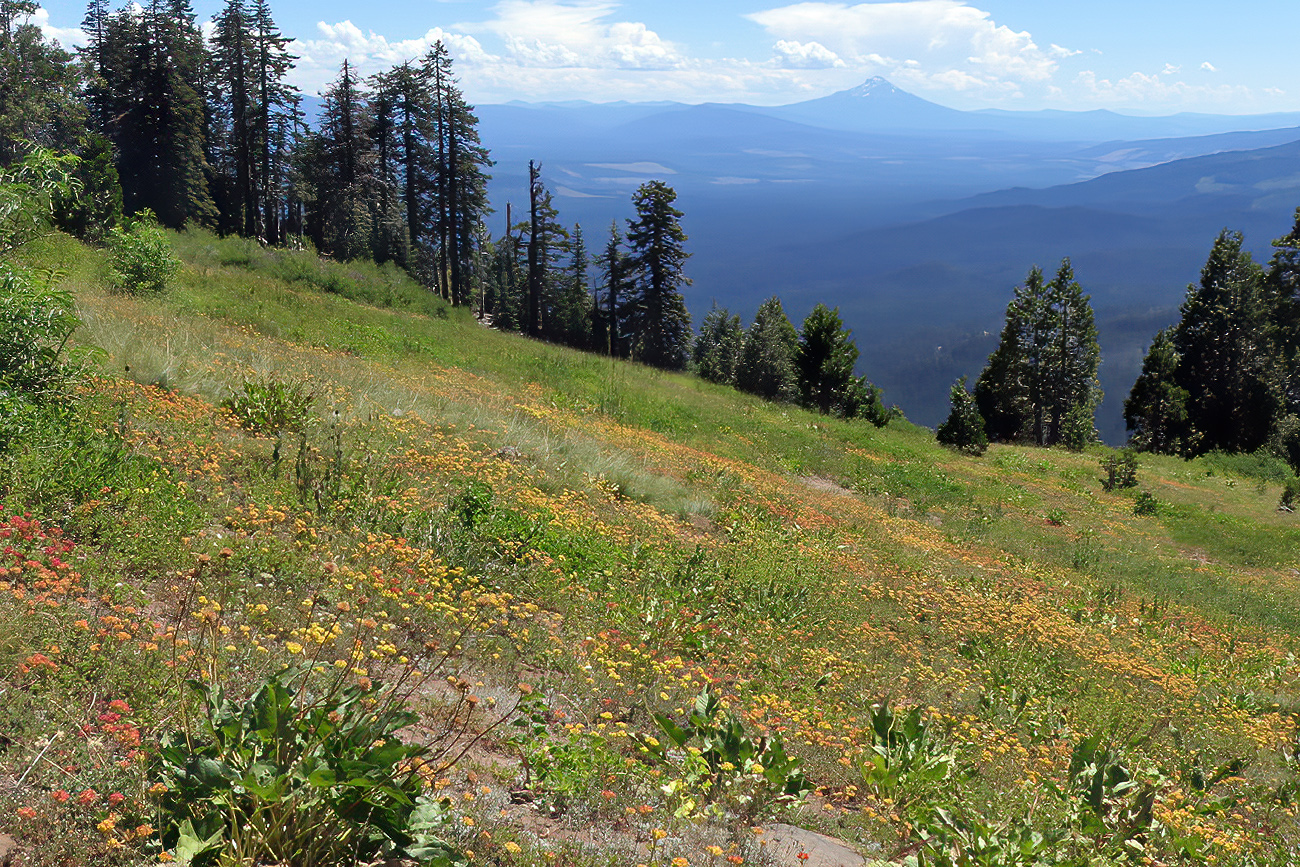
You can see Mount McLoughlin to the southeast from the summit meadow.
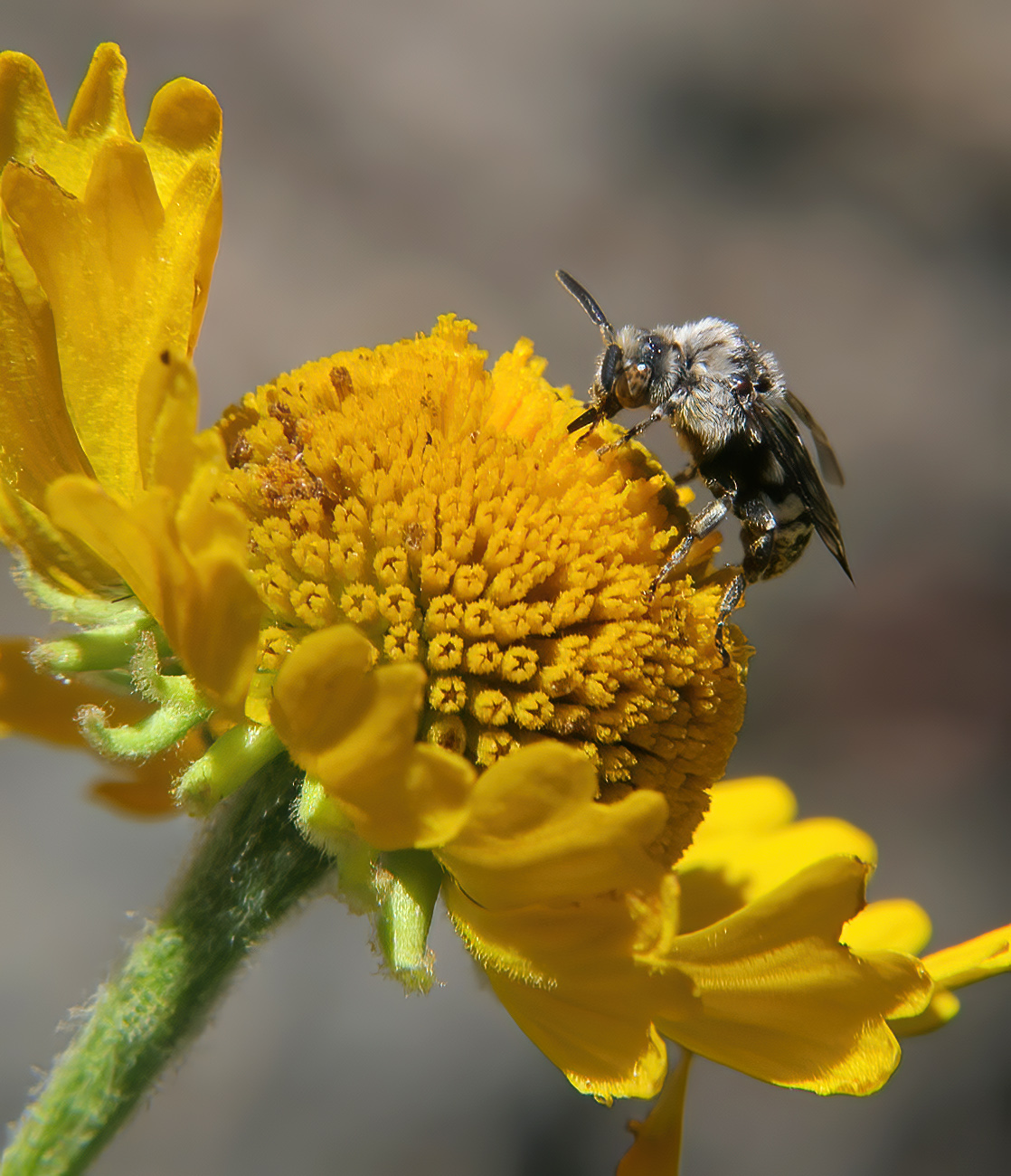
This cute bee is nectaring on tall sneezeweed (Helenium bigelovii), a southwestern Oregon species I’ve only seen in the Cascades near the Abbott Butte trailhead and at nearby Donegan Meadows.
In late June, I received an e-mail from Adam Schneider, another avid wildflower photographer, saying he was heading down to the Rogue-Umpqua Divide and did I have any suggestions for where to go. This is one of my favorite areas of the Cascades, and I used to try to get down there every year. But then I got busier with work, and every time I thought about going there was a heat wave or thunderstorms in the forecast or a nearby fire or smoke. Somehow a decade passed without a visit! Then when my old van became too untrustworthy to drive into the mountains, we got an electric vehicle. I’d been keeping an eye on charging stations, but as of summer of 2024, there still weren’t any on the east side of the Cascades that I could use to make the long trip. Adam’s e-mail prompted me to take another look, and I was thrilled to see a fast-charging station had been installed in Chemult last fall! Read the rest of this entry »
Looking for Rare Species at Tidbits Mountain

Gorman’s aster has one to only a few flower heads per stem. Each compound flower head has white ray florets (we saw a couple of purple-tinged buds) and yellow disk florets. It has short rhizomes that allow it to spread on rocky slopes and ridges, but most populations aren’t very large. The Tidbits ones are the largest I’ve seen. Evidently, there is some debate about lumping the genus Eucephalus into Doellingeria, similar eastern asters. Until that’s sorted out, I’ll stick to calling this species Eucephalus gormanii.

Checkerspots were plentiful this summer. Here, four snowberry checkerspots nectar on lovage (Ligusticum sp.).
Way back in 2007, I discovered a large population of Gorman’s aster (Eucephalus gormanii) on the talus slope at Tidbits Mountain. It is a rare Cascade endemic, found only in Linn, Marion, and Clackamas counties, and along the western edge of Jefferson County on Mt. Jefferson. The Oregon Biodiversity Information Center (ORBIC) puts it on their List 1: Threatened or Endangered Throughout Range. The populations on Tidbits are the southernmost. It is just a little over a mile north of Lane County, but it has yet to be found there. Though I collected specimens for the OSU Herbarium, I’d never managed to get one of the Forest Service botanists up to Tidbits to see it there. Sarah Uebel left the Middle Fork district to take over as the McKenzie River district botanist last year. I was thrilled when she expressed interest in going up there with me to see the two populations I’d found. We had a date all set for last July, but then all the fires started, including the Ore Fire that burned through the H.J. Andrews Experimental Forest just to the east. The area was closed for most of the rest of the summer, so we had to postpone our trip for a year.
NPSO Field Trip to Moon Point

Relaxing by the lookout. The foliage of beargrass (Xerophyllum tenax) is really soft comfortable to sit and lie on.

Heading down the overgrown trail. The tall foliage on the left is alpine knotweed (Aconogonon phytolaccifolium).
On July 10, eleven (vaccinated) nature lovers gathered at the Middle Fork Ranger Station in Westfir for a field trip to Moon Point sponsored by the Native Plant Society. Jenny Moore, district botanist, was the official leader of the trip, but since she hadn’t been to Moon Point before our pre-hike a month earlier (see Early Bloomers at Moon Point), she asked me to co-lead. What with the pandemic, it was the first field trip I’d led in quite a while.
We had a lovely day up at Moon Point. The plants had grown like crazy since our earlier trip, so the trail looked very different. While a number of flowers were past peak with this summer’s heat and drought, there were still some showy species like skyrocket (Ipomopsis aggregata) and mountain owl’s clover (Orthocarpus imbricatus) in good bloom as well as inconspicuous ones like blunt-sepaled starwort (Stellaria obtusa). There were plenty enough flowers to attract quite an array of insects. Everyone was really inquisitive and as interested in all the butterflies and other insects as they were in flowers. We went all the way out to the point at the end of the trail, and on the way back most people bushwhacked with us over to the lake. Read the rest of this entry »
Unusual Sightings at Grasshopper Meadows

Lovely lilies, lupines, and lovage—a nice alliteration and a good view toward the southeast and Diamond Peak from the top of Grasshopper Meadows!
On July 21, I went for a hike at Grasshopper Meadows. I figured there would still be some meadow flowers in bloom and plenty of butterflies. My first surprise was seeing another car as I arrived at the trailhead and finding it was fellow Native Plant Society of Oregon member and friend Rob Castleberry and his wife Joyce and their dog Wiley, who had arrived just minutes before me. We were able to walk together across the meadow to edge of the cliffs. On the way, we were surprised by a family of grouse bursting out of the grass in front of us. Joyce wasn’t up to the bushwhack down through the woods to the bottom of the cliff, but Rob joined me. It’s always a pleasure to share one of my favorite off-trail spots. It was too bad Joyce couldn’t come down, but I was happy she didn’t mind being left on her own for a little while. Read the rest of this entry »