Posts Tagged ‘frogs’
Another Great Wildlife Day at Hills Peak
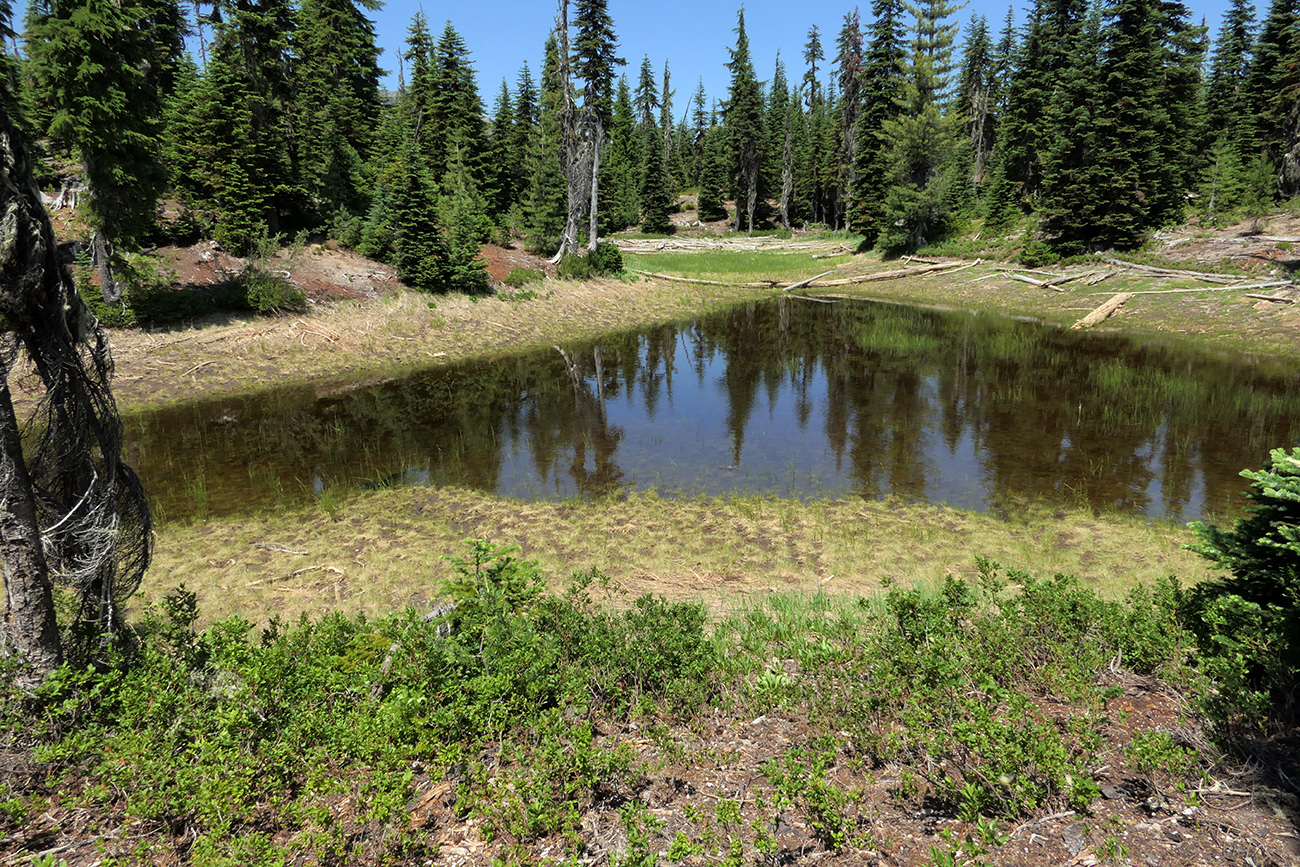
This shallow pond disappears fairly soon after the snow melts, so this was probably only the second time I’d seen it with any water in it. It might not look like it at first glance, but it was teeming with life.

I was hoping to see the tiny flowers lesser bladderwort (Utricularia minor), a rare carnivorous plant, but I only turned up one of them.
On July 14, I braved another hot day to head back up to Hills Peak, where I had just been a week and a half before (see Exploring a New Wetland Near Hills Peak). Accompanying me were Angela Soto and her partner Daniel. As on the previous trip, I wanted to go somewhere that would be reasonably easy and close to water, given the heat. The area around Hills Peak is the perfect place for relaxing exploration and is a great place for wildlife as well as plants.
I also really wanted to see and photograph the flowers of little elephant’s head (Pedicularis attollens), an east-side species that is rare on the west side of the Cascades. It hadn’t started blooming in time for my first trip, but I hoped it would be out by now. And since it was the first time Angela or Daniel had been to this interesting area, I wanted to show them a number of the easily accessed wetlands along with the rocky crags of Hills Peak itself. Read the rest of this entry »
“Mistmaiden Meadow” Still Outstanding

Rosy plectritis paints the hillside pink as Daniel and Angela climb back up “Mistmaiden Meadow.”

Bramble green hairstreaks are really hard to tell from Sheridan’s green hairstreaks; the former has less green on the underside of the forewing and less conspicuous white markings. The best way to tell is to look around for the host food plant as they don’t travel very far from it. The road here is lined with big deervetch (Hosackia crassifolia), the main host food plant of the bramble. Sheridan’s uses buckwheats, none of which grow there. This is where a botany background really helps in learning about butterflies.
Continuing my periodic surveying of what I’m now calling “Mistmaiden Meadow,” the steep meadow on the west flank of Sourgrass Mountain, I headed back up on June 25. This time I was accompanied by fellow NPSO member Angela Soto and her partner, Daniel. My plan was pretty much to follow what Sheila Klest and I did a couple of weeks before (see Shooting Stars are Stars of a Great Day), going to Mistmaiden Meadow and then on to Elk Camp and Nevergo Meadow. Before we even got to the meadow, we had to stop for a small roadside wet spot on Road 1912 when I spotted devil’s club (Oplopanax horridus) out of the corner of my eye. This striking spiny shrub is not that common in southern Lane County, so I don’t see it too often. I’m not sure how I missed it on my previous two trips, although it probably hadn’t leafed out on my first trip this year (see Early Look at Meadow on Sourgrass Mountain).
This spot was just before the intersection where we turn left onto Road 140. Read the rest of this entry »
Planning Trip to Grassy Glade

I do hope that some of the beautiful purple milkweed will be in bloom on our upcoming trip to Grassy Glade!

Beautiful harsh paintbrush (Castilleja hispida) blooms along the road by Hills Creek Reservoir.
On Saturday, May 27, I headed out to the Rigdon area to plan the field trip I’m leading for the Native Plant Society of Oregon Annual Meeting the following Saturday. I want to give people a taste of the interesting plants in this area that are more common to the south, especially the lovely purple (or heartleaf) milkweed (Asclepias cordifolia) that I’ve written about so many times. I’ve been crossing my fingers that we will see some in bloom somewhere, but with the crazy shift in weather this spring, it’s hard to anticipate how the plants are going to react. There are lots of great places in the Rigdon area, but I wanted to know which would work best for our non-trail field trip.
I drove straight to Grassy Glade and parked along the side road near the beginning of the meadow. I did a quick spin through the meadow, which was half baked and half moist. On the road in, I had noticed some of the potholes were partly filled with water. Obviously, some of the thunderstorms that I’d heard had occurred out here had blessed the area with some much-needed moisture—there hasn’t been a drop for almost three weeks at my house. My guess is that some of the meadow had already dried out before the rain, while the moister parts had been refreshed before the annuals died. Spring gold (Lomatium utriculatum) and many species of clover (Trifolium spp.) had started along with the cute narrow-leaf owl’s clover (Castilleja attenuata). Read the rest of this entry »
A Froggy Day at Lopez Lake

There are many aquatics in the shallow lake and lots of sedges and other graminoids along the edges.
Taking a break from our usual obsession with the Calapooya Mountains, on July 30, John Koenig and I headed to Lopez Lake. We went straight to the lake, rather to the other interesting spots along Road 5884, and spent most of the day there, exploring it more thoroughly than we had in the past. Neither of us had been back to the lake since a trip we took with Sabine Dutoit in 2014 (see A Glorious Day Near Lopez Lake).

We enjoyed watching this chubby toad hop into the lake and eventually swim away.
First Flowers at Coal Creek Bluff
After discovering new sites for purple (or heartleaf) milkweed (Asclepias cordifolia) in the Western Cascades last summer, my main goal for this spring and summer is to explore these lower elevation meadows in the Rigdon and North Umpqua areas of the Western Cascades for more milkweed sites—and hopefully more monarch sightings. Several weeks ago, John Koenig, Sheila Klest, and I tried to get to what I named “Coal Creek Bluff” last fall on my first visit there (see Final Outing of 2017). We drove across a thin layer of snow on the bridge across Coal Creek but were immediately stopped by a tree across the road. So we changed our plans and went back to “Monarch Meadow” and “Many Creeks Meadow”. John hadn’t been to Monarch Meadow, and Sheila hadn’t been to Many Creeks Meadow. It was an enjoyable day, and things were a little further along than the earlier trips I posted about most recently, but it was still quite early, so not much to report yet.

Gold stars light up the steep slope near the base of the open area. A glimpse of Coal Creek can be seen through the trees below.
Bristow Prairie: 2015 Trip 2

Looking to the northwest along the front of the cliff. Compare this with the photo from last year. The seep is now damp and mossy. In the distance, 6000′ Bohemia Mountain and Fairview Peak can be seen with no snow on their south-facing sides. They usually don’t melt out for another 6–8 weeks.
One of my goals for the year is to track the botanical progression at Bristow Prairie by getting up there at least once a month, hopefully more. There’s such a broad variety of habitats, from cliffs to meadows to wetlands, that it should be an excellent site for observing the effects of the largely snowless winter on the different plants. So on April 27, John Koenig headed up to Bristow Prairie for my second trip of the year. While there had finally been some snow a week or so before, it was all melted again, and we only saw a few patches along the upper road and on nearby ridges. Our main destination was the lower, west-facing cliffs we first visited last fall (see First Trip to Cliffs Northwest of Bristow Prairie), so we started again at the north trailhead. Read the rest of this entry »
Super Early Look at Snowless Bristow Prairie
My first post of the year, and it’s already April. What with the heat and forest fires, my summer hiking season petered out much earlier than usual last year. Then my work with the Oregon Flora Project ramped up, and I’ve been super busy all winter. I’ve been editing, designing, and doing layout for the new Flora of Oregon (more about that another time). I’m usually happy to be parked in front of my computer most days in the winter, but with all the glorious weather during this winter-that-wasn’t, it’s been really tough not having time to go out, especially after getting reports from my friends of getting up into the Western Cascades in February(!). We’re almost done with the Flora, and we just had a brief, much-needed respite while the publisher read through the manuscript. At last, I was able to take a day off and get up into the Cascades to see what it looked like after this unusual, largely snowless winter.

Looking north from Bristow Prairie, there is no snow in sight—very scary for late March! In the center of the photo is the imposing south face of “Mosaic Rock”. Youngs Rock and Moon Point can also be seen, just to the left of the dark tree on the left.
A Glorious Day Near Lopez Lake

Subalpine spiraea (Spiraea splendens) was at peak bloom here at “Zen Meadow” and also at Lopez Lake.
Two years ago, Sabine Dutoit and I first discovered the beauty of Lopez Lake and the surrounding area near the end of Road 5884 (see Aquatics and More Near Lopez Lake), southeast of Oakridge. I was really looking forward to doing some more exploring up there, so on Thursday, July 17, I headed up there accompanied by Sabine and John Koenig. The three of us had gone to Bristow Prairie the week before and spent the day under cloudy skies and sprinkles, so we were all thrilled that it was an absolutely gorgeous clear day and also not as hot as it had been lately. Before heading to the end of the road, we made a quick stop to check out three small lakes that showed up on the map. Only one had any water left, and there weren’t many flowers or plants of interest other than some quillwort (Isoëtes sp.), an odd grass-like plant that grows in the bottoms of shallow lakes. This lake looked like a perfect mosquito breeding area, and indeed they were out in numbers here, so we didn’t linger here very long. Read the rest of this entry »
Early Blooming at Elk Camp and Nevergo Meadow

Mountain shooting star (Dodecatheon jeffreyi) and marsh marigold (Caltha leptosepala) put on a great show at the Elk Camp meadow. Note how similar this photo is to one I took here last year on June 10.

Shooting star flowers go through a number of changes as they bloom. Buds start out upright, then bend over. The flower petals and sepals start out forward, then they flip back. This makes it easier for bees to do “buzz pollination” where they hang on the style, and their buzzing shakes the pollen onto them. Mountain shooting star has flower parts in 5s, long styles, and glandular pedicels.
With the mountains melting out fast, it is time to go willow hunting in earnest, so on Tuesday, May 20, I headed up to the wetlands at Elk Camp, Nevergo Meadow, and Saddleblanket Mountain. As it turns out, this is the exact date I went to Nevergo last year (see Wetland Bloom Starts with a Bang Near Elk Camp Shelter). Last year I was stopped by snow across the road just at the trailhead for Elk Camp and didn’t bother to go into the meadow, being quite satisfied with everything blooming at Nevergo Meadow a quarter mile earlier. This year, there were just a few very small patches of snow in the ditches. The plants were a little farther along but still quite beautiful and fresh. In fact, they were almost as far along as they were on June 10, last year (see Back to Elk Camp Shelter—Not Once But Twice). The skunk cabbage (Lysichiton americanus) was especially noticeable as being ahead of last year. All three locations had beautiful shows of marsh marigold (Caltha leptosepala) at peak bloom with Mountain shooting star (Dodecatheon jeffreyi) just coming on. Along the drier edges of the meadows were lots of the gorgeous blue Oregon bluebells (Mertensia bella). At the edges where the last snow had melted there were still plenty of glacier lilies (Erythronium grandiflorum). Along the roadside were blooming Lyall’s anemone (Anemone lyallii) and round-leaved violet (Viola orbiculata). Read the rest of this entry »
Willows and More Blooming at Ikenick Creek

Sitka sedge (Carex aquatilis) blooming along the edge of the south pond in the northwest wetland.

Crab spiders know that willows are insect pollinated and lay in wait for prey like this unsuspecting bee on Geyer’s willow (Salix geyeriana).
On Friday (May 16), Dave Predeek and I went to check out some of the wetlands along Ikenick Creek in the Smith Ridge area. Dave is one of the few people I’ve met who was already familiar with this fascinating area. The willows were mostly still in bud two weeks ago (see Triple Treat up the McKenzie), so I thought this would be the perfect time to see them in bloom. Indeed it was. We spent most of our time exploring the large wetland just south of Road 2672. The large thickets of Geyer’s willow (Salix geyeriana) were all blooming. They are pretty easy to recognize because they have very small and relatively short catkins. In small patches near the southern end of the wetland, we found Sierra willow (Salix eastwoodiae) and Booth’s willow (S. boothii) in bloom. They both have much larger and showier flowers; the former has hairy ovaries while the latter has glabrous ovaries and fewer hairs on the leaves. I don’t think I could separate the males this time of year. Later on, the leaves of Booth’s willow are shinier, but this early they both have some hairs. Read the rest of this entry »