Posts Tagged ‘Erysimum’
Butterflies at Patterson Mountain
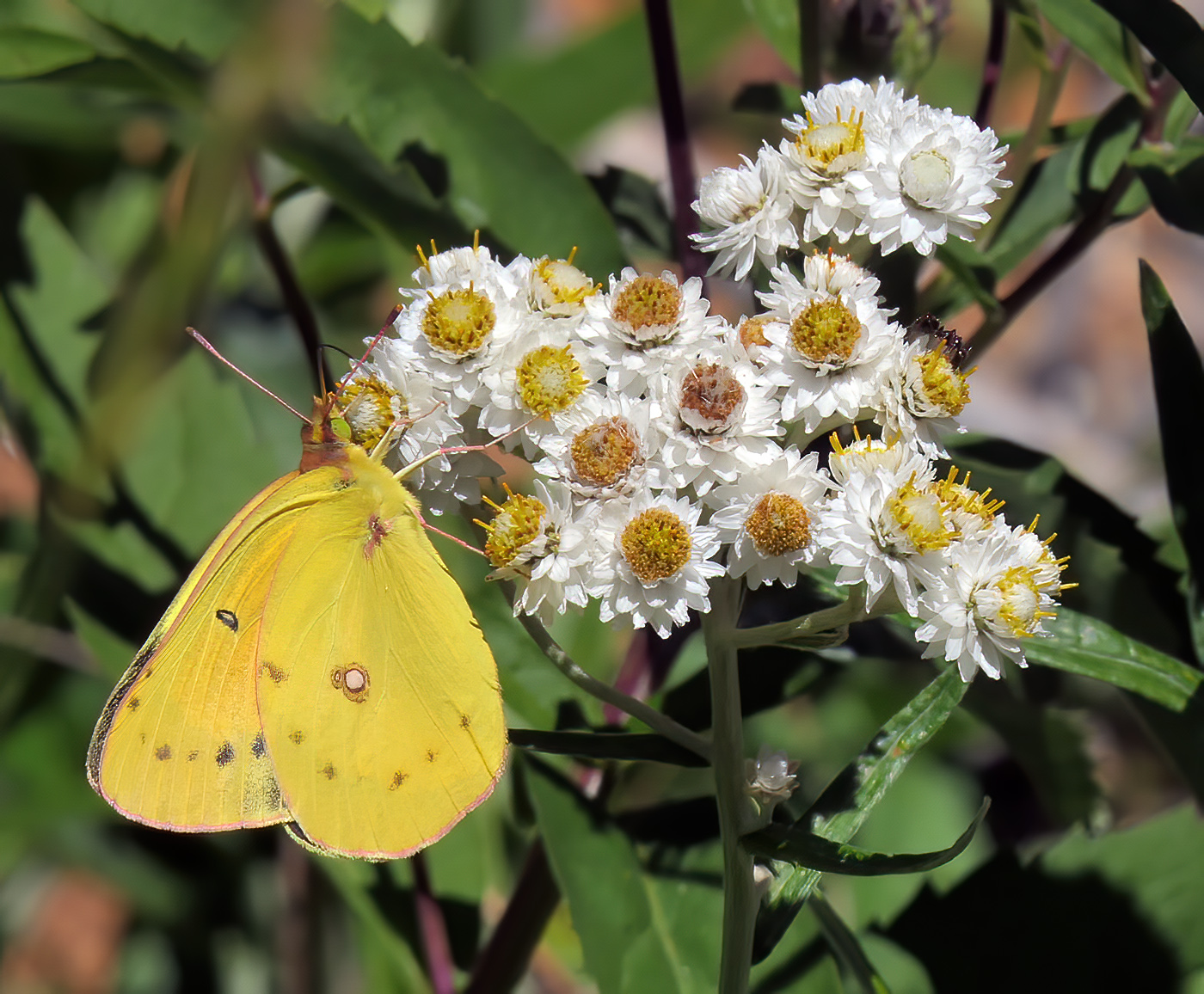
Orange sulphurs hardly ever sit long enough for me to get a good photo, and when they do, they never open their wings. I watched several nectaring on pearly everlasting (Anaphalis margaritacea) in one of the side meadows near the summit. It occurred to me that if I could record a video while they flew, I might actually be able to get a decent look at their bright orange dorsal side. You can see this in the slowed down (~1/7 speed) video below. This sulphur was accompanied by a couple of Edith’s coppers and what looks like some kind of a fly.

A clodius parnassian drinking from a mountain thistle (Cirsium remotifolium)
On July 22, I went up to Patterson Mountain in hopes of collecting seed of one of my favorite native plants, great polemonium (Polemonium carneum). It grows in abundance on the south side of the mountain, well off the trail. There is also a smaller population growing on the edge of the meadow near the Lone Wolf Shelter. My timing was good, and I came home with enough polemonium seed to share. I also found seeds of Scouler’s valerian (Valeriana sitchenis var. scouleri), another native that is growing well for me. Nothing particularly exciting happened, but I did enjoy watching butterflies, so I thought I’d share some photos and a video.
End of the Season Trip to Tire Mountain

September rains had knocked most of the fires back, but they were still smoldering in October. Thankfully, most of the smoke remained in the valleys around Oakridge and Hills Creek Reservoir, and we managed to stay above it. It seemed awfully late in the year to still have to worry about air quality.

I was surprised to find quite a number of western wallflower (Erysimum capitatum) reblooming. I was also really happy to find a lot of ripe seed left in the long siliques (seed capsules) remaining from the original bloom, probably in July.
As a result of a small fire on Tire Mountain and the much larger Chalk Fire to the east (part of the aftermath of the nasty thunderstorm on July 17), the Tire Mountain area was closed much of the summer. The closure area was finally reduced at the end of September, allowing access to the Tire Mountain trail at last. The beginning of October was still dry and somewhat smoky, so it wasn’t until October 18th that I finally went for my annual seed collecting trip to Tire Mountain. This also turned out to be my last botany trip of the season. While I really enjoyed being up in one of my favorite places, it’s always bittersweet knowing there’s such a long wait until the flowers return and I can get back up into the mountains.
Angela Soto and her partner Daniel joined me for a pleasant day of collecting seeds and berries and looking for anything interesting left at the end of season. Here are photos of some of the highlights of our day. Read the rest of this entry »
Collecting Foray at Hills Peak

The folks from the herbarium collecting specimens in the wetland near the lake

Suksdorf’s paintbrush can be recognized by the yellow and green below the red on the bracts and its prediliction for wetlands.
At long last—after a year’s delay because of the pandemic—it was time for the Burke Herbarium’s 25th annual collecting foray. On June 24th, I headed down Road 21 to Sacandaga Campground to meet the participants, including Dick Olmstead and David Giblin who organize the forays every year, several volunteers, and five UW students. Also there were John Koenig and James Mickley, the new head of the OSU Herbarium. None of the Washington folks, nor James, had ever been to the Calapooyas, so John and I were really looking forward to introducing them to our favorite spots.
On Friday morning (June 25th), we split into three groups. John went up to Bristow Prairie, David and James took a group to Potter Mountain, and I went with Dick Olmstead and his wife Sheila and dog Lolly, Scott, a volunteer, and Ava, a student, to Hills Peak. We were also joined for the day by Gail Baker, a friend and fellow local NPSO member. Read the rest of this entry »
Exploring Meadows Below Sawtooth Rock

From the south ridge on Mount June last year, we had a good view of Sawtooth Rock at the right end of its large meadow as well as the three smaller openings below that I went to on this trip. The Three Sisters and Mount Bachelor had way more snow than this year almost exactly a year ago on June 22, 2020.
For years I’d wanted to explore all the meadows and rocky openings in the area of Mount June and Sawtooth Rock. I’m pretty sure I’ve checked out all the open areas on Mount June and regularly make a loop down the south ridge and west side when I go up there now (for a look at last year’s trip, see A Rainbow of Flowers at Mount June). I had also once explored several of the small openings just east of Sawtooth Rock Meadow (see More Meadows Near Sawtooth Rock). But I’d never made it down to a string of three rocky openings downhill to the southwest of the main meadow. On June 19, I decided to make that my goal.

At the first rocky opening, the paintbrush was attracting a rufous hummingbird. I tried to be ready to photograph it as it zipped around, but this was the only decent photo I was able to get. Perched as I was on the steep rock, I couldn’t move much, nor could I even see it most of the time, but its hum let me know it was still around. The blue flowers are bluefield gilia (Gilia capitata).
Long Overdue Return to Cloverpatch

The narrowleaf mule’s ears (Wyethia angustifolia) were at peak bloom in the main meadow. With almost the same shade of yellow orange, at first I didn’t notice the wallflowers (Erysimum capitatum) hiding among them in plain sight. The purple flowers are ookow (Dichelostemma congestum). Definitely a spot to return later to collect seed!

Ichneumon wasps apparently don’t feed much as adults, but since they are parasitoids, perhaps the ones I saw floating about above the herbaceous layer of the forest were looking for caterpillars to lay their eggs on.
The Cloverpatch trail west of Westfir is one of the closest trails to my house, yet I hadn’t been there in five years. And with the many off-trail meadows to explore, I hadn’t been up to the uppermost meadow in nine years (see Cloverpatch is in the Pink), so on June 1, I headed to the trailhead. While the day started out overcast, by the time I got to the first meadows, the clouds were dissipating. The flowers were terrific, and I’m so glad I decided to return. I headed straight up to the uppermost meadow to the east. While there used to be a path leading off the trail near the top, I almost walked right by it. The foliage was so lush, I just barely noticed someone had pushed it down as they walked up there (apparently I’m not the only one who enjoys heading off-trail to that meadow!). So I did manage to get back up to the lovely seepy meadow area. While I missed the blooming of the beautiful shooting star seen in the report from 2011, the drifts of great camas (Camassia leichtlinii) and Tolmie’s cat’s ears (Calochortus tolmiei) certainly made up for it. Here are some of the highlights of my trip. Read the rest of this entry »
Back to Back Trips to Horsepasture and Lowder Mountains

The view of the Three Sisters is outstanding from the summit of Horsepasture.
It’s been a busy week, so I’m just going to post some photos from my last two trips. On Wednesday, June 22, I went up to Horsepasture Mountain with Jenny Lippert, Willamette National Forest botanist, to scout for an upcoming trip that she’ll be leading during the Native Plant Society of Oregon annual meeting in a few weeks. Then on Sunday, June 26, I led a trip to Lowder Mountain for Oregon Wild with Chandra LeGue, their Western Oregon Field Coordinator, and six other hikers interested in learning some Cascade wildflowers. Both trails are in the Willamette National Forest McKenzie District. The flowers on both mountains are still great, but we are definitely a few weeks earlier than “normal”, and things are moving along fast. Read the rest of this entry »