Posts Tagged ‘Erigeron’
Very Early Trip to Groundhog Mountain Area
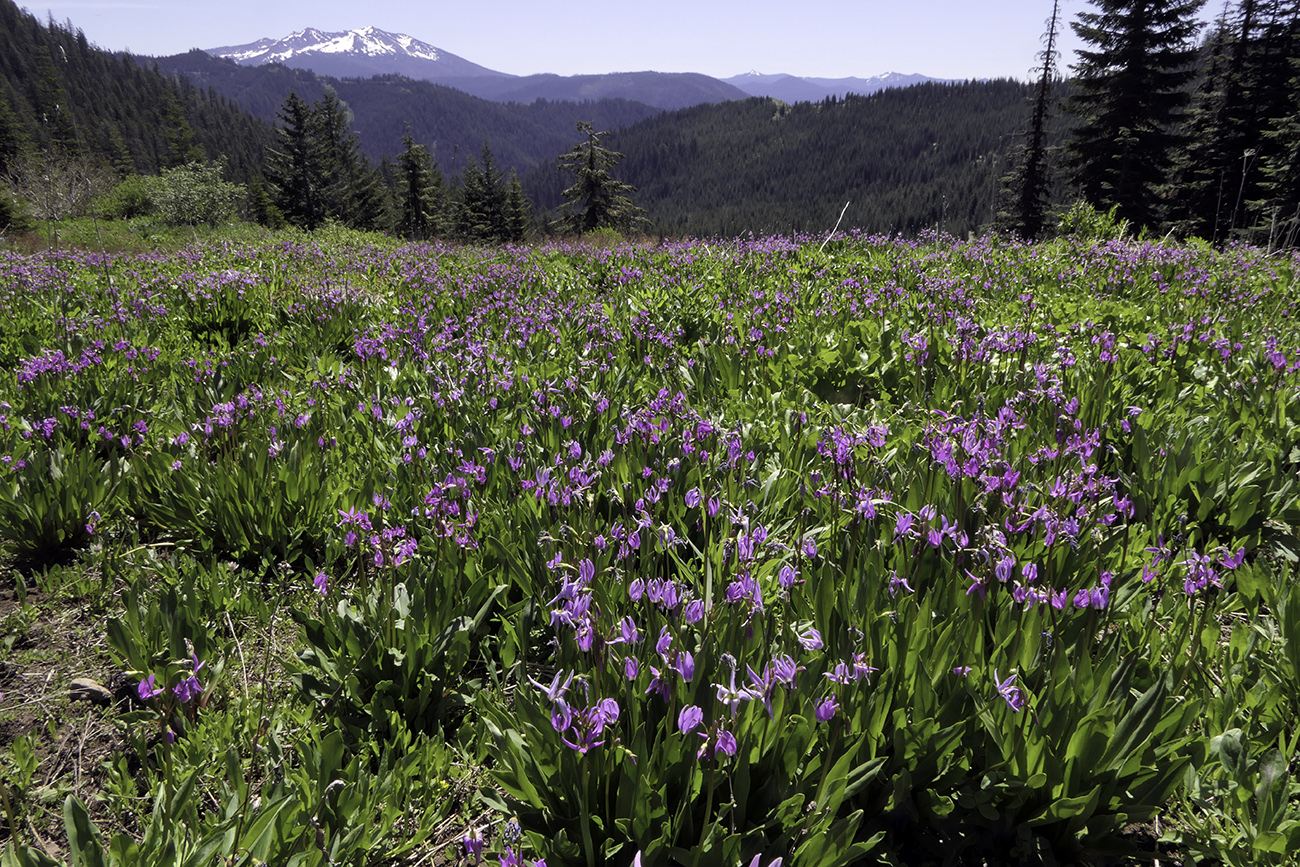
Not much snow for late May on the west side of Diamond Peak. The mountain shooting star (Dodecatheon [Primula] jeffreyi) was putting on quite a show.
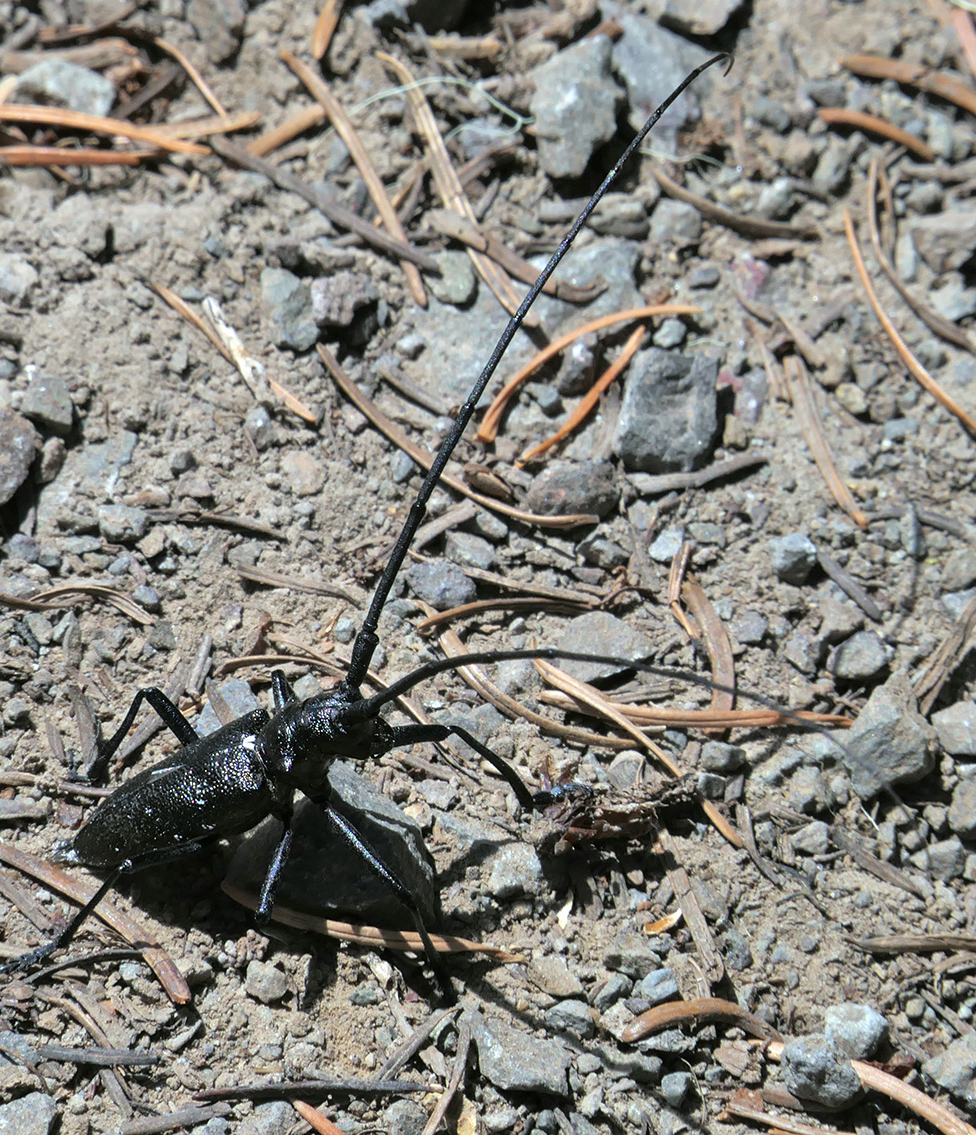
The long antennae of this large white-spotted sawyer beetle (Monochamus scutellatus) caught everyone’s eye on the road to Logger Butte. Apparently this wood-boring beetle doesn’t really bite, but it can grip hard if you’re trying to get it off you.
On May 24th, I headed up to Groundhog Mountain with Alan Butler, Dave Predeek, and Hannah English. It was only the second time I’d ever been up there in May as it is usually snowed in until at least mid-June. Dave and I had also come on May 24th way back in 2015 (see Two Foggy Outings)—after the only other winter since I moved here over 30 years ago when there was no snowpack in the Western Cascades.
We came in from the north via Road 2309 to see the roadcut flowers. It was already drying out there—with no snowpack, it is a very early year indeed. We made a number of our usual stops to Waterdog Lake, Logger Butte, Road 452, the pond just north of Logger Butte, and we also drove all the way up the west side of Groundhog to see the cliffs at the north end (in Alan’s high-clearance truck—I wouldn’t do that in my car!). Here are some highlights of a very pleasant day with other nature lovers observing flowers and insects. Read the rest of this entry »
More Exploring in the Rigdon Area

Here’s a view to the east from the easternmost meadow on the ridge. While there is snow on Diamond Peak, there is frightening little snow anywhere else. I caught a glimpse of Bristow Prairie while looking to the south. Although it is just above 5000′, it was almost melted out. I usually can’t even get up there until early June because of the snowpack. You can also see how much of the forest has been burned at high intensity here in the last few years. It’s really heart-breaking. The nearby logging doesn’t make me happy either.

I had just finished telling my friends we should keep our eyes out for Moss’s elfins along the reservoir cliffs where broad-leaved stonecrop (Sedum spathulifolium) grows when one appeared—my first of the year. It enjoyed nectaring on the abundant gold stars. (click image to see a larger photo where the color isn’t washed out—what’s up WordPress!)
On March 18, Sarah Erskine, Max Kant, and I went for a botanizing trip to the Hills Creek Reservoir and Rigdon area of southeastern Lane County. Although I’d just been there on my previous trip (see 2026 Botanizing Season Begins), I wanted to do some more exploring. I also wanted to show Sarah and Max some of my favorite hidden spots. We repeated the same stops I’d made along the cliffs by the reservoir and then headed to “Many Creeks Meadow.” We spent a while checking out the early flowers, including chickweed monkeyflower (Erythranthe alsinoides), meadow nemophila (Nemophila peduculata), Shelton’s violet (Viola sheltonii), and gold stars (Crocidium multicaule). Larger perennials were also appearing. Pacific hound’s tongue (Adelinia grandis) was up, and chocolate lily (Fritillaria affinis) and Oregon fawn-lily leaves were emerging, but there was no sign of the abundant Oregon geranium (Geranium oreganum) or chocolate tips (Lomatium dissectum) yet. Read the rest of this entry »
NPSO Field Trip to Groundhog and Warner Mountains

A lilac-bordered copper and two checkerspots nectaring on leafy fleabane (Erigeron foliosus)

A skipper, a checkerspot, and a field crescent all happily enjoying a meal together on a goldenrod (Solidago elongata). If only people could get along this well!
When the forecast for July 12th was for 95° in the valley, I was really glad I’d already chosen Groundhog Mountain as the destination for the July 12th field trip I was leading for the Emerald Chapter of the Native Plant Society of Oregon. There are no trails, so we didn’t have to walk a long way to get to some destination. Instead, we just made several stops where we had more time and were able to look carefully at different habitats with their different plant species. We did some easy walking along the road and a couple of short bushwhacks across beargrass meadows. Our elevation varied from 5500–6000′, so it was much cooler than in the valley. It got into the 70s where we were, but while the high-elevation sun on the clear day was quite strong, the air itself was pleasant. And our relaxed pace kept us from overheating. We had a chance to get to know each other better and learn more about plants and pollinators. And after all my worrying, the roads were fine, the flowers great, the butterflies excellent, and I think all 13 of us had a good time. What a relief! Read the rest of this entry »
Butterflies Abound on Seed-Collecting Trip to Rigdon

I was disappointed to be a little late for the peak bloom of Lewis’ mock orange (Philadelphus lewisii) at Many Creeks Meadow, but there was still one last shrub in good bloom whose fragrant flowers were attracting pollinators like this snowberry checkerspot and MacCulloch’s forester, a pretty day-flying moth.

Several butterflies were showing some interest in a damp spot by Staley Creek. I poured some more water from the creek on the spot, and very quickly there were several bumble bees and 3 butterflies, including this silver-spotted skipper.
On June 28th, I took a break from looking at higher-elevation flowers to collect seeds along Hills Creek Reservoir and nearby lower-elevation meadows in the Rigdon area, south of Oakridge. I went as far as Grassy Glade and Rigdon Meadow next to the Sacandaga campground. I figured it would be a fairly uninteresting day with most flowers all dried up, but it turned out to be a great day for seeing butterflies. And I managed to collect seeds of a number of species for restoration on my property, including spring gold (Lomatium utriculatum), Pacific hound’s tongue (Adelinia grandis), and ookow (Dichelostemma congestum). Here are some highlights of the day. Read the rest of this entry »
Another Try at Groundhog Mountain
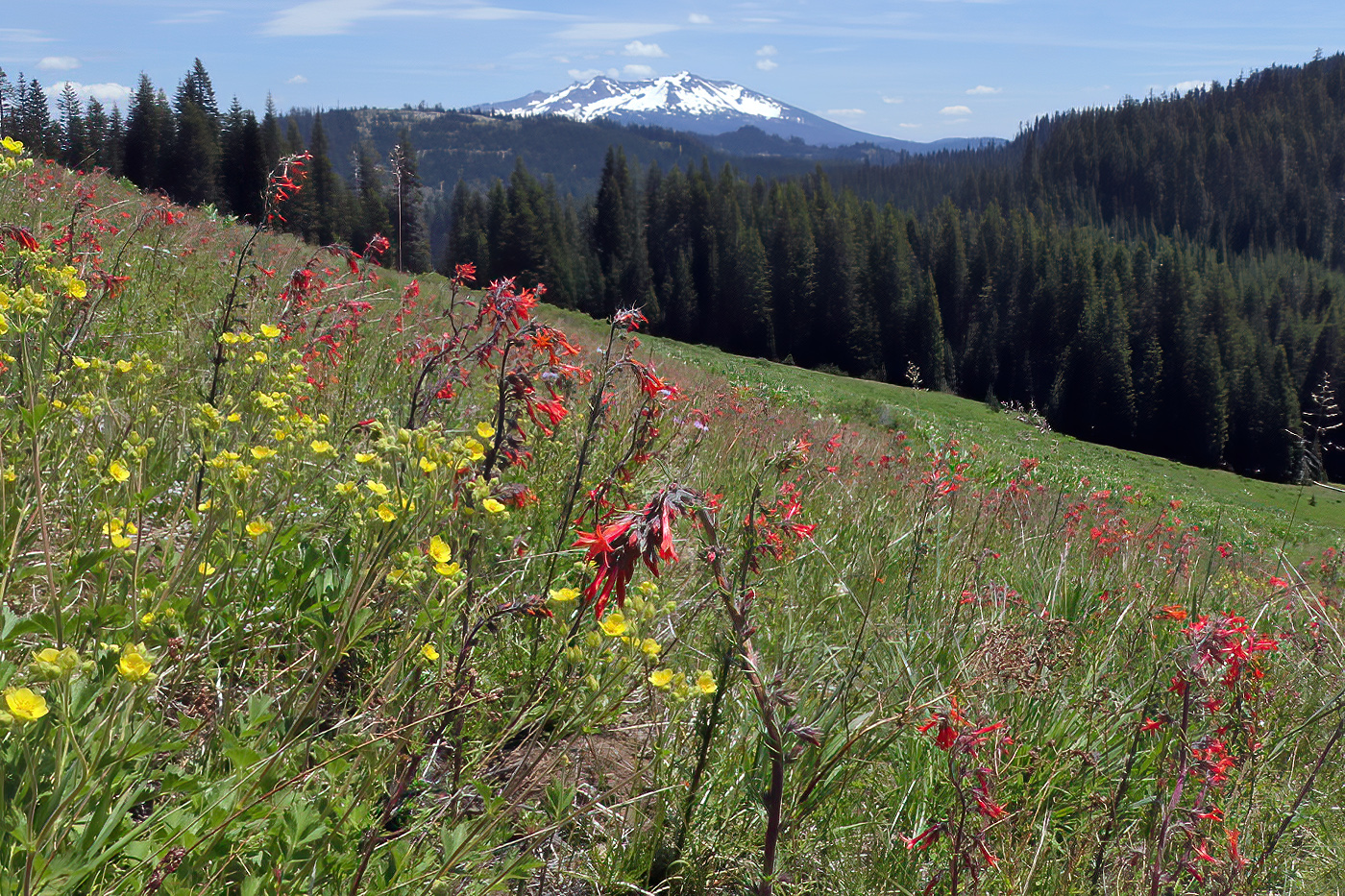
From high up on Little Groundhog meadow where the skyrocket (or scarlet gilia) and sticky cinquefoil were abundant, I got a great view of Diamond Peak to the east.
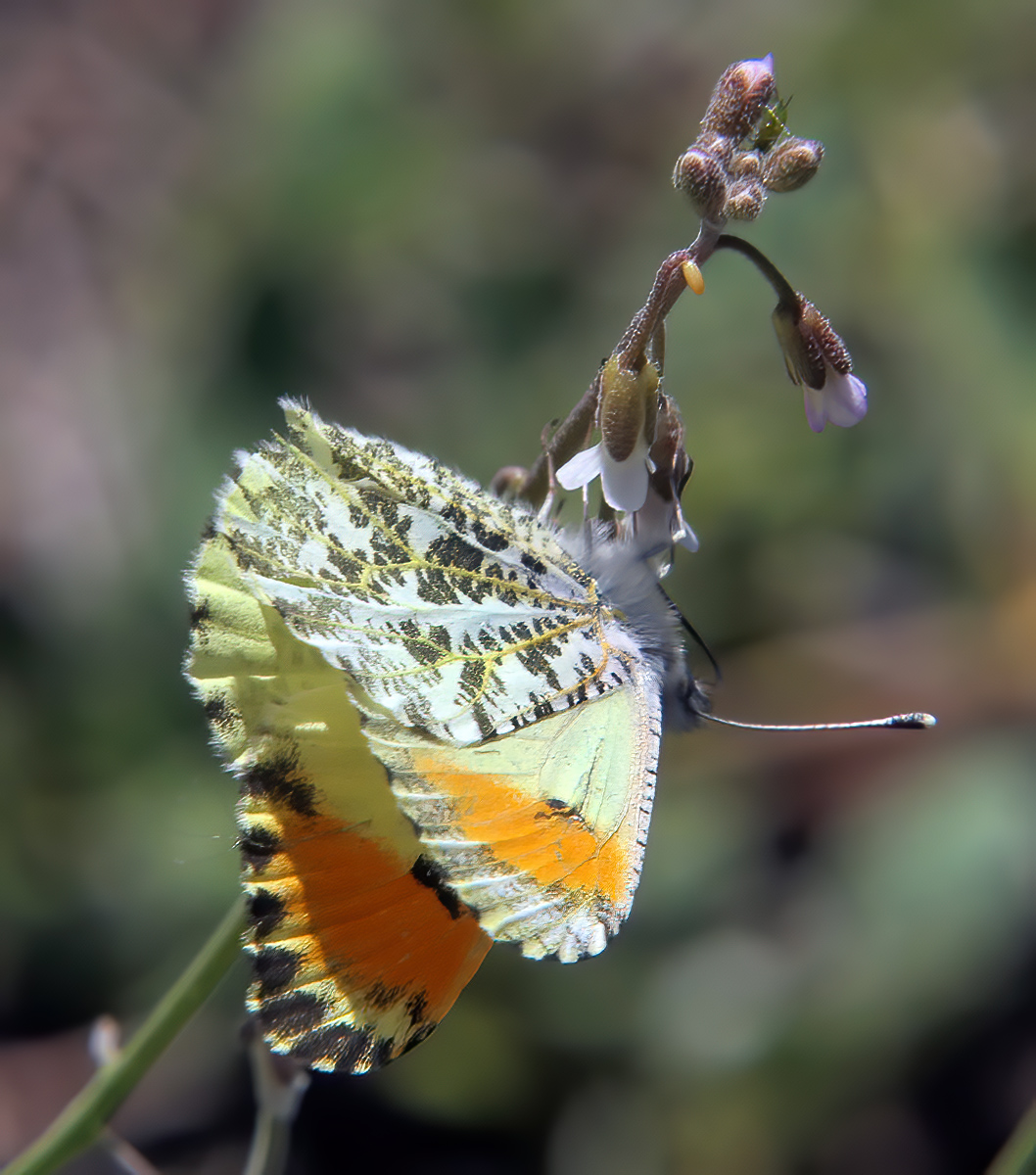
This lovely female Julia’s orangetip was nectaring on a rockcress (Boechera sp.), which might also serves as a host food plant for many whites, including orangetips.
After not reaching the wetlands at Groundhog Mountain the previous week (see Long Overdue Return to Warfield Bog and Hemlock Butte Wetland), Alan Butler, Dave Predeek, Don Wirtala, and I made another attempt on June 25th. This time, we headed in from the west starting on Road 2120, like I’ve been doing for a number of years. The first 4 or 5 miles were in good shape, and I was hopeful for a relatively easy drive up, but then we started to see lots of trees down on the road. Someone had cut some gaps, but we got out a number of times to move branches and small trees off the road. I was going to be leading a field trip for NPSO on July 12th, so I was hoping to make sure the road was clear for passenger cars. After a while, however, it became apparent that there were too many obstructions for me to get my car up this way, let alone to take a group. Having gotten most of the way up, however, Alan didn’t want to turn around and thankfully was able to slowly get his truck over, under, and around dozens of downed trees. Read the rest of this entry »
Long-awaited Return to McCord Creek Falls
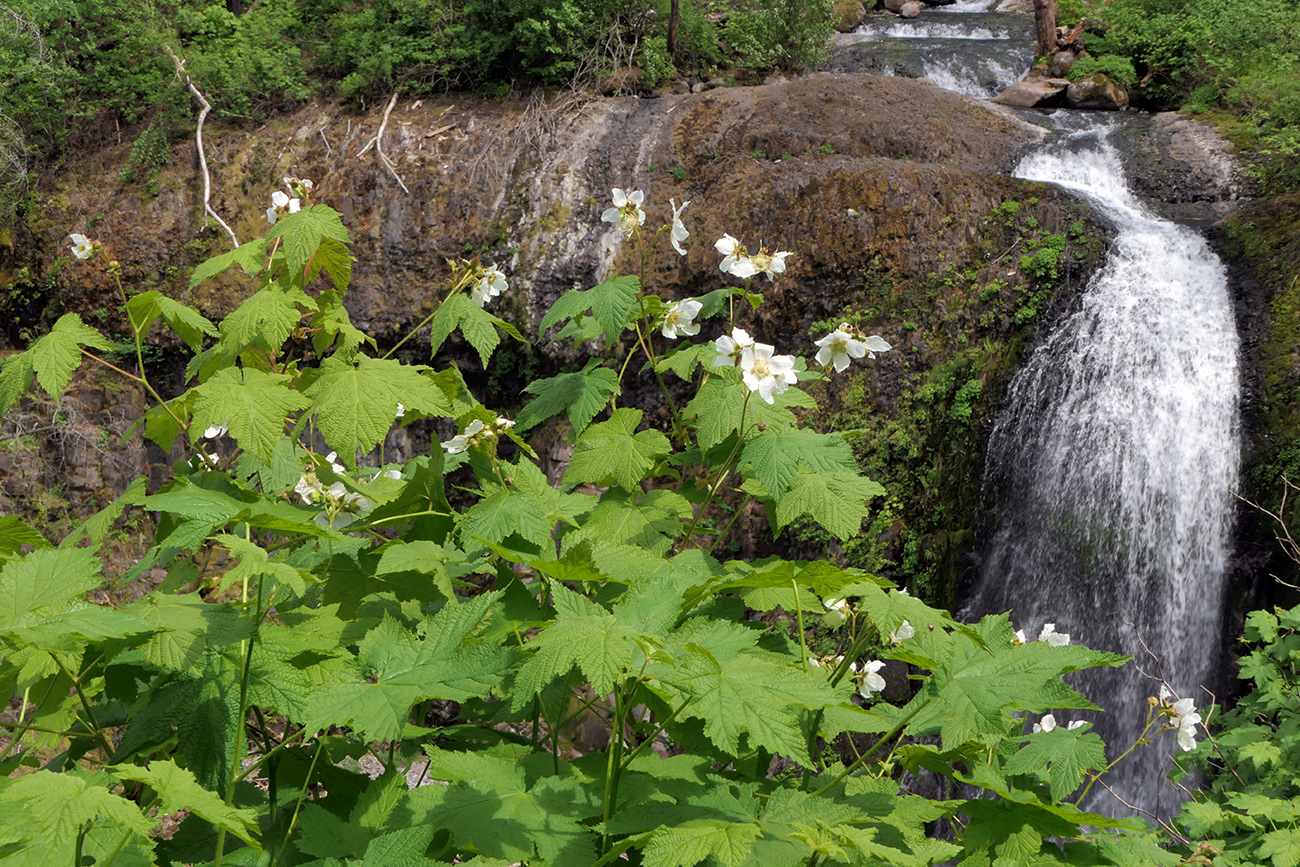
Thimbleberries blooming in front of McCord Creek Falls
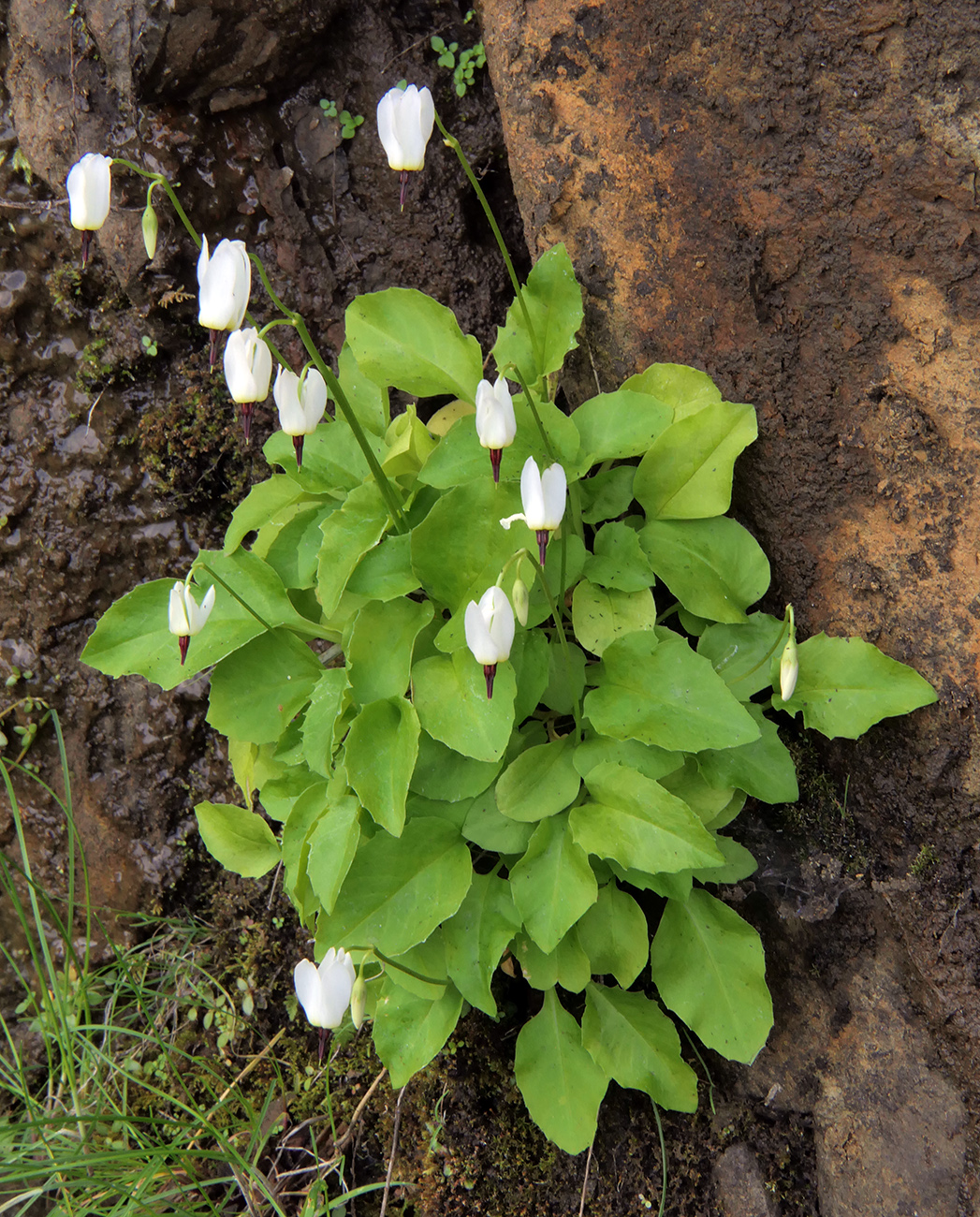
White shootingstar was in perfect bloom in the damp areas of the cliff.
My first visit to McCord Creek Falls was on a trip led by Russ Jolley, the author of the classic field guide, Wildflowers of the Columbia Gorge. It was way back in 1997, on a field trip organized by the now-defunct Emerald Chapter of the North American Rock Garden Society. I immediately fell in love with the place because part of the trail is cut into one of those amazing vertical cliffs that grace the Oregon side of the Columbia River Gorge. While I have a lot of favorites, plants that have adapted to survive the brutal conditions of life in rock crevices have to be my favorite favorites. You have to respect anything that tough. And the contrast of the colorfully flowered and delicate-looking plants with the hard and craggy rocks appeals to the artist in me. Over the next 13 years, I made the long trip north 10 more times. But somehow it just dropped off my radar. I guess I got too busy to drive all the way up there because my last trip there was in 2010 (see Late Bloom at McCord Creek Falls). Read the rest of this entry »
Exploring a New Wetland Near Hills Peak

There’s a good view of the long ridge of Hills Peak from the wetland.

As a result of its proximity to the High Cascades, the soil near Hills Peak has an abundance of pumice. This is the preferred substrate for Hall’s sedge (Carex halliana), which was growing in areas with few other plants.
On the east side of Hills Peak, which is at the east end of the Calapooyas, there’s an 80-acre logged area I’d never checked out before. There were hints of a couple of small ponds in aerial images but nothing that looked terribly interesting, especially when there are so many wonderful places close to the peak that I never have time to check them all out anyway. Every time Google Earth’s images are updated, they look a little different. The angle of lighting was different when I looked at the aerial images of Hills Peak this year. The new view showed what looked like a narrow strip of wetland snaking along the south edge of the disturbed area. Apparently the shadows of the mature forest obscured this in the past. With a major heat wave forecast for at least a week and the temperature “only” in the 90s in the Willamette Valley, I decided to go check it out on July 4th before it was too hot to go out at all. Poking around relatively level wetlands is about the only thing I can handle in heat. Read the rest of this entry »
Peak Flowers at Groundhog Mountain

The road banks along 2309 are about 1000′ lower than the highest section of the road, so the flowering season was much farther along. Lots of vibrant Oregon sunshine (Eriophyllum lanatum) and harsh paintbrush (Castilleja hispida) grew among the softer colored annuals, rosy plectritis (Plectritis congesta) and bluefield gilia (Gilia capitata).
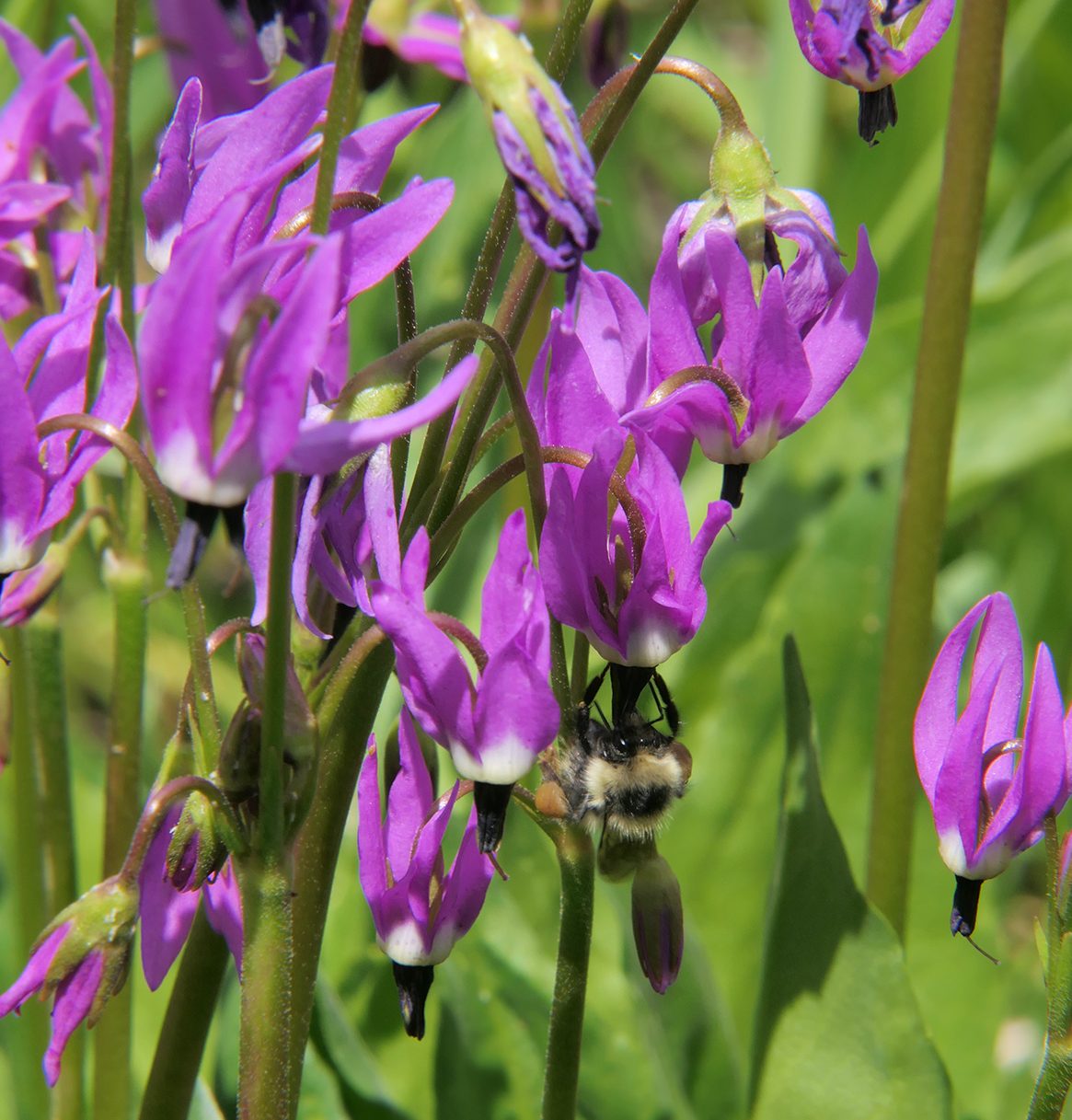
The reflexed petals of tall mountain shooting star are designed for bumblebees, and the bees are happy in any wetland filled with these beauties.
After we had such a great time at Groundhog Mountain and Logger Butte two years ago (see Wonderful Day at Groundhog Mountain and Logger Butte), NPSO buddies Dave Predeek and Alan Butler were as anxious as I was to get back up there this year. We all had the day free on June 30th, so Alan drove us up there for another excellent day of botanizing. As on the previous trip together, we headed up there from the north so we could pass by the floriferous roadcuts of Road 2309. They were still colorful, so we made multiple stops along the road. There was so much to see that Dave and I walked along the road while Alan moved the truck up the road a bit at a time. What a luxury to have someone else drive so I can focus on botanizing, taking photographs, and chasing butterflies! Read the rest of this entry »
Exploring Balm Mountain’s Slippery Slopes

The slope right below the lookout site is extremely steep and slippery. I didn’t even attempt going down there, although someday I think I might get to the bottom by following the trees down along the north edge. The tallest points in the distance are Mt. Thielsen and Mt. Bailey.

Great arctics have a two-year life cycle, so the adults tend to be abundant every other year. This year is an “off year,” but I’ve seen several this summer.
Balm Mountain, the highest point in the Calapooyas, has been one of my favorite places ever since I discovered it in 2010 (see First Exploration of Balm Mountain). Several times I’ve walked the trailless ridge between the old lookout at the north end and the high point at the south end, starting at both the north and south ends. What I’d never had time or energy to do was to head down the steep, gravelly slopes on the east side at the north end of the ridge. On July 18, I was on my own, so it seemed like a good time to see how much of this was traversable. Most of my friends either can’t or wouldn’t want to negotiate such a steep and unstable habitat, and I’d never ask them to. I also wanted to spend some time watching butterflies, which are particularly abundant in rocky areas of the Calapooyas when the mountain coyote mint (Monardella odoratissima) is in bloom; it had just been starting at Potter Mountain when I was there a couple of weeks earlier (see Finally Back to Potter Mountain). Read the rest of this entry »
Wonderful Day at Groundhog Mountain and Logger Butte

The rock formations of Logger Butte are quite stunning, and the many colorful wildflowers growing in the rocks make it even more special.

Dave admiring the cliff on the south side of Logger Butte.
Groundhog Mountain in southeastern Lane County has been one of my favorite botanizing sites for almost 20 years (over 40 trips so far!). Unfortunately, despite many roads leading up to the numerous wetlands and rocky spots, it has been getting more difficult to get up there, so my visits have been getting less frequent. From any direction, it’s 10 miles or more of gravel roads that have been deteriorating over time, and with no trails and no real logging of late, there has been no upkeep on the roads. So I was thrilled to get invited by Dave Predeek to go up there with him and Alan Butler, who also loves the area. Both are fellow members of the Native Plant Society of Oregon. Alan has a hefty truck and doesn’t mind driving—my kind of a guy! On July 15, Alan drove us up the northern route to Groundhog via Road 2309, the road I took for many years until I finally gave up on it when a deep gully developed in the middle of the road. I was really happy to see the gully seemed to have filled in on its own, and the road wasn’t as bad as the last time I’d driven. Not to say I would take my smaller car up that way yet, but it was passable for a sturdy, high-clearance vehicle. Read the rest of this entry »