Posts Tagged ‘Elk Camp’
Pollinators and Posies at Mistmaiden Meadow and Elk Camp

You can see the fading scintillae (metallic scales) on the hind wings of the beautiful lupine or acmon blue (very hard to tell apart!). Buckwheats are host plants for both of these species, and this female appeared to be laying eggs—curling her abdomen and pushing it into the northern buckwheat (Eriogonum compositum) inflorescence. I was unable to spot any eggs, however.

We stopped along Road 140 to look for butterflies. This has been a very reliable spot to find the gorgeous bramble hairstreak as there is a large population of their host food plant, big deervetch (Hosackia crassifolia). I was thrilled when Nancy finally spotted this fresh one.
On June 23, I made my third trip of the year to Mistmaiden Meadow, Elk Camp, and Nevergo Meadow, northwest of Oakridge. There’s just so much to see in this area between Saddleblanket and Sourgrass mountains, and none of it is too far from the road. Just wandering about rather than actually hiking is my favorite way to spend a relaxing day, part of the reason I return to this area so often. My previous trip (see Mistmaiden Meadow and Elk Camp Round 2) was 3 weeks earlier, so much had changed. This time, I was accompanied by Nancy Bray and Kate Shapiro. We had a very pleasant if uneventful day looking at plants and insects. Here are some photographic highlights. Read the rest of this entry »
Mistmaiden Meadow and Elk Camp Round 2
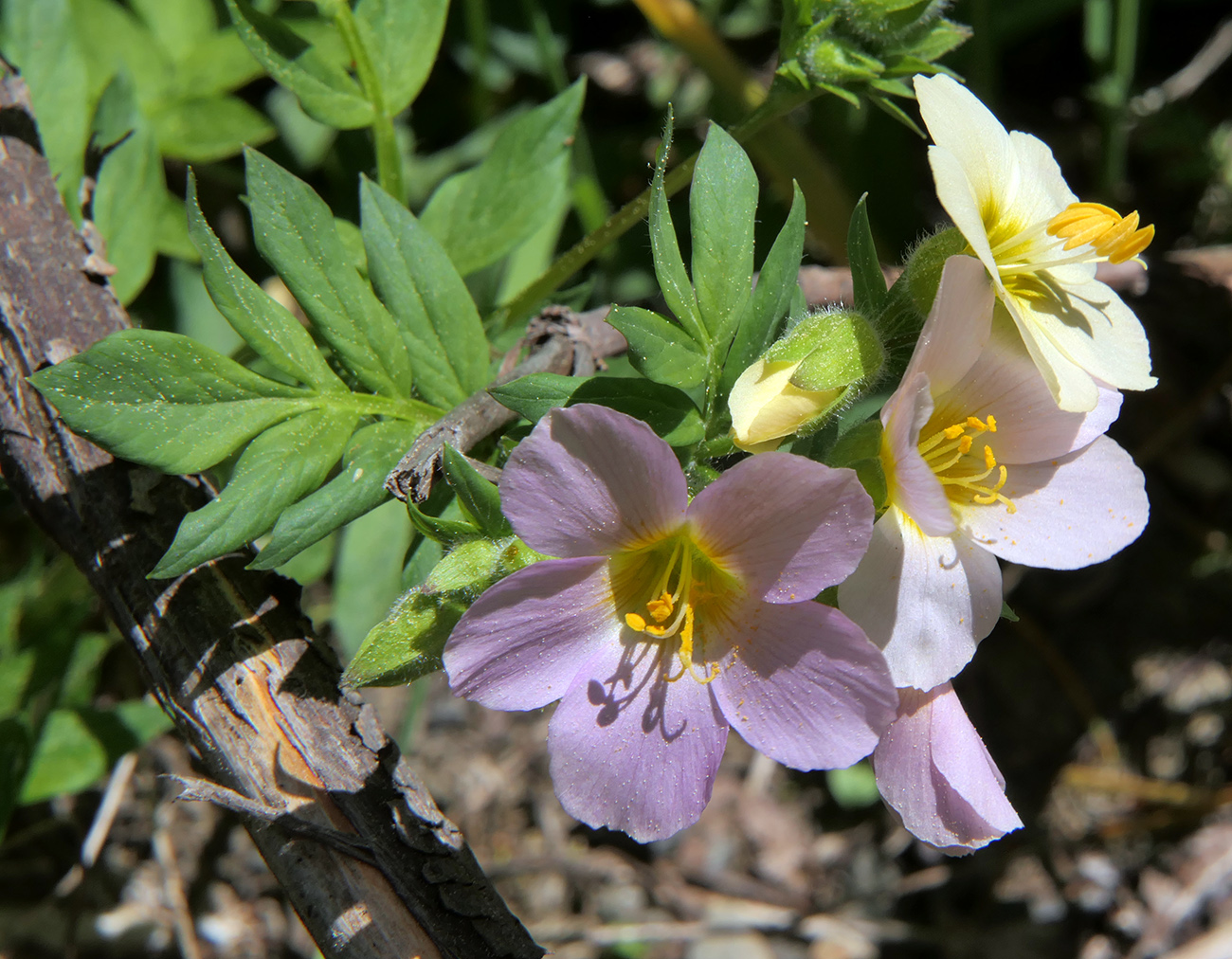
Without a doubt, one of the stars of the day was the gorgeous great polemonium (Polemonium carneum). It grows profusely at both Mistmaiden Meadow and Nevergo Meadow. While many polemoniums (also known as Jacob’s ladder) are in shades of blue, this species shifts from pale yellow through peach and lavender to pinky purple. You can see the progression in this photo from the yellowish bud to the pale yellow flower in the upper right, still fresh with undehisced stamens, to the pale purple flower in the middle with dehiscing stamens, and finally to the darker flowest in the front.
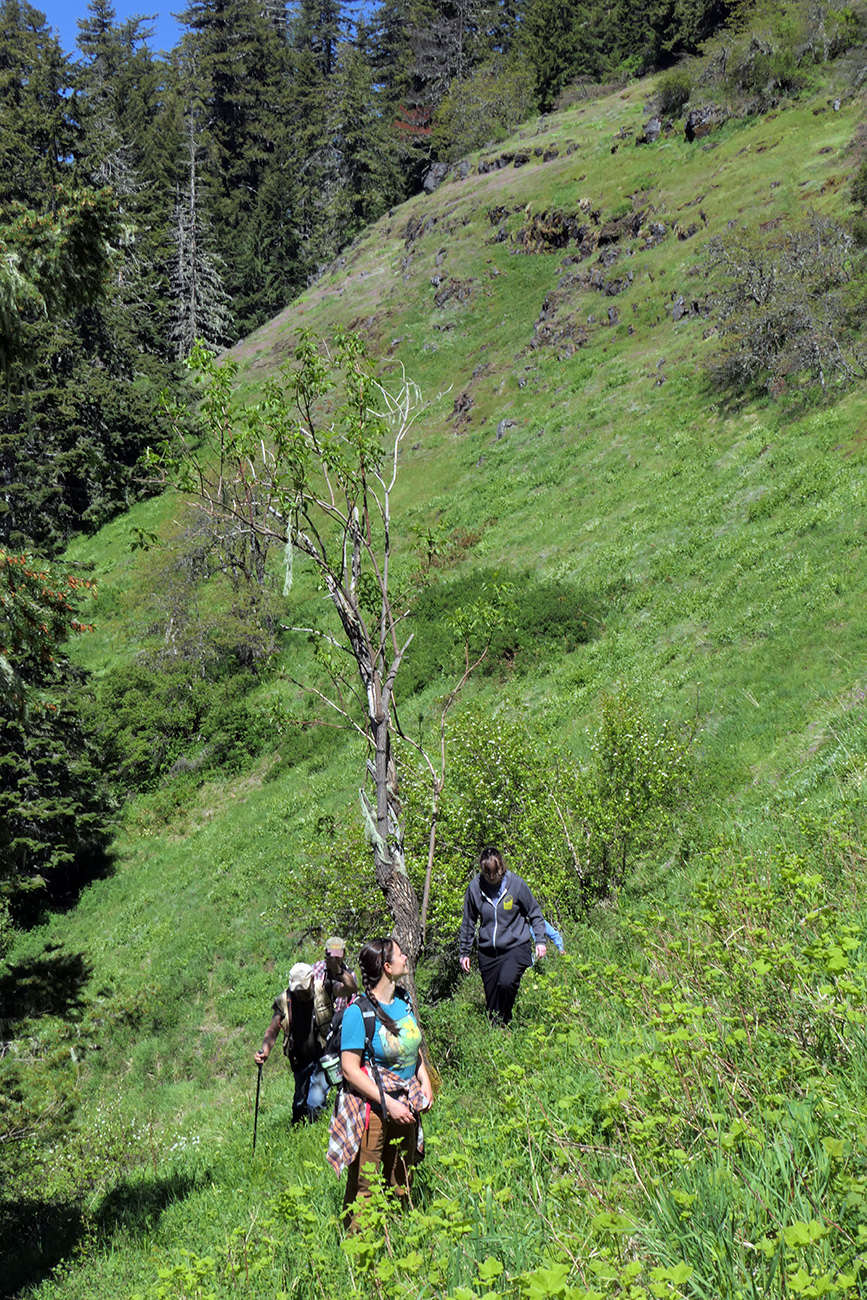
Traversing Mistmaiden Meadow
After successfully reaching Mistmaiden Meadow and Elk Camp and Nevergo Meadow the previous weekend (see last post, Early Spring Bloom Begins at Elk Camp and Mistmaiden Meadow), I felt comfortable inviting people who said they were interested in seeing Mistmaiden Meadow. So on May 31st, I was joined by Linda Hardison, my boss at OregonFlora, Denny Albert, an ecologist who has contributed to the Flora of Oregon, Leela Hickman, botanist in the district, and Sol Ziegert and his partner Hattie.
It was a beautiful sunny but cool day—perfect for a day of botanizing. Since Mistmaiden Meadow was what people were most interested in exploring, we went there first. It was lovely as always. The Thompson’s mistmaiden (Romanzoffia thompsonii) was finishing, but there was still enough to show everyone this adorable Cascade endemic. Better still, its lookalike, Nuttall’s saxifrage (Cascadia nuttallii) was now blooming, so we were able to look at them side by side. The rosy plecritis (Plectritis congesta) was coming along and starting to form swaths of pink in the meadow. Along with the annuals, perennials including western waterleaf (Hydrophyllum occidentale), Hooker’s fairybells (Prosartes hookeri), and fern-leaved biscuitroot (Lomatium dissectum) and shrubs like Douglas’ hawthorn (Crataegus gaylussacia) were in bloom. There was still plenty of moisture fueling the lush vegetation. Read the rest of this entry »
Fourth Trip of the Year to Mistmaiden Meadow

There were at least five large areas of narrowleaf mule’s ears in the lower half of Mistmaiden Meadow.

I was surprised to see three different blooming clumps of Oregon iris (Iris tenax) along Road 140. While very common at low elevations, this is only the second area I’ve ever found them above 3500′. In eastern Lane County, they usually give way to slender-tubed iris (I. chrysophylla) at about 1500′.
On July 7, I headed back up to the meadow on the west side of Sourgrass Mountain that I’m calling “Mistmaiden Meadow.” My first stop was the roadside along the east end of Road 140 with beargrass (Xerophyllum tenax) and other goodies because it had been an interesting spot on the previous trips. As I mentioned in the report on my last trip (see “Mistmaiden Meadow” Still Outstanding), there were a number of butterflies there, so I wanted to see what was flying about at this point. Once again, I saw several pretty bramble green hairstreaks. Also present were silver-spotted skippers and persius duskywings. What do these three butterflies have in common? They all use big deervetch (Hosackia crassifolia, formerly Lotus crassifolius) as a host food plant for their caterpillars. This species likes disturbed areas and is abundant along the road here. It appeared to be attracting a lot of other insects as well. Bumblebees were busy flying from one flower to the next. I found several caterpillars that did not look like butterflies munching through the leaves. New for me were some tiny and strange-looking lace bugs (Corythucha sp.), but they were so small my photos didn’t come out well enough to include. I wouldn’t have thought about planting something as large as big deervetch—and I’ve never seen it advertised by a nursery—but it seems this species is very popular with insects, and it isn’t unattractive, with its reddish flowers and glaucous leaves. Maybe I’ll collect some seeds on one of my return trips. Read the rest of this entry »
Shooting Stars are Stars of a Great Day

The population of the seep-loving beautiful shooting star was more gorgeous than I had imagined in “Mistmaiden Meadow.”

Did it just snow? Nuttall’s saxifrage coats the rocks at “Mistmaiden Meadow.”
I was really anxious to get back to the steep meadow on the east side of Sourgrass Mountain after my first trip of the season (see Early Look at Meadow on Sourgrass Mountain). Exactly two weeks after the first trip, on June 13, Sheila Klest and I went to see what was in bloom. We weren’t disappointed. It was even prettier than we expected. As soon as we stepped out into the upper part of the slope, we were greeted with a sweep of pink rosy plectritis (Plectritis congesta). There was much more moisture than there had been at nearby Tire Mountain the week before (see NPSO Annual Meeting Trip to Tire Mountain). Tire Mountain is known for similar drifts of color in wetter springs, but this year was rather disappointing. Here, however, the moisture from the above-normal snowpack on Sourgrass was trickling down to the meadow and keeping it fresh in spite of a month with little or no rain. Read the rest of this entry »
Exploring Two New Meadows

Looking east across the Saddleblanket Bald meadow, you can see the alder thicket following the water as it drains from the wetland uphill.
While planning a trip to collect seeds at Elk Camp and Nevergo Meadow, I was showing my husband where I was going on Google Earth and happened to notice what looked like a small natural meadow less than a mile west of Elk Camp. It wasn’t far from a road that once led to an old trailhead for Saddleblanket Mountain. I remembered it being gated the last time I drove by, but it was only a half-mile or so to walk if it was still closed. Intrigued, I decided I should add it to my trip. The following day, August 15, I headed up to Nevergo Meadow by my usual route, south from Big Fall Creek Road 18. After a short stop at Nevergo Meadow, I drove south on Road 142 past the trailhead that hooks into the Alpine Trail near the Elk Camp Shelter. It’s only another 1/3 mile to Road 143, which deadends after 0.6 miles. The gate was actually open, and the road was clear and in good shape. I found out later it had been opened and brushed to use as a fire break. Thankfully last year’s Gales Fire never made it over to this area, though I passed burned trees on the drive up farther north. Read the rest of this entry »