Posts Tagged ‘Douglasia’
Very Early Trip to Groundhog Mountain Area
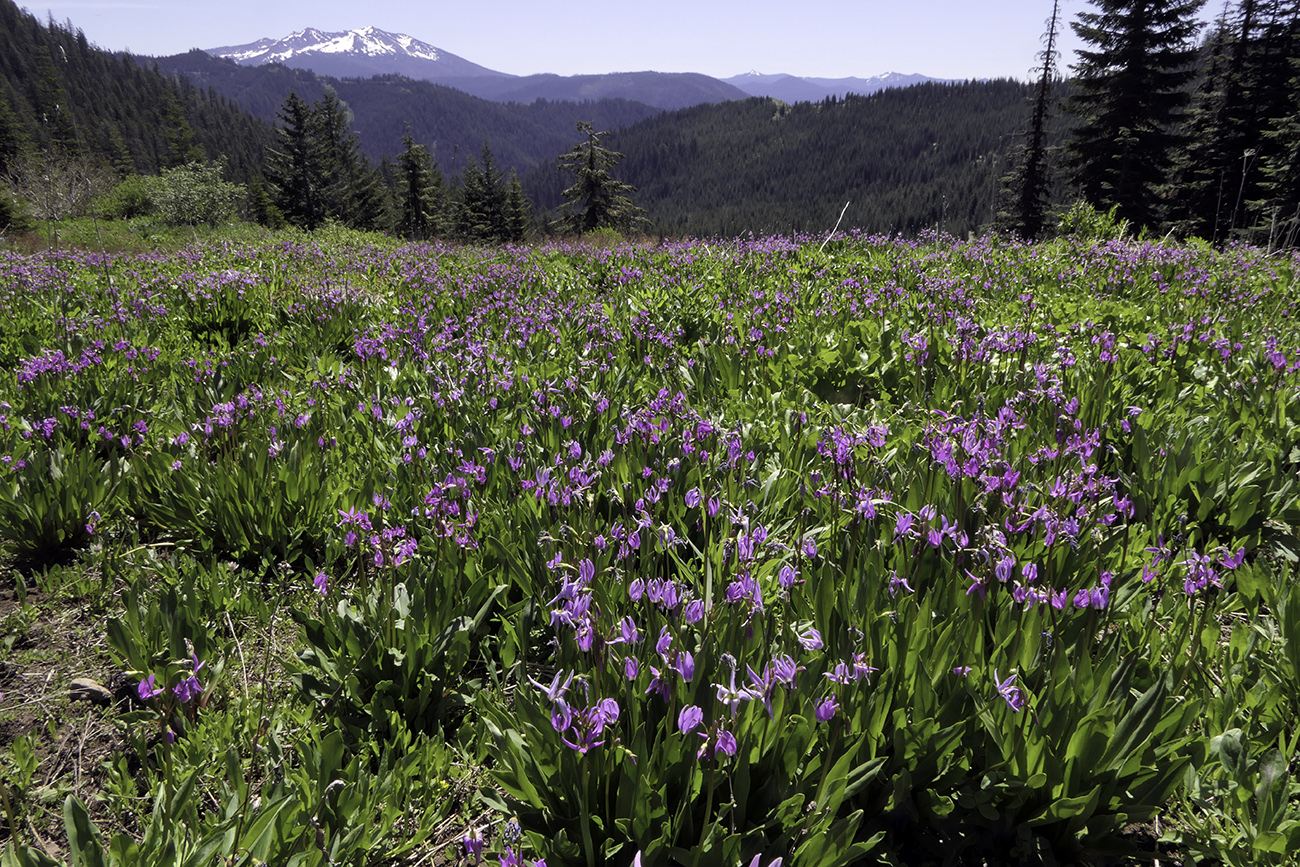
Not much snow for late May on the west side of Diamond Peak. The mountain shooting star (Dodecatheon [Primula] jeffreyi) was putting on quite a show.
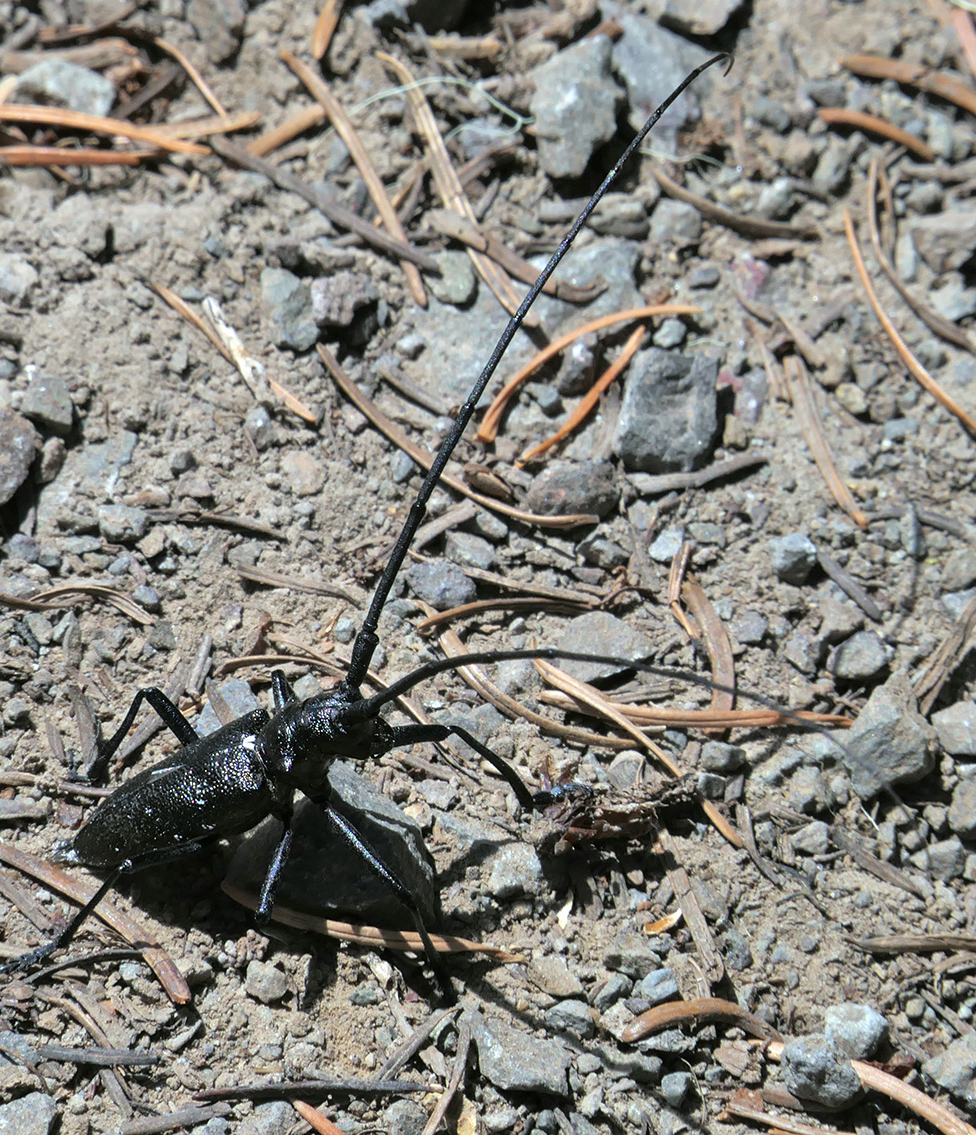
The long antennae of this large white-spotted sawyer beetle (Monochamus scutellatus) caught everyone’s eye on the road to Logger Butte. Apparently this wood-boring beetle doesn’t really bite, but it can grip hard if you’re trying to get it off you.
On May 24th, I headed up to Groundhog Mountain with Alan Butler, Dave Predeek, and Hannah English. It was only the second time I’d ever been up there in May as it is usually snowed in until at least mid-June. Dave and I had also come on May 24th way back in 2015 (see Two Foggy Outings)—after the only other winter since I moved here over 30 years ago when there was no snowpack in the Western Cascades.
We came in from the north via Road 2309 to see the roadcut flowers. It was already drying out there—with no snowpack, it is a very early year indeed. We made a number of our usual stops to Waterdog Lake, Logger Butte, Road 452, the pond just north of Logger Butte, and we also drove all the way up the west side of Groundhog to see the cliffs at the north end (in Alan’s high-clearance truck—I wouldn’t do that in my car!). Here are some highlights of a very pleasant day with other nature lovers observing flowers and insects. Read the rest of this entry »
Glorious Day at the Summit of Cone Peak

The steepest part of the 700′ climb up to the summit from the trail is when you’re almost at the top. But you want to go slowly to look at all the flowers anyway.
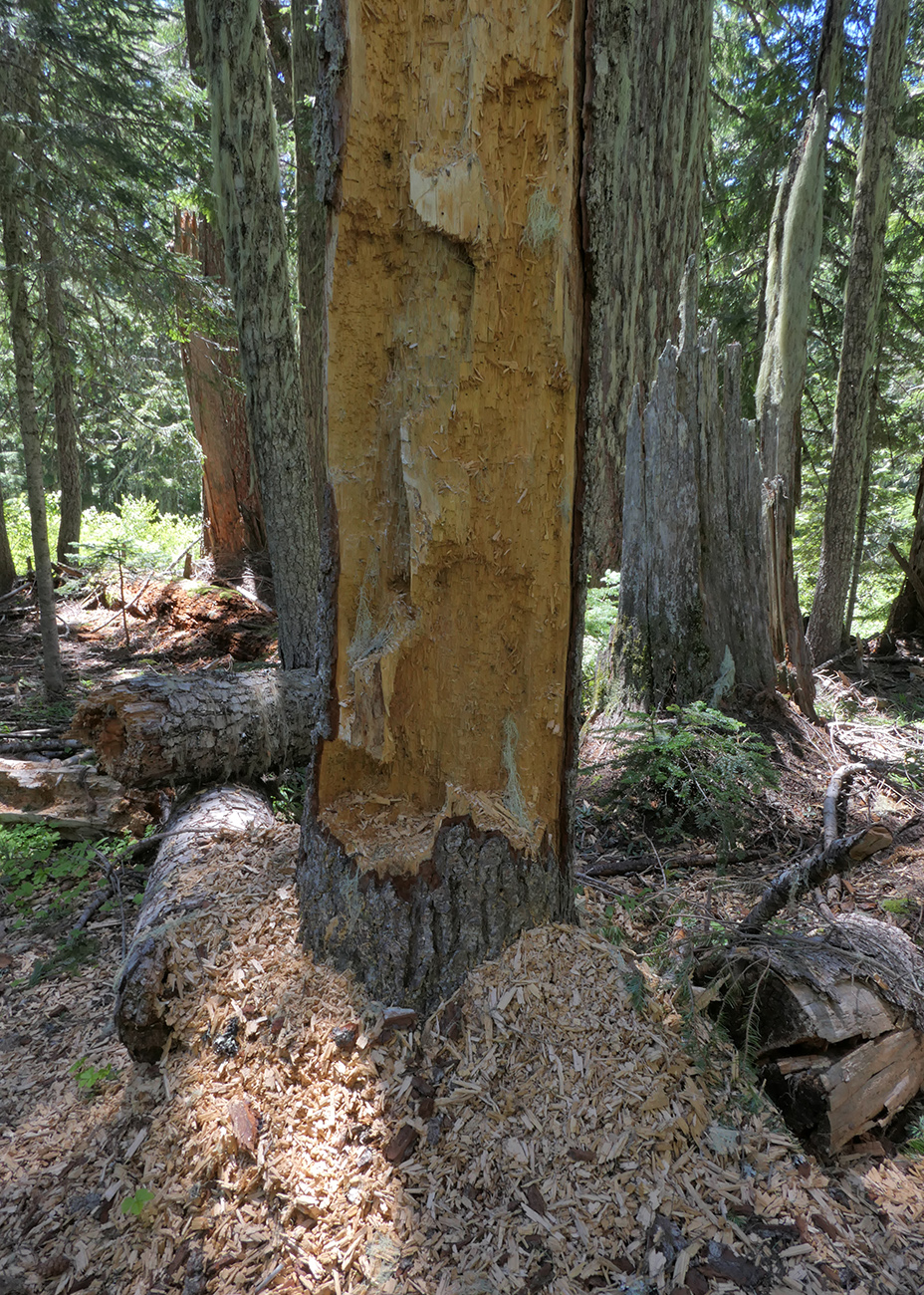
Sheila and I were intrigued by this dead tree. Pileated woodpeckers commonly make rectangular-shaped holes in dead trees, and there were some higher up, but I’ve never seen them carve up a tree so thoroughly. We thought it looked like a totem pole. You can see the huge pile of wood chips at the base. There was a smaller one on the other side of the trail.
Sheila Klest and I had planned to go to Cone Peak the previous week, but I had to cancel at the last moment after barely sleeping the night before. Even if I could have handled the long drive and hike, I wouldn’t have enjoyed it on two hours of sleep. It’s tough finding a time when Sheila can get away from her native plant nursery, Trillium Gardens, so I was relieved she was able to reschedule to go up there with me on Thursday, June 13. Coincidentally, that the was the exact date and day of our previous trip (see A Rainbow of Colors at Cone Peak and Iron Mountain), but we hadn’t made it to the summit that time, and the bloom season was a little farther ahead of this year.
I had wanted to get up there as early as possible to see the first flowers while there were still a few snow banks left. My early-season trip with Sabine Dutoit back in 2008 (see Top of Cone Peak Starting to Bloom) is still one of my favorite experiences. While it was later in June, that was an above-average snow year, so we walked over snow drifts with snowmelt species blooming in the newly bare spots to get to the top of Cone Peak where the bloom was gorgeous. What makes Cone Peak such a great place to see very early flowers is that you can hike from a paved road that is cleared of snow in June. Most of my other high-elevation spots require going up long gravel roads, so the earliest plants are often done before the roads are clear of snow and downed trees. Read the rest of this entry »
Two Foggy Outings
I’m a fairweather hiker and usually avoid going out on days without a good amount of sun. But sometimes it happens. On both of my last two outings, I ended up spending most of the day literally in the clouds. I don’t take anywhere near the number of photos I usually do, but I thought I’d share a few.
Bristow Prairie, 5/15/15
Molly Juillerat, Middle Fork NF district botanist, and her dog Ruby and I made the same trip John Koenig and I had done a couple of weeks before (see Bristow Prairie: 2015 Trip 2), but the low clouds gave the area a distinctly different mood. From a scientific standpoint (not from one of comfort!), it was interesting to see how much moisture the plants received without any actual rain.

Low clouds dancing around below the road at Bristow Prairie
Successful Return to Groundhog’s North Cliff

This smooth douglasia (Douglasia laevigata), on the right side of this photo, clearly bloomed quite well, but, unfortunately for me, that was several weeks ago. It was growing in an exposed spot near the top of the cliff. Wolf Mountain can be seen not so far away in the top center of the photo. Fuji Mountain is behind it just to the left.
Ever since I discovered the most southerly population of Douglasia laevigata on Groundhog Mountain in the fall of 2010 (see Exciting Cliff at Groundhog Mountain), I’ve been wanting to get back to see the hidden cliff on the north end in bloom. The deep snow pack last year discouraged me from even trying, as the cliff plants would have been quite far along before the north-facing road melted out, and Douglasia is a very early bloomer. Two weeks ago I decided to give it a try, but, alas, I ran into snow before the turn onto Road 451 to Waterdog Lake, so I cut over to Moon Point instead (see Butterflies, Currants, Shooting Stars, and More). Yesterday (July 2), I was pretty confident I could get over to the west side of Groundhog, and I hoped that there might be at least of few flowers left on the Douglasia. Sabine Dutoit and Ingrid Ford and her sweet dog Bogy joined me. Read the rest of this entry »
Exciting Cliff at Groundhog Mountain
I hadn’t expected any excitement when Sabine and I headed up to Groundhog Mountain yesterday (October 1). Earlier in the week, I had hurt my foot (no, not while bushwhacking over logs or climbing up a talus slope—I stepped wrong on my carpeted stairs!). I had planned to go to Olallie Mountain, but I was too unsure of my foot to risk hiking seven miles. At Groundhog, I could enjoy a relaxing day of roadside botanizing, and if my foot gave out again, I wouldn’t be too far from the car. I had no real agenda other than enjoying the sunshine (the fog didn’t lift until late afternoon at home) and spending a few more days in the mountains before winter.

Out in the sun, these creeping snowberries (Symphoricarpos mollis) have far more berries than usual. The view west is terrific, with a little fog visible in the Valley.
We headed straight for Waterdog Lake. Today is the first day of gun hunting season, and there were already several hunters camping by the lake. They turned out to be very friendly and came over to see what we were doing on our hands and knees on the ground. I thought this might pique their curiosity. We were looking for the remnants of the tiny Botrychium simplex that Molly Juillerat and I had found back in August (see Awesome Day at Groundhog). There were only a few withering yellow leaves left. In contrast, the much larger Botrychium multifidum, a few hundred feet to the north, were sporing and had large, handsome green leaves. Dozens of little Boreal toads were hopping around throughout the area, still dispersing from the massive congregation in the lake in August. Read the rest of this entry »
Top of Cone Peak Starting to Bloom
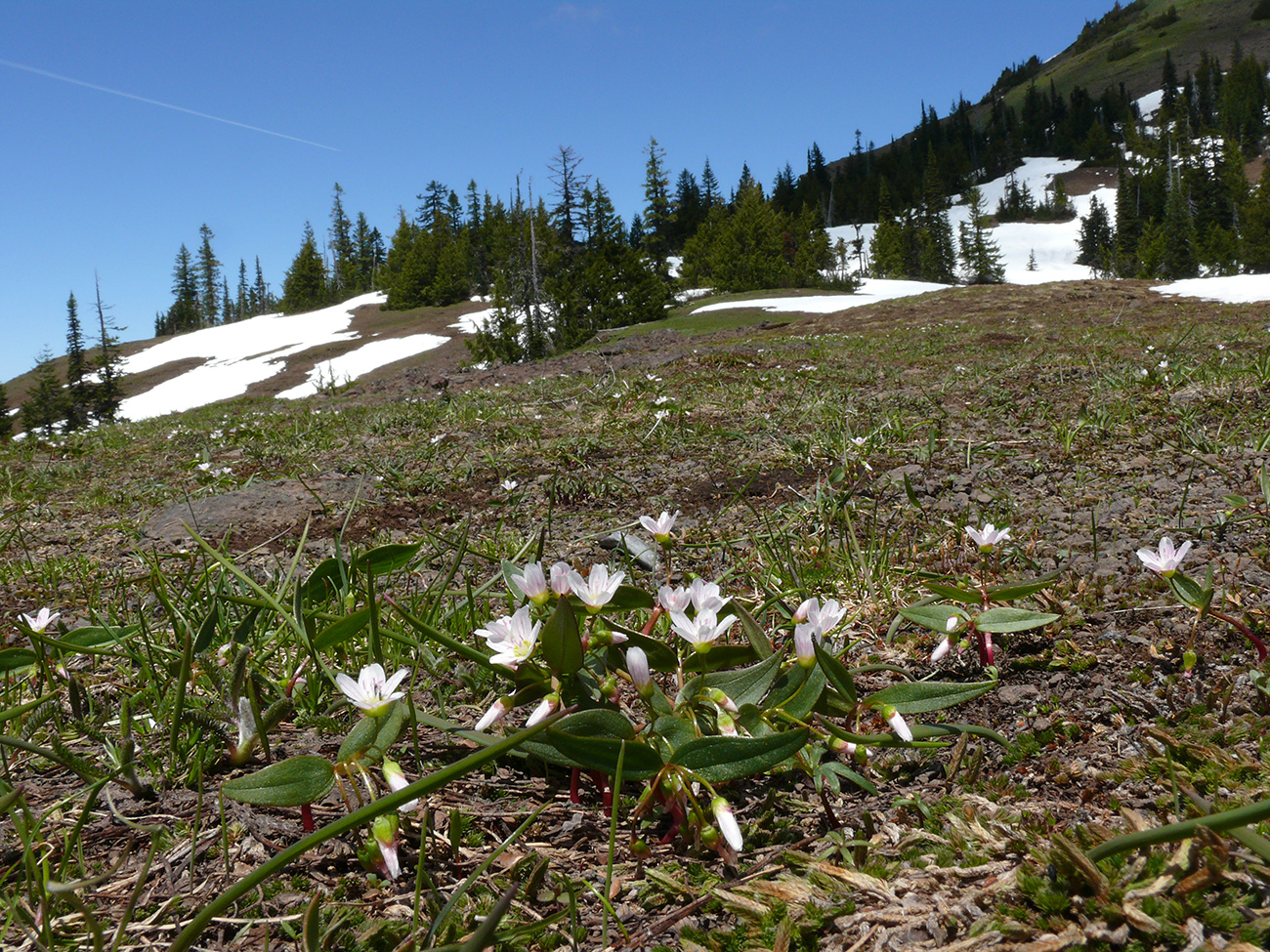
Western springbeauty blooms as the snow melts.

Beautiful shooting star (Dodecatheon pulchellum)
I thought you might be interested in what Sabine Dutoit and I found at Cone Peak yesterday. Not surprisingly, things are way behind. There’s quite a bit more snow than when I was there on either 6/3/06 and 5/24/04. I’d say it’s 4 weeks or more behind the last few years. Almost everywhere I’ve been able to get to so far is 3–4 weeks behind. There was a lot of snow right at the beginning of the trail, but we could see the top was open, so we figured we’d give it a try. The trail cleared off shortly, but then, before the series of switchbacks, we ran into lots of snow again and lost the trail. We just headed for the top across the snow and eventually got right up to the main meadow and the trail, which were half open and covered with Western springbeauty (Claytonia lanceolata). Then we crossed a bit more snow right at the base of the trail and were all clear from then on.