Posts Tagged ‘bird’
Butterflies at Patterson Mountain
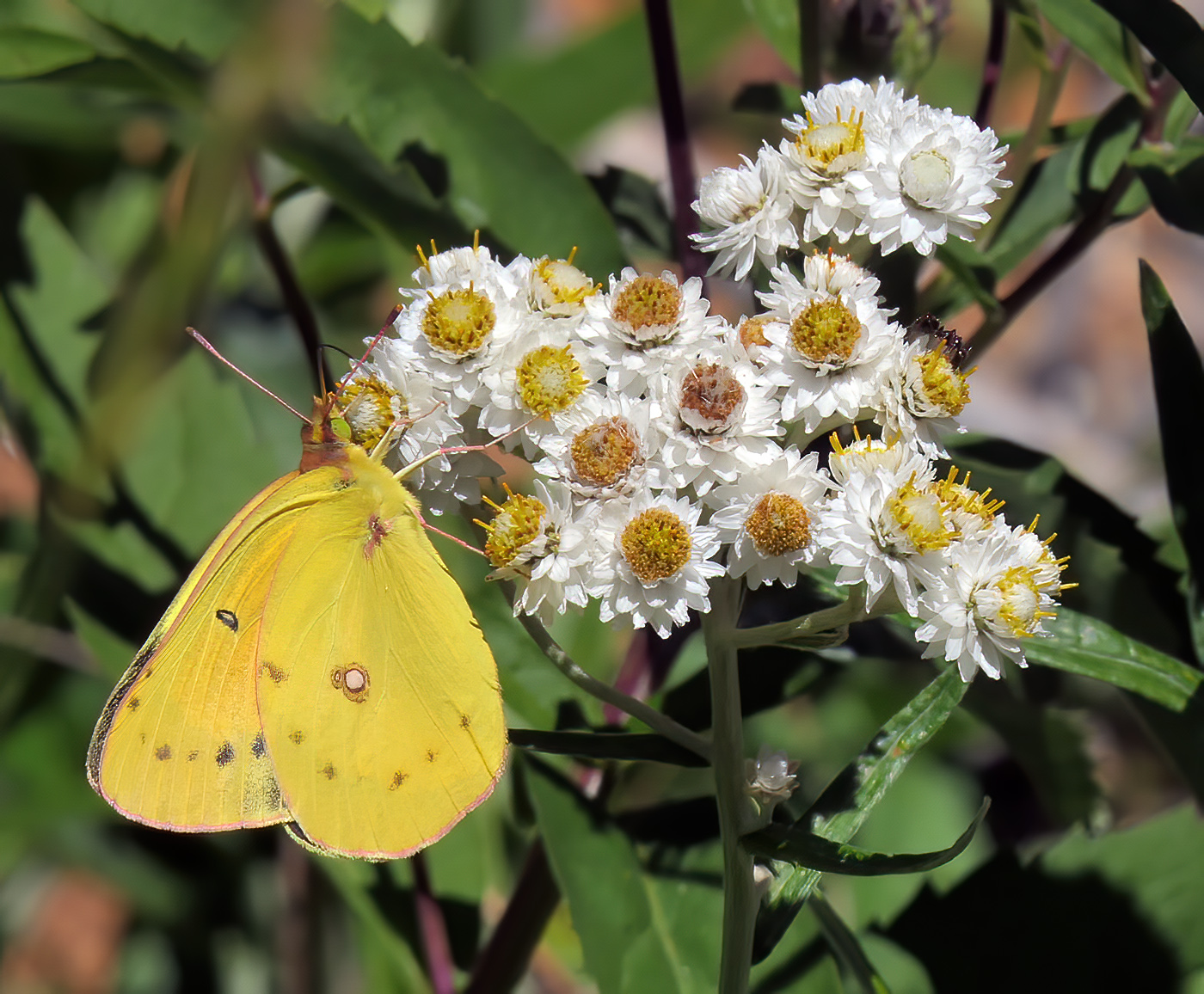
Orange sulphurs hardly ever sit long enough for me to get a good photo, and when they do, they never open their wings. I watched several nectaring on pearly everlasting (Anaphalis margaritacea) in one of the side meadows near the summit. It occurred to me that if I could record a video while they flew, I might actually be able to get a decent look at their bright orange dorsal side. You can see this in the slowed down (~1/7 speed) video below. This sulphur was accompanied by a couple of Edith’s coppers and what looks like some kind of a fly.

A clodius parnassian drinking from a mountain thistle (Cirsium remotifolium)
On July 22, I went up to Patterson Mountain in hopes of collecting seed of one of my favorite native plants, great polemonium (Polemonium carneum). It grows in abundance on the south side of the mountain, well off the trail. There is also a smaller population growing on the edge of the meadow near the Lone Wolf Shelter. My timing was good, and I came home with enough polemonium seed to share. I also found seeds of Scouler’s valerian (Valeriana sitchenis var. scouleri), another native that is growing well for me. Nothing particularly exciting happened, but I did enjoy watching butterflies, so I thought I’d share some photos and a video.
Collecting for the Annual Wildflower Show

There was plenty of water in Staley Creek, fueled by melting snow from the Calapooya Mountains above. After such a dry spring, however, the rocks and meadow areas were quite dry. Still, the rosy plectritis (Plectritis congesta) was blooming well, and we saw other annuals like the large-flowered blue-eyed Mary (Collinsia grandiflora) to its left.
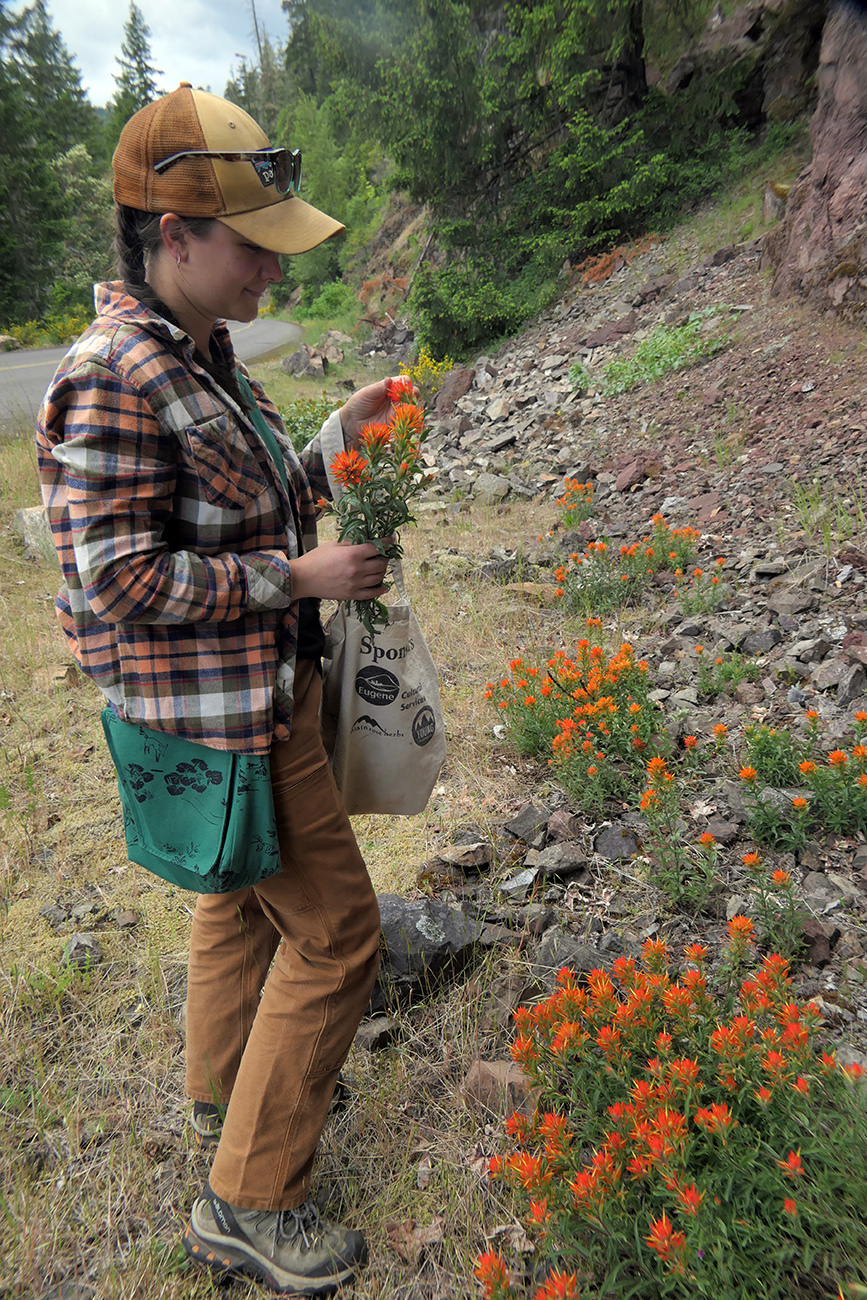
Leela collected a few of the abundant paintbrush along the side of Hills Creek Reservoir. We looked at the wide degree of variation between plants. While most are undoubtedly the common harsh paintbrush (Castilleja hispida) with its wide well-lobed leaf blades, there were quite a number with narrower leaves and no lobes at all. They also had pointier calyx teeth than typical C. hispida. These may be hybrids of frosted paintbrush (C. pruinosa), more common in the area at higher elevations.
The 46th Annual Mount Pisgah Arboretum Wildflower Festival was on May 18th this year. On Friday, May 16th, I accompanied Leela Hickman on a trip to the Rigdon area south of Oakridge to collect for the wildflower show, a joint project of the Emerald Chapter of the Native Plant Society of Oregon and the botany department at Lane Community College. With the current state of chaos in the government, Leela is now the only botanist in the Middle Fork District of the Willamette National Forest. In fact, she’s one of only a few botanists left in Willamette National Forest. It’s a sorry state of affairs, but don’t get me started….
It was a very pleasant day, though somewhat cloudy, so there weren’t many butterflies. We found a number of interesting plants I hoped might be in bloom that weren’t normally displayed at the show, including Marshall’s saxifrage (Micranthes marshallii), Rattan’s blue-eyed Mary (Collinsia rattanii), Howell’s violet (Viola howellii), many-stemmed sedge (Carex multicaulis), field pussytoes (Antennaria howellii), and the easily overlooked slender woolly-heads (Psilocarphus tenellus). I also got to show Leela some special spots in the district. She was all prepared with containers, water, and a cooler to store them in so they would still look good a couple of days later. Read the rest of this entry »
Butterfly Day at Moon Point and Warner Mountain

The best view of the striking Moon Point rock feature is from along Road 2129 on the drive back down when the sun highlights it in the late afternoon.

A friendly (northwestern?) fritillary found my pant leg to be quite the treat.
During the long heat wave this July, Nancy Bray and I were looking for someplace easy to go on July 12th. It was one of the slightly cooler days when we figured we could handle being outside all day at higher elevation, but we didn’t want to work too hard. We headed up Road 2129 south of Oakridge and Hills Creek Reservoir.
Our first stop was to the Youngs Rock trail, where I spent an hour or so collecting seeds of spring gold (Lomatium utriculatum) in the first few meadows, while it was still relatively cool. I was also able to get seeds of my favorite annual clover, branched Indian clover (Trifolium dichotomum), as well as smallhead clover and tomcat clover (T. microcephalum and T. willdenovii). The latter two have germinated and bloomed successfully in my meadow, but I’ve been hoping to try the less common branched Indian clover for a while. I’ll be crossing my fingers and looking for its pretty purple, lavender, and white flowers next spring. Read the rest of this entry »
Baby Insects in the Rigdon Area

I believe this interesting insect is the nymph of a bush katydid. It looks like it might have just molted as you can see an empty shell under the flower of snapdragon skullcap (Scutellaria antirrhinoides). It sure is cute!

A hairstreak caterpillar wrapped around the fruit of rose checkermallow.
Low elevation seeds were starting to ripen, and the weather was still cool (little did I know then how hot it would get!), so on June 24th, I decided to spend a day collecting seeds around the Rigdon area of southeastern Lane County. I had vague plans of the favorite places I wanted to stop by but ended up changing my plans all day. I had planned to head straight south of Hills Creek Reservoir, but as I left Oakridge, I remembered that the stretch of roadside meadows along the north end of the lake (east of the dam, less than 2 miles on Road 23) was the only easy place in the area to get silver lupine (Lupinus albifrons) seeds. When I arrived there, they were mostly gone, but the seeds (technically mericarps) of rose checkermallow (Sidalcea asprella [malviflora] ssp. virgata) were ripe and abundant. That reminded me I had seen caterpillars on them in the past. Once I started looking, I spotted at least 9 greenish to pink slug-like caterpillars—most likely those of gray hairstreaks. A great start to the day! Read the rest of this entry »
Thinking About Climate Change at Youngs Rock

The north side of Youngs Rock is hard to get close to. Although there’s no talus, the slope is still quite steep and slippery, and the rock outcrops are not all stable. It reminds me of a Japanese garden. With binoculars, I could see lots of blooming Oregon fawn-lilies and a single cliff paintbrush, but I didn’t feel comfortable trying to get close to them like I did when I first started coming here.

The south side of the rock is really craggy and supports many interesting plants in its cracks. It’s open but also really hard to get up close to because of the slippery and steep talus at its base. Better have binoculars!
On May 26, Lauren Meyer and I spent a beautiful day hiking up to Youngs Rock. It was sunny but only in the low 70s—pretty much perfect. In my work for the Flora of Oregon, I had just read through a draft copy of a chapter on climate change that will be part of the third and final volume of the flora. I couldn’t help but look at what we saw along the trail through the lens of climate change. We discussed it quite a bit as well. The Youngs Rock trail follows a south-facing ridge in the Rigdon area of southeastern Lane County. We hiked the middle stretch—my favorite part through a string of meadows—from about 3100′ to Youngs Rock itself, an impressive pillar rock, at about 4500′. There are a number of plants here that are near the most northerly edge of their range. These include whisker brush (Leptosiphon ciliatus), ground rose (Rosa spithamea), birdbeak (Cordylanthus sp., I’m still unsure how to distinguish the species), and many-stemmed sedge (Carex multicaulis). I’d only discovered the latter a couple of years ago (see Back to Lower Meadows of Youngs Rock) and was surprised at how much more there was along the lower stretches of the trail. I’ll admit I don’t spend much time on graminoids, and this sedge looks more like a rush (Juncus spp.) than a sedge. Farther up the trail, where we didn’t go on this trip, is the most northerly site (so far) for galium broomrape (Aphyllon epigalium). With the caveat that I’m not a scientist, I would think these meadows might adapt to climate change fairly well and could even become home to more species adapted to the hotter regions to the south, though I suspect blooming periods might move up. Read the rest of this entry »
Long-awaited Return to Mosaic Rock

The more-or-less east end of the rock above the road.

I spotted a small area of spring phacelia at Mosaic Rock. This is a new site for this easily overlooked species, which is only found in Douglas and southern Lane counties.
My husband isn’t excited about little plants the way I am, and waiting for me while I try to photograph butterflies isn’t his favorite way to spend the day either. So we don’t hike together all that often. But he does really like rocks, and I’d been wanting to take him to the amazing rock formation in the Rigdon area that Sabine and I named “Mosaic Rock” (43.4808°N, -122.4539°W) back in 2011 (see Amazing Rock Feature Worthy of a Name). It’s a magnificent example of columnar jointing, and the cracks provide a foothold for several special cliff-loving plants, including cliff penstemon (Penstemon rupicola) and Merriam’s alumroot (Heuchera merriamii). It’s several hundred feet high in places, about 1400′ long and less than 200′ wide, and reminds me of a giant that looks like a flying saucer or frisbee that crashed into the ground on its edge. While I had driven by it many times in the last decade since you pass under it on the way up to Bristow Prairie, I hadn’t explored the rock itself since that first trip. We finally made it there on May 20, on a perfect sunny but cool day. Read the rest of this entry »
First Botanizing Trip of 2024
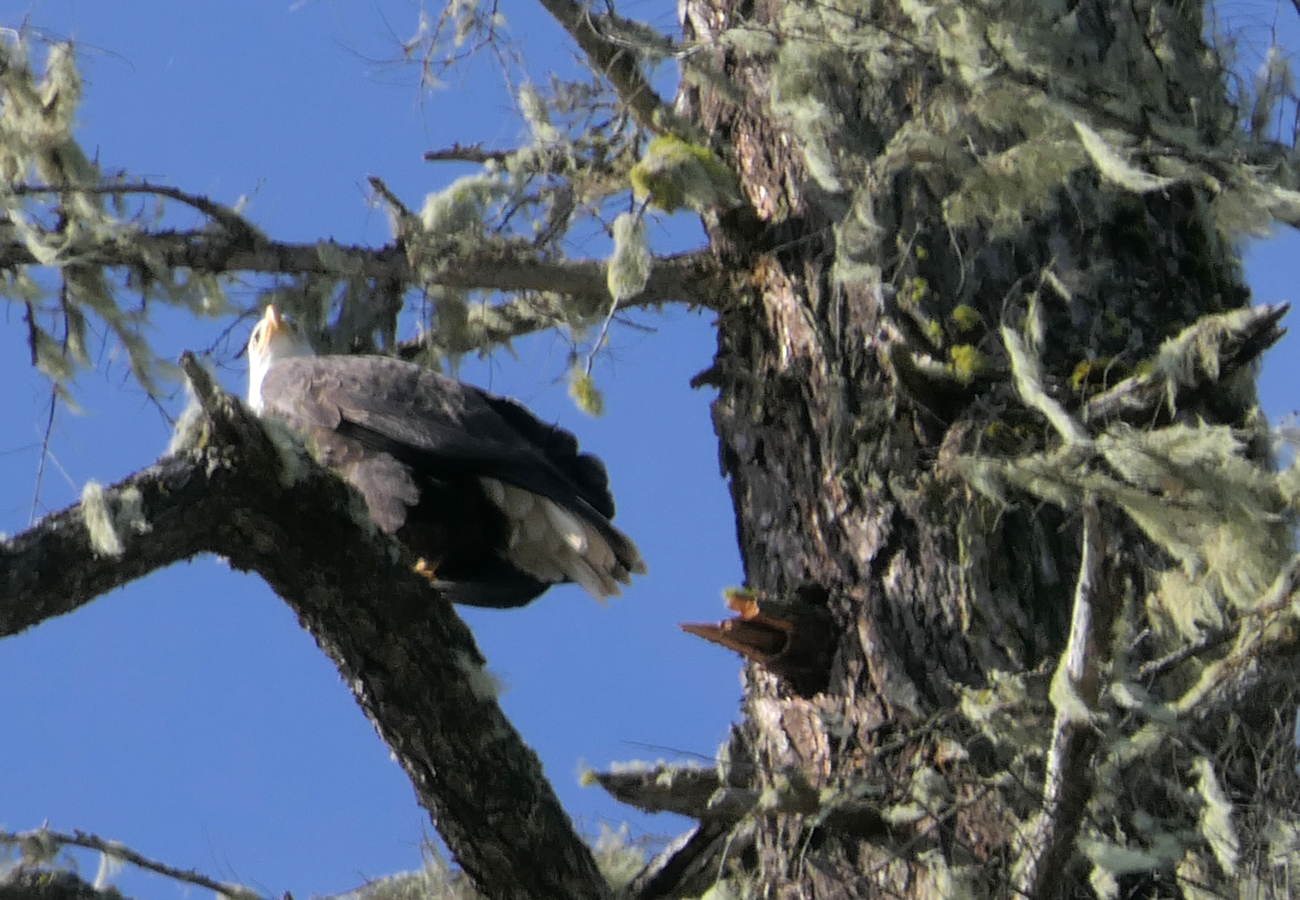
While looking at the flowers on the cliffs, Lauren spotted a bald eagle sitting in a dead tree above us!
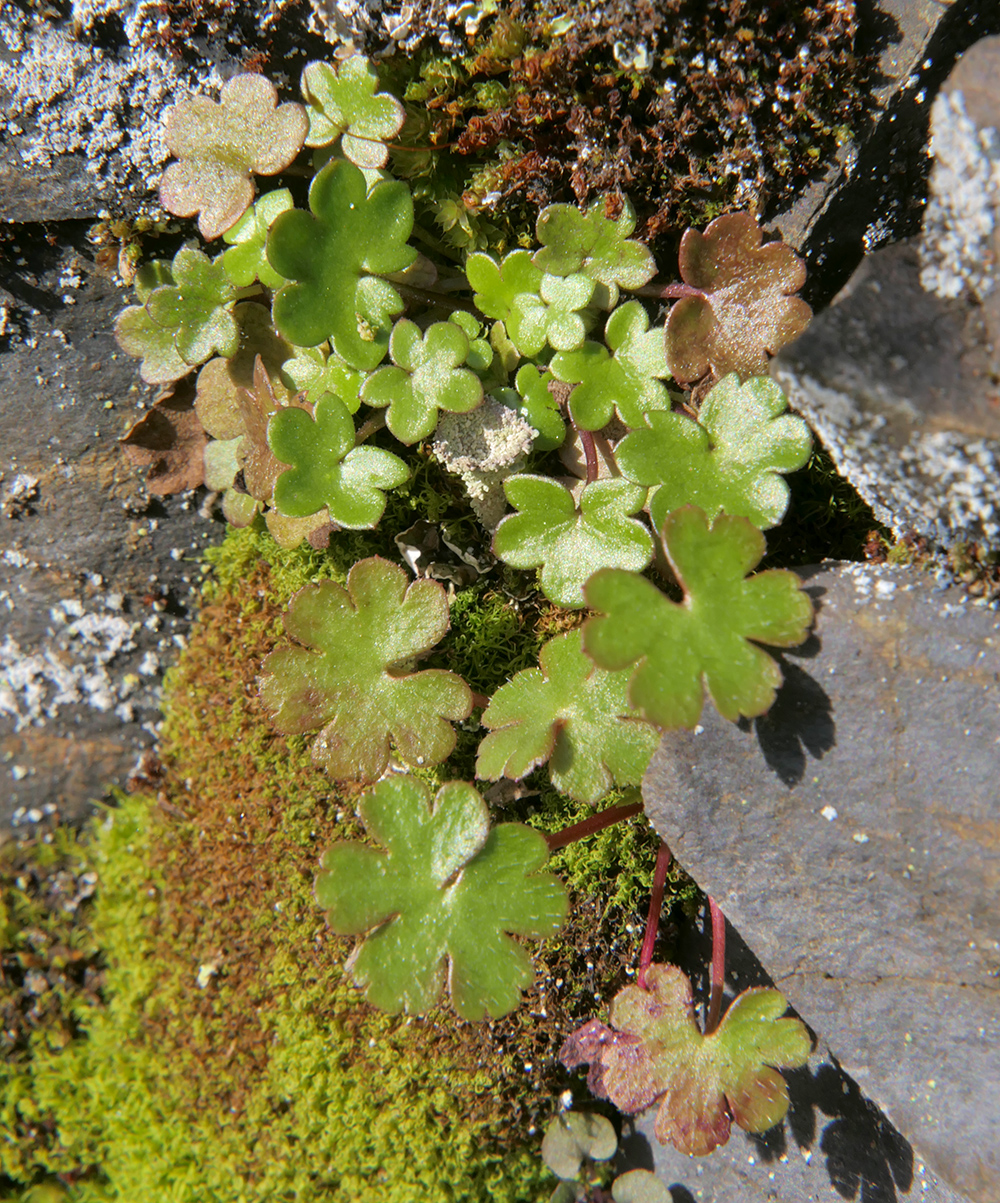
Sadly, the population of shining geranium (Geranium lucidum) at the base of the cliffs near milepost 7 is starting to spread up onto the rocks despite attempts to remove it. Here you can see how similar the geranium leaves (bottom) are to the lovely native California mistmaiden (Romanzoffia californica, top) that grows abundantly there. I tried to at least pull out the ones on the cliff so no one else would accidentally pull the mistmaiden. We looked carefully at the leaves and noted good distinguishing marks are the small tips on the lobes of the glabrous mistmaiden leaves vs. rounded lobes on the slightly hairy leaves of the geranium.
As is my tradition, my first botanizing of the year was to Hills Creek Reservoir south of Oakridge on March 17th. It’s such a relaxing way to start the year. I was joined by fellow Native Plant Society of Oregon (NPSO) members Nancy Bray and Lauren Meyer. We made a number of stops along Road 21 as far as Big Pine Opening across from the bridge that leads to Coal Creek and Staley Creek roads. It didn’t seem worth going any farther as there were still patches of snow in the ditches. Lots of snow up higher as well. It was a lovely warm day, however, and we enjoyed the beautiful gold stars (Crocidium multicaule) and other early flowers. And while not abundant, we did see four species of butterflies: California tortoiseshells, unidentified blues, an anglewing, and a mourning cloak. Seeing butterflies always starts my spring fever. Here are some photos of our (mostly) pleasant day. Read the rest of this entry »
Dodder at Patterson Mountain

The meadow by the Lone Wolf Shelter was quite pretty with lots of scarlet paintbrush (Castilleja miniata) and celery-leaved lovage (Ligusticum apiifolium), but the smoke was unpleasant, so I didn’t stay long. Weeks later, this little smoke would have seemed like a good day!

A tangle of mountain dodder in the rocky meadow at Patterson Mountain
On Sunday, July 23, I left the house planning to head back up to “Mistmaiden Meadow” for my fifth every-other-week-or-so survey. As I headed toward Lowell, something looked terribly wrong. I could see an ominous bank of gray smoke to the east. I stopped to call my husband to see if he could find out where it was coming from—I don’t have a data plan on my phone, so I couldn’t check that way. It turns out the Bedrock Fire had started the afternoon before by the Bedrock Campground along Big Fall Creek Road 18. Obviously, I didn’t want to go anywhere near the fire, so Mistmaiden Meadow was out of the question. I had no idea in which direction and how far the smoke was going to move, but I also didn’t want to bail on going on an outing. I made a quick decision to go to Patterson Mountain. It was one of the closest trails to Lowell, slightly west of the fire, and south of Highway 58—the fire being over 10 miles north of the highway. I figured the smoke would mostly blow to the east, and if I was wrong and had to come home early, at least I wouldn’t have driven too far. Read the rest of this entry »
NPSO Trip to Grassy Glade

The group checking out the monkeyflower and annual clovers in the areas of Grassy Glade that were still moist.

Someone spotted several morels along the edge of Staley Creek.
On Saturday, June 3rd, I took a group of folks attending the Native Plant Society of Oregon‘s Annual Meeting (first one since the pandemic!) to Grassy Glade and Staley Creek Bridge. We didn’t have as much time as I would like for a field trip as we had to get back to Eugene in time for the banquet and other evening festivities. But it was a perfect day for a field trip, and we had a chance to look at some of the diversity of the Rigdon area, exploring both the meadows and dry forest at Grassy Glade and the wet creekside habitat and lusher forest along Staley Creek. Unfortunately, the purple milkweed (Asclepias cordifolia) that I had hoped to show everyone still wasn’t in bloom, and in fact didn’t look much farther along than it had been the week before on my prehike (see Planning Trip to Grassy Glade). It was new plant for many people, however, and they enjoyed the handsome foliage. Hopefully, everyone found something new and interesting. Here are some highlights of our trip. Read the rest of this entry »
Wonderful Day at Groundhog Mountain and Logger Butte

The rock formations of Logger Butte are quite stunning, and the many colorful wildflowers growing in the rocks make it even more special.

Dave admiring the cliff on the south side of Logger Butte.
Groundhog Mountain in southeastern Lane County has been one of my favorite botanizing sites for almost 20 years (over 40 trips so far!). Unfortunately, despite many roads leading up to the numerous wetlands and rocky spots, it has been getting more difficult to get up there, so my visits have been getting less frequent. From any direction, it’s 10 miles or more of gravel roads that have been deteriorating over time, and with no trails and no real logging of late, there has been no upkeep on the roads. So I was thrilled to get invited by Dave Predeek to go up there with him and Alan Butler, who also loves the area. Both are fellow members of the Native Plant Society of Oregon. Alan has a hefty truck and doesn’t mind driving—my kind of a guy! On July 15, Alan drove us up the northern route to Groundhog via Road 2309, the road I took for many years until I finally gave up on it when a deep gully developed in the middle of the road. I was really happy to see the gully seemed to have filled in on its own, and the road wasn’t as bad as the last time I’d driven. Not to say I would take my smaller car up that way yet, but it was passable for a sturdy, high-clearance vehicle. Read the rest of this entry »