Posts Tagged ‘beetle’
Very Early Trip to Groundhog Mountain Area
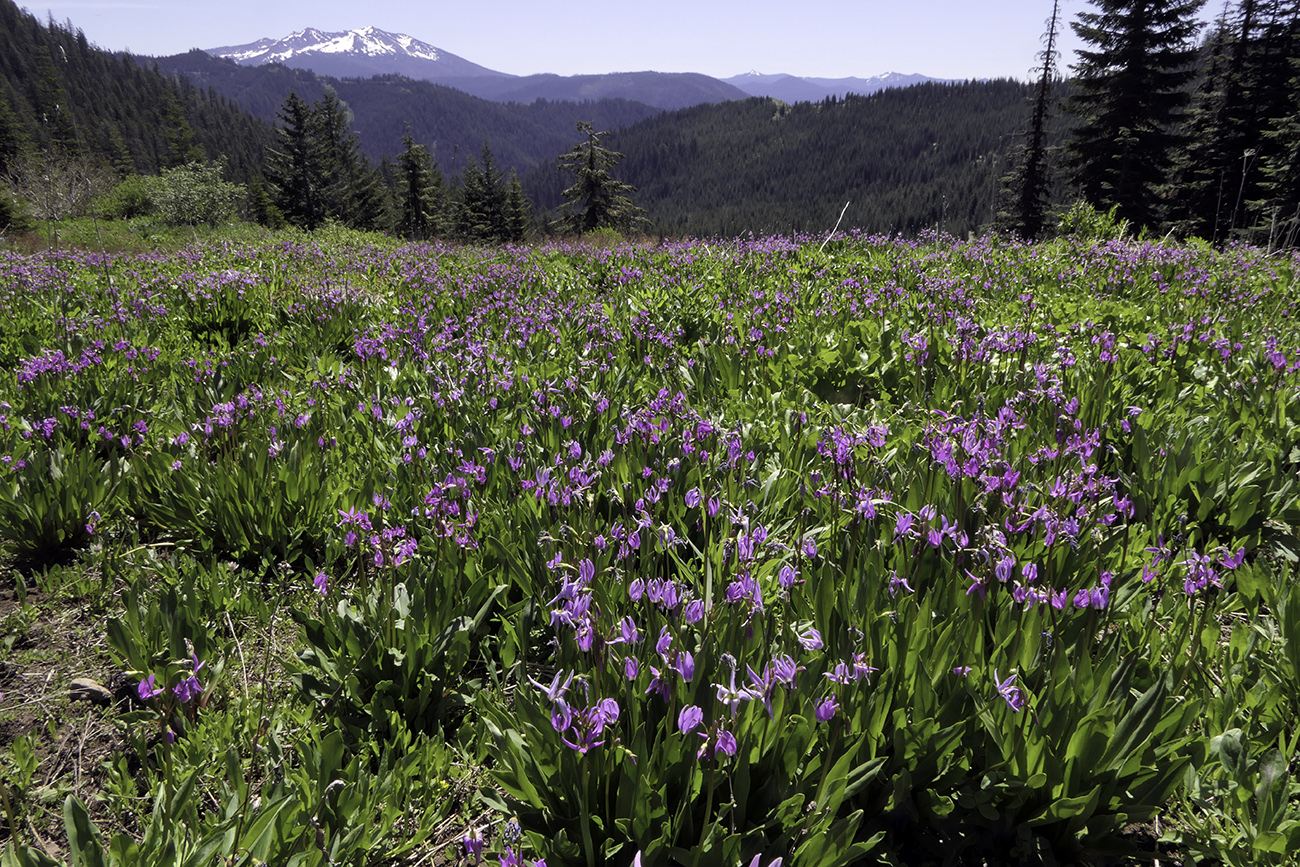
Not much snow for late May on the west side of Diamond Peak. The mountain shooting star (Dodecatheon [Primula] jeffreyi) was putting on quite a show.
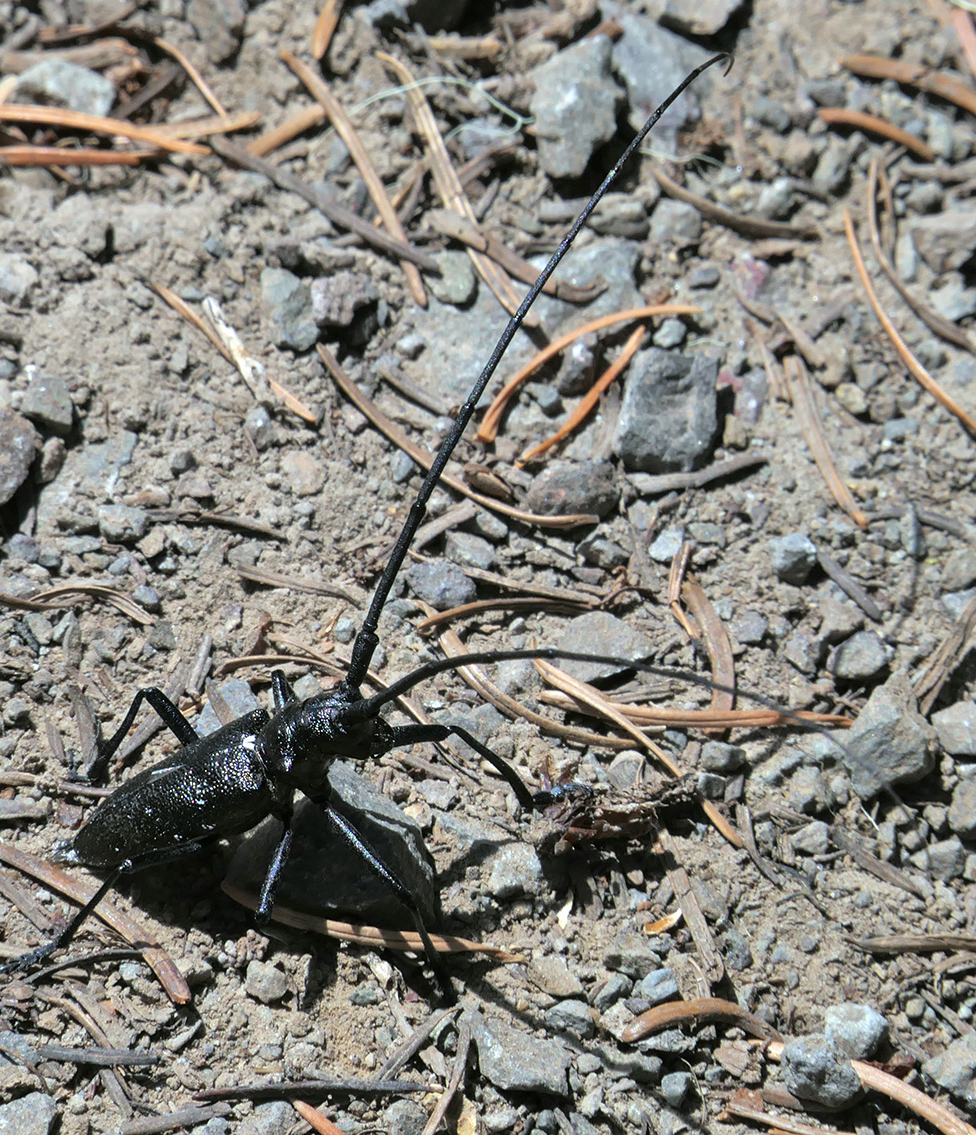
The long antennae of this large white-spotted sawyer beetle (Monochamus scutellatus) caught everyone’s eye on the road to Logger Butte. Apparently this wood-boring beetle doesn’t really bite, but it can grip hard if you’re trying to get it off you.
On May 24th, I headed up to Groundhog Mountain with Alan Butler, Dave Predeek, and Hannah English. It was only the second time I’d ever been up there in May as it is usually snowed in until at least mid-June. Dave and I had also come on May 24th way back in 2015 (see Two Foggy Outings)—after the only other winter since I moved here over 30 years ago when there was no snowpack in the Western Cascades.
We came in from the north via Road 2309 to see the roadcut flowers. It was already drying out there—with no snowpack, it is a very early year indeed. We made a number of our usual stops to Waterdog Lake, Logger Butte, Road 452, the pond just north of Logger Butte, and we also drove all the way up the west side of Groundhog to see the cliffs at the north end (in Alan’s high-clearance truck—I wouldn’t do that in my car!). Here are some highlights of a very pleasant day with other nature lovers observing flowers and insects. Read the rest of this entry »
Early Season at Echo Basin

From the meadow as we approached the wetland, we could see snow remaining on the north-facing slopes of the basin.
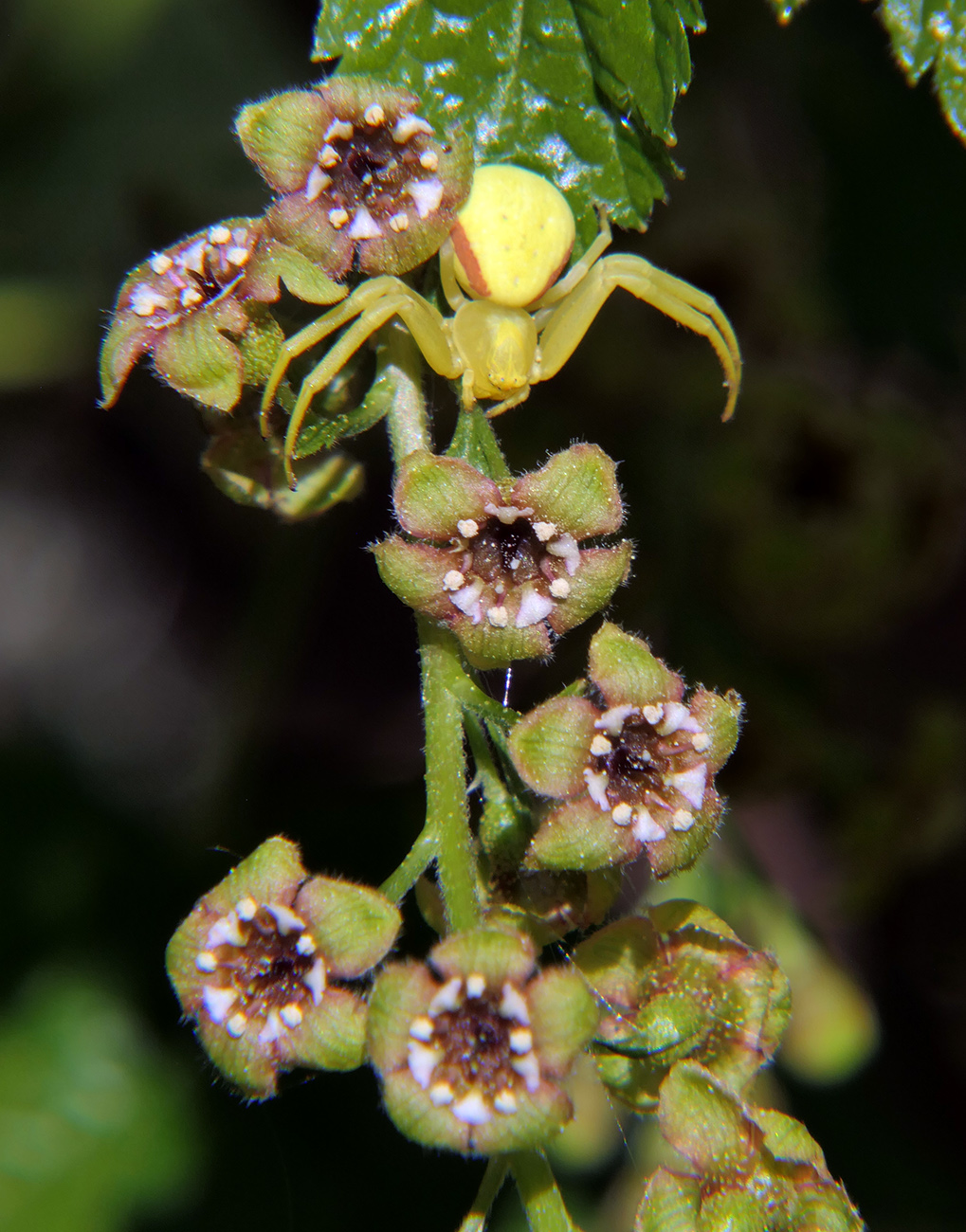
A crab spider strikes a scary pose on the inflorescence of stink currant (Ribes bracteosum).
Echo Basin, just east of Cone Peak, is one of my go-to places in late summer since its wetland and creek retain moisture for a long time, and there are lots of late-blooming wildflowers. It’s also a fairly easy trail with plenty of shade, making for a pleasant hike on a hot day. I realized last October when I went seed collecting (see Berry Collecting at Echo Basin) that it had been many years (20!) since I’d been there to see the early part of the season. When a short but unpleasant heat wave hit us in early June, I decided Echo Basin was the perfect destination for Saturday, June 7th. It wasn’t supposed to be the worst day of heat (although it was 93° when we drove through McKenzie Bridge on the way home), but it was still too hot for anything strenuous. Read the rest of this entry »
Beetles and Botany at Bearbones
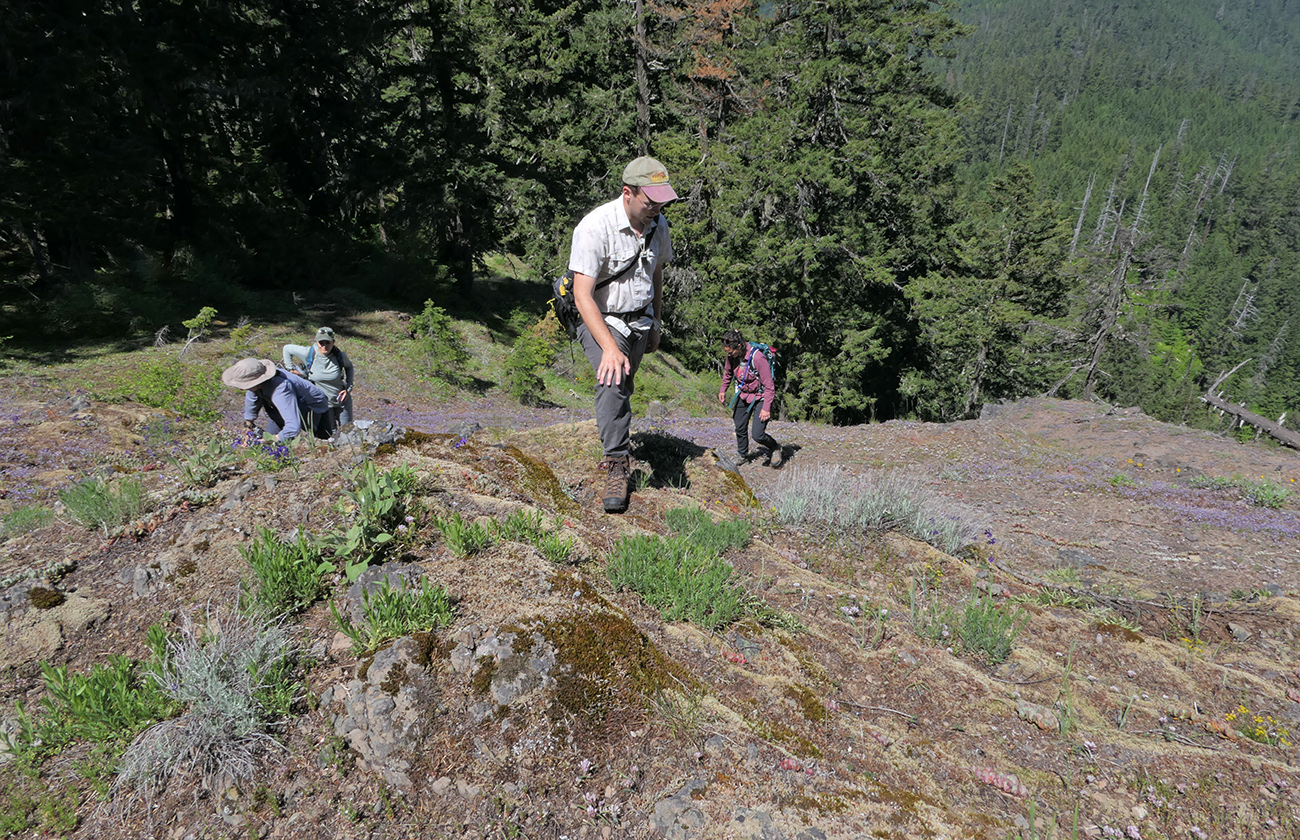
Angela, Leela, Sol, and Lauren exploring the north side of Bearbones Mountain a little below the summit. We were surprised to see rubber rabbitbrush (Ericameria nauseosa) growing in the cooler conditions of the north-facing slope. More common to the south and east, it usually grows in hotter, drier sites. The purple tinge on the slope was a large sweep of large-flowered blue-eyed Mary (Collinsia grandiflora).

Stunning cliff penstemon lights up the rocky ridge. The two rocky slopes in the nearest ridge are Spring Butte. The small prominence behind and to the left is “Mosaic Rock” where I went in May (see Long-awaited Return to Mosaic Rock). The large ridge beyond that is Staley Ridge.
Bearbones Mountain is a former lookout site with a 360° view, and it is a really interesting area botanically, but the trail is little known, rarely used, and hard to find now that the hiker symbol post is gone. I’ve been trying to bring people up there for years to see its hidden treasures. On June 9th, I introduced it to four more botanically minded folks, two of whom work for the Middle Fork district of the Willamette National Forest where it is located but hadn’t been there yet. The flowers were even better than when I’d been there a couple of weeks before (see First Trip of the Year to Bearbones Mountain). The cliff penstemon (Penstemon rupicola) was outstanding, and there were plenty of other beautiful wildflowers to keep everyone satisfied. We also saw interesting insects although I was again disappointed in the relative lack of butterflies. Everyone enjoyed the beautiful weather and great view. It’s a good place to get oriented when you’re in the southeastern part of Lane County. Hopefully my younger friends will bring other flower lovers up here in the future. Read the rest of this entry »
Late Start to 2023 Botanizing

While the center yellow lines were painted by a road crew, Mother Nature created the line along the edge of the road with a bright yellow ribbon of gold stars. They are also sprinkled all over the cliffs along Hills Creek Reservoir.

A little rove beetle(?) has gotten completely covered with pollen from the tiny flowers of skunk cabbage (Lysichiton americanus).
I almost always start my botanizing year with a trip in March to the Rigdon area in southeastern Lane County. With the cold, wet weather of March and April and the lateness of the wildflower emergence, I didn’t get out there until April 26! As I suspected, the wet spring was ideal for gold stars (Crocidium multicaule), and most everything was at least 3 weeks later than usual. Here are a few highlights.
Read the rest of this entry »
On the Menu at the Butterfly Café

From the west opening on the bluff next to Sacandaga campground, you can see the snow on the area that burned in the 2009 Tumblebug Fire.

I was so happy to see so many handsome male catkins on the Fremont’s silktassel (Garrya fremontii) next to the bridge and boat ramp at Hills Creek Reservoir. This lovely native plant was accidentally cut down by a Forest Service crew while working on nearby weedy shrubs a few years back. It has been slowly recovering ever since.
One of the best benefits of having a remote job doing layout and design is that I set my own hours. Or in other words, I can usually play hooky when I feel like it! When I saw that the forecast for Oakridge was supposed to be in the 70s (!) on Wednesday, March 31, I dropped everything to see how things were progressing down in Rigdon. And after spending several weeks focusing on butterflies while preparing my slide show on “Favorite Plants of Butterflies of the Western Cascades” for the North American Butterfly Association and the Middle Fork Willamette Watershed Council (you can view the recording here), I couldn’t wait to spend a day with some butterflies. Read the rest of this entry »
Buggy Day at Bristow Prairie

The wetland by the lake was filled with bistort (Bistorta bistortoides), Oregon checkermallow (Sidalcea oregana), and arrowleaf groundsel (Senecio triangularis). We hadn’t had time to explore this area last trip, but I like to come down here at least once a year. There are too many wonderful spots at Bristow Prairie to see them all on a single trip.

Follicles of Menzies’ larkspur still filled with seeds. Usually when an animal brushes by the plant, the seeds get flung out of the capsules. More than once, I inadvertently kicked a plant as I reached forward to grab the seeds, knocking them out before I could get any. Plants have so many clever ways of distributing their seeds.
After the terrific trip John Koenig and I had to Bristow Prairie earlier in the month (see Still More Discoveries at Bristow Prairie), I decided to return on July 15 to see the next wave of flowers. This trip was not nearly as pleasant as the first because most of the afternoon I was hounded by biting flies. Some looked to be deer flies; others were both larger and smaller, but they were all determined to drive me crazy. At the very end of the day, some house fly-sized ones were actually leaving what looked like bruises on my arms just minutes after they bit me. Luckily they didn’t itch for all that long. I’ve never experienced that before in the Western Cascades, so it was doubly disconcerting. Biting flies were one of the many things I disliked about my short tenure living in the Midwest. Read the rest of this entry »
Watching Bees and Butterflies at Medicine Creek Road

Sadly not a monarch but a worn California tortoiseshell on purple milkweed.
On Memorial Day, May 25, I made the long drive down to the North Umpqua to check out the population of purple milkweed (Asclepias cordifolia) along Medicine Creek Road 4775. I was a little disappointed to find it was just starting to open. I think the cool weather of late had slowed things down because Big Pine Opening was at about the same stage weeks ago, and although it is lower elevation, it is also much farther north. But although the milkweed wasn’t attracting many insects, there were plenty of plants that were.

A silver-spotted skipper was one of many insects nectaring on silverleaf phacelia.
So Many Blues at Bradley Lake

The show of great camas (Camassia leichtlinii) was outstanding alongside Bradley Lake.

Two male Sierra Nevada blues resting on their host food plant, mountain shooting star (Dodecatheon jeffreyi), already finished blooming.
I’m way behind posting reports again, but I couldn’t pass up sharing some photos of a trip John Koenig and I took to Bradley Lake on July 6th. After driving up Coal Creek Road a few days before to go to Balm Mountain (see Fabulous Loop Trip Around Balm Mountain) without being able to check all our favorite roadside stops, both of us agreed we wanted a more relaxing day and, despite all the other possible destinations we came up with, we wanted to go back up Coal Creek Road 2133, the gateway to the western side of the Calapooyas. We figured it would be a good time to check on the population of Sierra Nevada blues at Bradley Lake, so that was our eventual destination, but we didn’t even start walking to the lake until 2:30 pm. We stopped numerous times on the drive up, collecting seeds, photographing plants, and looking at all the butterflies—over 22 species for the day. Read the rest of this entry »
A Rainbow of Colors at Cone Peak and Iron Mountain

The Cone Peak meadows at peak bloom. What else can you say but “Wow!”?

The ivesia (Ivesia gordonii) was in perfect bloom on the side ridge of Cone Peak. It’s also on the top of the peak, but there are no records of it anywhere else on the west side of the Cascades.
Sabine Dutoit had a hankering to go to Cone Peak and Iron Mountain, so last Thursday, June 13, Sheila Klest and I joined her for an excellent day out in the Cascades. It was a gorgeous day, and the flowers were outstanding. We walked the 6.6-mile loop trail up through the Cone Peak meadows, over to Iron Mountain (passing just a few last patches of snow on the north side), and up to the Iron Mountain summit before returning to the road. It was great to be out with good friends, enjoying the flowers and views, and not working too hard. And there weren’t the usual crowds at Iron Mountain—undoubtedly the most popular wildflower site in the Western Cascades. Although that’s much longer than I usually hike, it seemed so relaxing not studying, surveying, or collecting seeds, and not bushwhacking. I’ll have to try that more often! It was hard to choose just a few photos to post. You’ll just have to imagine the rest—or go yourself! Read the rest of this entry »
Purple Milkweed on the Illahee Flat Trail

An interesting beetle on the purple milkweed flower
While we have been concentrating on surveying purple milkweed (Asclepias cordifolia) in the Rigdon area of Lane County, there are also a few known populations in similar low elevation meadows and rocky slopes and on the north side of the North Umpqua. Medicine Creek Road is a fabulous and easy place to see a large population growing by a paved road. I also found another population in a nearby meadow when Nancy Bray and I were down there two summers ago (see A Week of Monarchs and Milkweed: Day 3). Crystal Shepherd, who had been working for the Forest Service in the Middle Fork District a couple of years ago, went back to work in the North Umpqua last year. She had remembered seeing another population along the Illahee Flat trail a number of years before and went back to relocate it last summer. We were all happy to hear it was still there. I never made it down last summer, but on June 1, I went down there with Kris Elsbree of Walama Restoration.

Henderson’s cluster-lily (Triteleia hendersonii) is more often seen to the south, so I was very excited that Kris spotted this one plant in the woods along the trail. The purple stripes on the petals make it much showier than hyacinth cluster-lily (Triteleia hyacinthina) that I see much more often up my way.