Posts Tagged ‘Acer’
NPSO Field Trip to Groundhog and Warner Mountains

A lilac-bordered copper and two checkerspots nectaring on leafy fleabane (Erigeron foliosus)

A skipper, a checkerspot, and a field crescent all happily enjoying a meal together on a goldenrod (Solidago elongata). If only people could get along this well!
When the forecast for July 12th was for 95° in the valley, I was really glad I’d already chosen Groundhog Mountain as the destination for the July 12th field trip I was leading for the Emerald Chapter of the Native Plant Society of Oregon. There are no trails, so we didn’t have to walk a long way to get to some destination. Instead, we just made several stops where we had more time and were able to look carefully at different habitats with their different plant species. We did some easy walking along the road and a couple of short bushwhacks across beargrass meadows. Our elevation varied from 5500–6000′, so it was much cooler than in the valley. It got into the 70s where we were, but while the high-elevation sun on the clear day was quite strong, the air itself was pleasant. And our relaxed pace kept us from overheating. We had a chance to get to know each other better and learn more about plants and pollinators. And after all my worrying, the roads were fine, the flowers great, the butterflies excellent, and I think all 13 of us had a good time. What a relief! Read the rest of this entry »
Mistmaiden Meadow Pretty as a Picture

The rosy plectritis (Plectritis congesta) was kicking in but not quite at peak bloom yet. There was also lots of slender cryptantha (Cryptantha affinis) and coastal manroot (Marah oreganus). The great camas (Camassia leichtlinii) had just barely started.
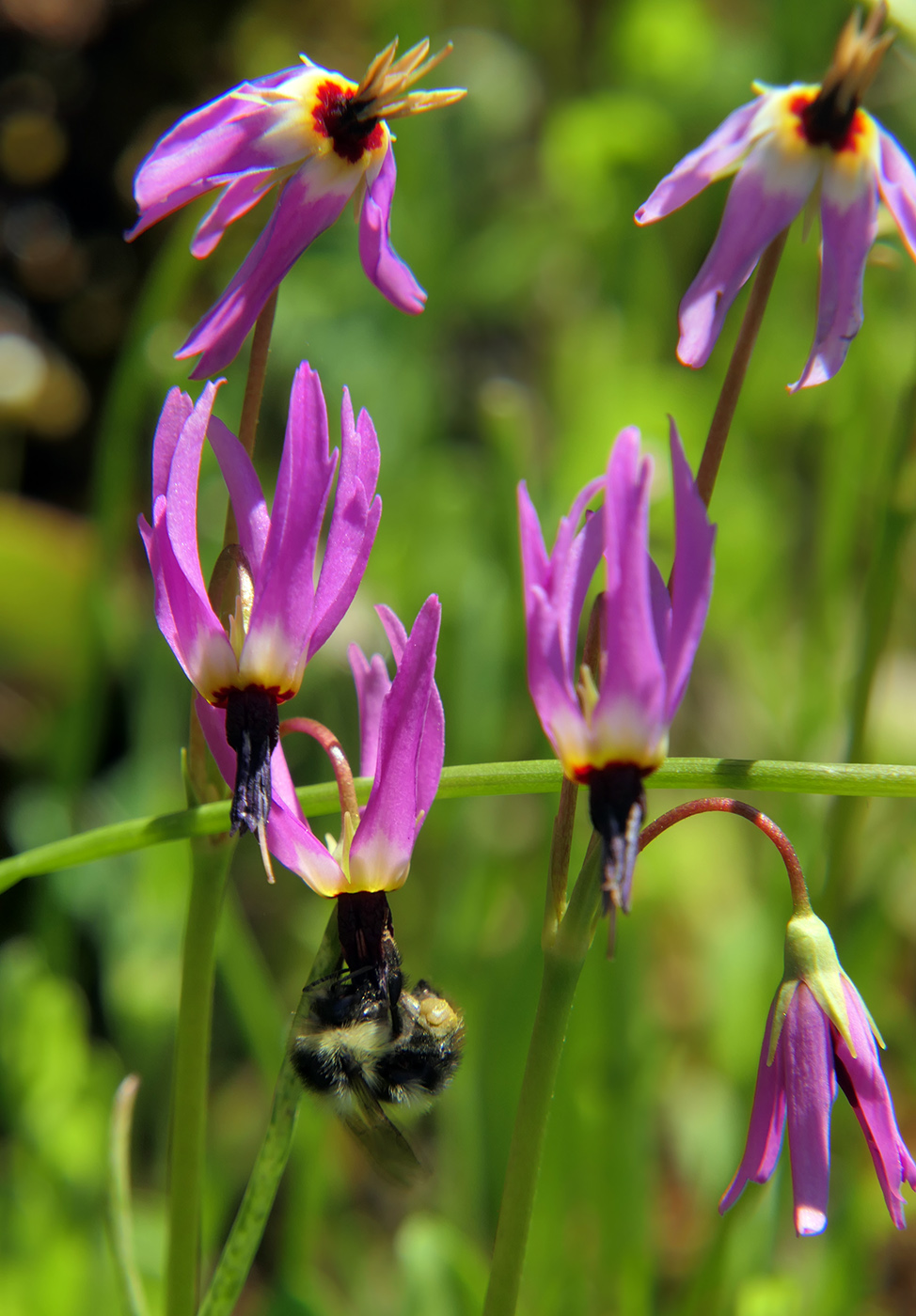
Shooting stars have downward-pointing flowers with reflexed petals in order to accommodate buzz pollination by bumblebees. There were lots of bumblebees taking advantage of the abundance of beautiful shooting star (Dodecatheon pulchellum) throughout the meadow. I was disappointed by the relative lack of butterflies but happy to see some pollinators.
On June 7, I took my husband, Jim, to see “Mistmaiden Meadow” on the west edge of Sourgrass Mountain. Although he’s not particularly interested in plants, we both feel safer if he’s familiar with all the places I visit regularly, in case he ever does have to come to my rescue. There are nice rocks and a view, and it was a lovely day to get out. If he’d stayed home, he would have spent the day doing chores like wood-splitting, so at least it was a nice change of pace.
The slope was still quite moist and lush with lots of colorful flowers. We’d missed the very earliest bloom, but there was still lots of the sweet Thompson’s mistmaiden (Romanzoffia thompsonii) that I named the site after. The very similar Nuttall’s saxifrage (Cascadia nuttallii) was just starting but will soon take over the seepy slopes. It is worth visiting this lovely and quiet spot multiple times during the flowering season. I was able to confirm my mystery cherry from my last trip last year (see Late Season at Mistmaiden Meadow) as choke cherry (Prunus virginiana) and added four other new species to my growing plant list for the site, so it felt successful as well as relaxing. And seeing a bear run across the road in front of us on our way home was like the cherry on top of a sundae—and the most exciting part of the day for Jim! Here are some pretty pictures of our very pleasant day. Read the rest of this entry »
Early Bloomers at Moon Point

After walking on a relatively level, viewless trail through forest and meadows, it is a surprise for those who haven’t been on the trail before—like Jenny (here) and Sheila—to come to the end of the trail atop a steep rock with a fantastic view. The coppery shrub on the left is actually a Pacific yew (Taxus brevifolia), and the tree on Jenny’s right is a krummholz ponderosa pine (Pinus ponderosa). The highest points on the horizon are Bohemia Mountain and Fairview Peak.
On July 10, Jenny Moore and I will be leading a hike to Moon Point for the Emerald Chapter of the Native Plant Society of Oregon (see details on the chapter website). Jenny had never been there before, so I thought we should do our pre-hike early to show her all the cool early blooming flowers there. So on June 10, we headed up there with John Koenig and Sheila Klest. Read the rest of this entry »
A Soggy Day on Tire Mountain

Great camas (Camassia leichtlinii) and harsh paintbrush (Castilleja hispida) were a beautiful combination in the large dike meadow.

Chocolate lilies (Fritillaria affinis) were one of the highlights of the day. They were hard to spot at first, but once the sun came out, they weren’t so inconspicuous.
Last weekend, May 22, I was invited to join Molly Juillerat and her dog Loki again, this time with some of her vaccinated friends: Michelle, Annie, Judy, and Julie. Three of them had never been to Tire Mountain but had heard how great the flowers are. It was a damp and cloudy day—not the kind I normally venture out in—but it was great to meet some new plant-loving women, now that we can start to return to normal activities (at least outdoors). We were pretty chilled for most of the day, but it was hard to be too upset about how wet everything was after I’ve spent almost every day of the last couple of incredibly dry months wishing it would rain.
It was still early, so the sweeps of colorful annuals hadn’t started yet—although the rosy plectritis (Plectritis congesta) was in bud and was probably the most asked-about species all day. Brightly colored harsh paintbrush (Castilleja hispida) and barestem lomatium (Lomatium nudicaule) were like bright lights in the gloom. The other lomatiums (L. utriculatum, L. hallii, and L. dissectum) were also flowering. The fawn-lilies (Erythronium oregonum) were at peak bloom but rather droopy from the rain. And, probably the most iconic flower on the mountain, the deltoid balsamroot (Balsamorhiza deltoidea) was also coming into bloom. Definitely worth coming out, even on a damp and gray day! Read the rest of this entry »
First Trip of the Year to Bristow Prairie

An unusual “pink-eyed Mary” (Collinsia grandiflora)!
So far, my botany season has been spent checking out lower elevation meadows in the Cascades. But finally, on June 4, it seemed like it was time to head up to the higher elevation sites. The Middle Fork District office told me that the day before they’d gotten a truck through Road 5850, which rides the ridge near Bristow Prairie, although there was a little bit of snow still along the side of the road. They weren’t sure about the upper part of Road 2125 where it comes into 5850, but I figured if the rest was clear, that part would be too. Thankfully it was, as I really wanted to see the early flowers at Bristow Prairie.

I saw a sawfly (sounds like a nursery rhyme or riddle: “I thought I saw a sawfly fly”) for the first time on Eagles Rock a few weeks ago (photo on right) and found another on this trip in the rock garden area (left). Actually, they are not flies (order Diptera) but are in the same order (Hymenoptera) as bees and wasps, and they fly with their legs hanging down the way wasps do. This one looks like the genus Trichiosoma. Although they are large and look rather intimidating, they don’t sting.