A Very Early Spring at Loletta Peak
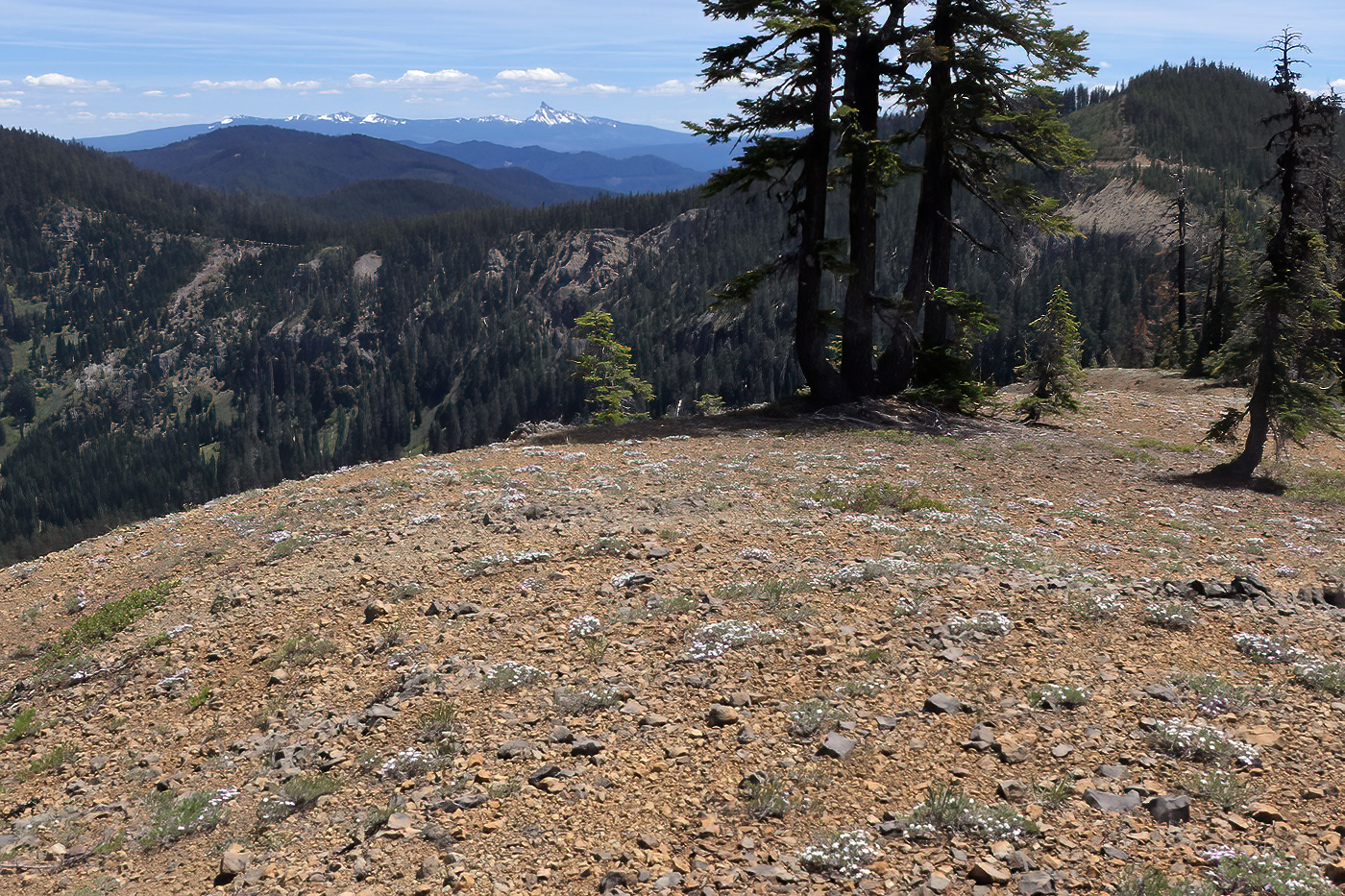
Looking southeast from the summit of “Loletta Peak,” there’s little evidence of fire. The sharp point of Mt. Thielsen can be seen 25 miles away. Nearby on the right side of the photo is north end of the Balm Mountain rdge. Spreading phlox is abundant all over the summit area.
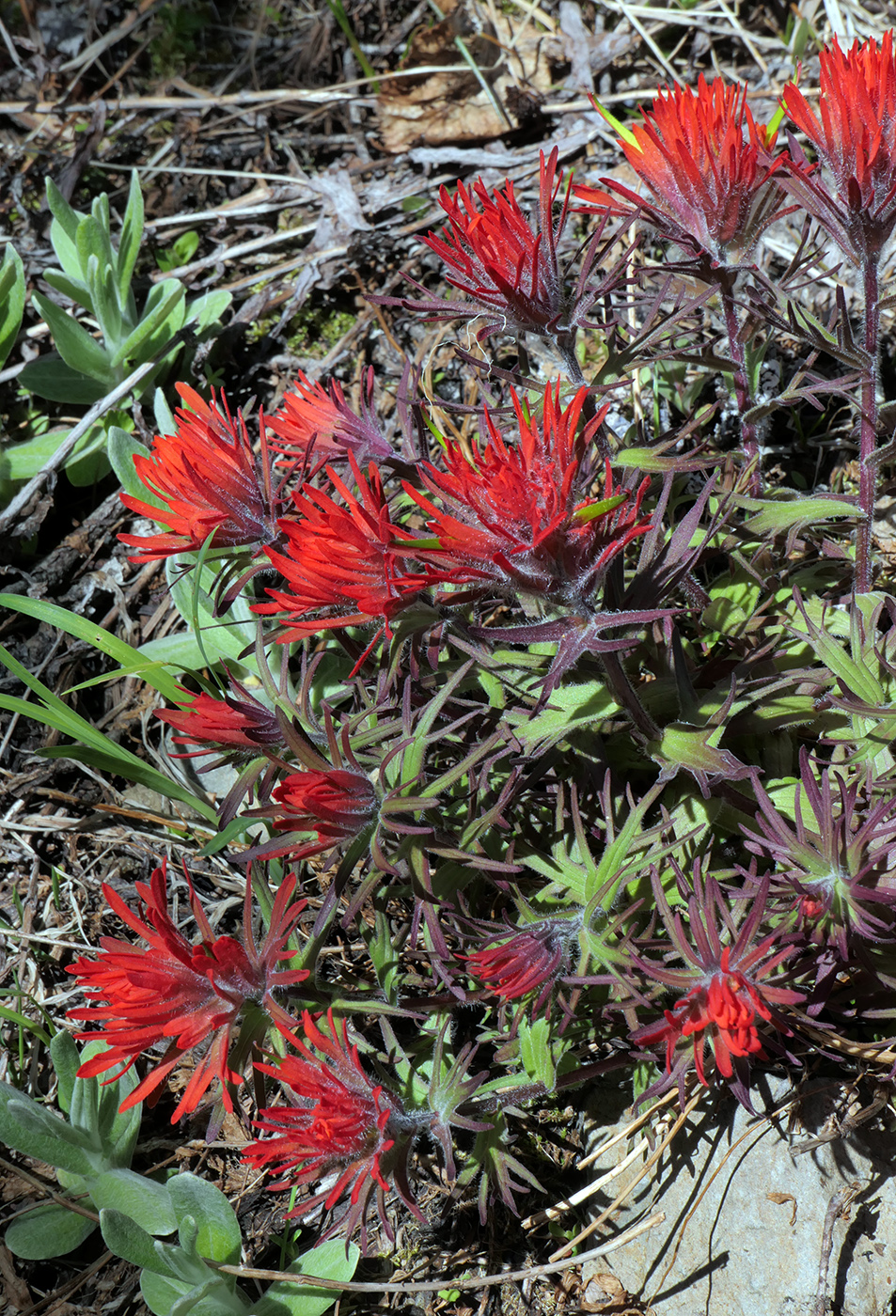
Several plants of cliff paintbrush (Castilleja rupicola) grow in the gravel along the upper part of Coal Creek Road. These are the only ones not out of reach on cliffs, so it’s a good opportunity to photograph them safely.
After seeing a fresh Siskiyou fritillary (Fritillaria glauca) at Bristow Prairie;(see Lack of Snowpack at Bristow Prairie Leads to Very Early Spring), I realized this would be a good year to look at the much bigger population at “Loletta Peak.” Like Bristow Prairie, my access to Loletta Lakes and the nearby ridge I’ve dubbed “Loletta Peak” is on the north side of the Calapooyas where the snow lasts longer. One of the small silver linings of having no snow pack is that the road is already open when the very early flowering fritillaries come into bloom. After the only other snowpackless winter I’ve experienced in Oregon, I made the same trip on May 29, 2015 (see Another Exciting Day in the Calapooyas).
On May 20th, my husband, Jim, and I headed up Coal Creek Road all the way to the primitive campsite at the east end of the plateau that Loletta Lakes sit in. It is a short but steep climb up through the forest on the south side of the road to get up to the open scree of the ridge. Even though it was well before the road is usually even open, there was plenty in bloom on the ridge. I was disappointed that the fritillary flowers I spotted were already spent, but I hoped that once we reached the top of the 5900′ peak (only another 300′ higher), there might be some left. Thankfully, I found several fresh flowers on the gentle slopes of the summit though each only had a single flower.

Tiger swallowtails seem to love spreading phlox. Who wouldn’t?!

Finally a fresh Siskiyou fritillary!
The phenology seemed quite similar to the 2015 trip. The most floriferous species we saw was spreading phlox (Phlox diffusa), which covered the open slopes. There was also Olympic onion (Allium crenulatum), Martindale’s lomatium (Lomatium martindalei), and a beautiful covering of large-flowered blue-eyed Mary (Collinsia grandiflora). Bright red cliff paintbrush (Castilleja rupicola) dotted the cliffs at the north edge of the slope.

Several butterflies including this spring white were hilltopping while we lunched.

Probably the rarest species in the area is Gray’s bedstraw (Galium grayanum var. nanum). It wasn’t even in bud yet, but its fuzzy bluish leaves are quite distinctive. I discovered it here back in 2010 (see More Interesting Finds in the Calapooyas) and later at nearby Balm Mountain. This is the most northerly site known with only a few other locations in the state.
After enjoying the flowers and terrific view and stopping for a bite to eat, we followed the west ridge downhill paralleling the main road. This is the route Molly Juillerat and I tried out on my most recent trip to Loletta Peak in 2021 (see Return to Loletta Peak.) I was somewhat surprised to find the south side of the ridge was moderately burned. There have been fires in the area recently, but I was unaware they’d reached Loletta Peak. We bushwhacked down to the road without too much trouble and headed back to where we’d parked the car, passing just a little snow in the roadside ditch.

The view west of the summit shows the extensive burns in and near the Boulder Creek Wilderness and right up to the edge of the summit.

Like at Bristow Prairie, some of the glacier lilies (Erythronium grandiflorum) in the wetland were short and upturned, presumably a reaction to the lack of snow cover.

When I realized the suksdorfia was in bloom, I made my way carefully over to the uppermost rocky spot it shares with littleleaf monkeyflower (Erythranthe microphylla) and Menzies’ larkspur (Delphinium menziesii). The extremely steep slope was carpeted with large-flowered blue-eyed Mary.
On the 2015 trip, I’d discovered a very uncommon species way out of its normal range: buttercup-leaved suksdorfia (Hemieva [Suksdorfia] ranunculifolia). It’s on the east edge of the plateau not far from where we parked, so we headed over to check on it. Jim had never explored this area, so I wanted to show him the rocky areas. and see if the suksdorfia was in bloom. It grows on a small rock wall at the south end of the open slope, but I couldn’t find any of the white flowers, so I had to head farther to the north where it gets much steeper and goes down much farther. Thankfully it was in bloom there. It looks like there is another shelf down slope that might have more plants, but to get down to the bottom safely, I would have to find some other way than straight down from there. One of these days I’ll check that out!
We also took a short tour of the wetland. It was already fairly dry, and we were able to walk around and find a way across it without boots. While that was convenient, it is way too early for so little moisture. The white marsh marigold (Caltha leptosepala) and mountain shooting star (Dodecatheon jeffreyi) were blooming. While we saw a few butterflies, it’s too early for Sierra Nevada blues that live here. They usually appear as the shooting star is fading, later in June or early July in a “normal” year. I do hope everything being a month early won’t be detrimental to them. Will their life cycle match the flowers or the calendar? I guess another trip is in order to answer that question.

Up close, you can see the buttercup-shaped leaves of the white-flowered suksdorfia that give this species its common and specific names. The flowers, however, more closely resemble other members of the saxifrage family, to which it belongs
The usual WOW!!! Thank you for taking me on this hike…photos only…NO work getting there!! LOL!! Thank you also for educating me in some more incredible Cascade Beauties!!!Love these photos… I would love to grow that “bed straw’!!! Compare to the commoon weed this galium is delightful!!
Happy hiking….hope it stays relatively cool..I’ve go to hit the back roads!!!( it always amazes me, when I ask our gardening friends, have they ever explored the back roads and too many have never been out of the Rogue Valley …
Thank you!!!
Tanya, just another note to say “thank you very much!” for sharing your botanical adventures. At this point I can barely walk around on a paved path in a botanic garden, far from being able to scramble up steep mountains where the good stuff is. I greatly appreciate your writing and your photographs!