Long-awaited Return to Abbott Butte
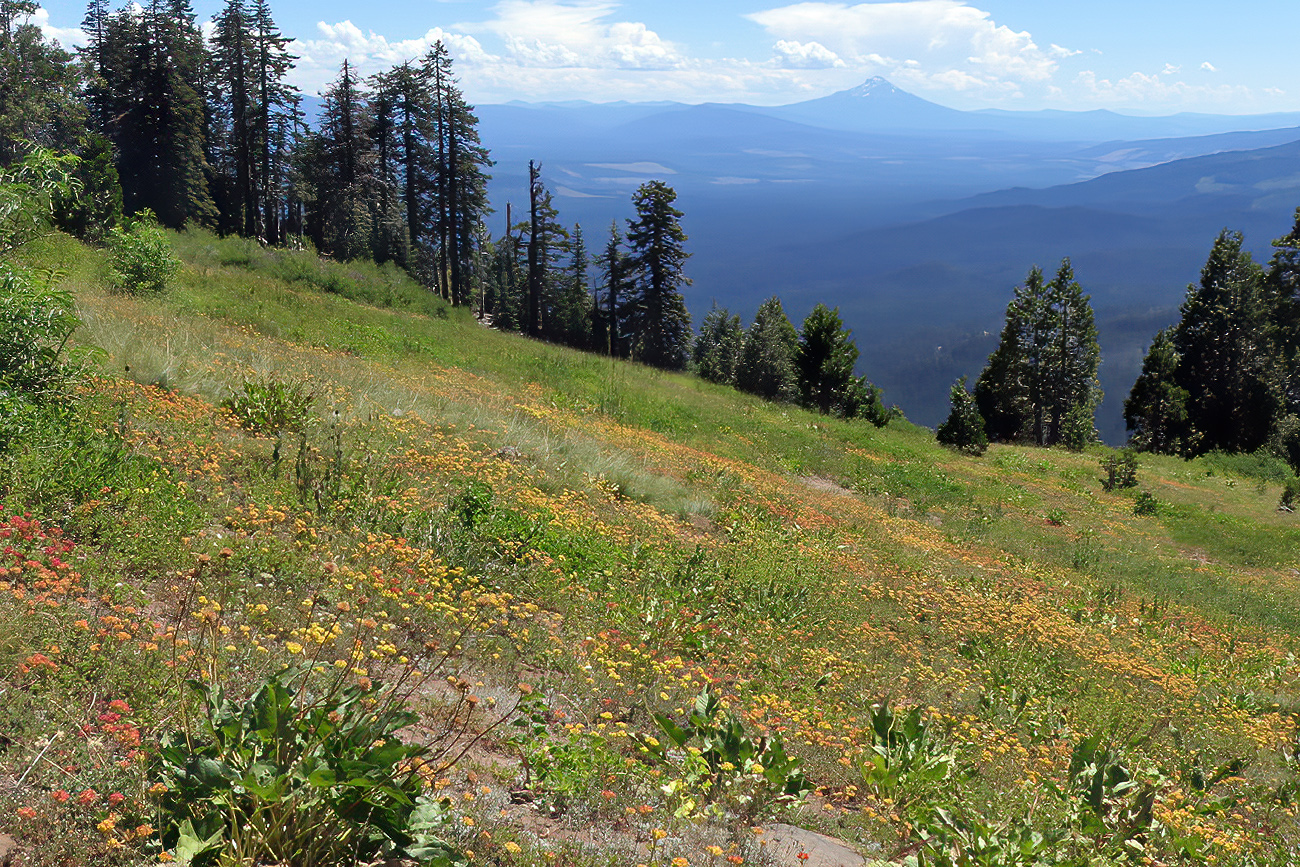
You can see Mount McLoughlin to the southeast from the summit meadow.
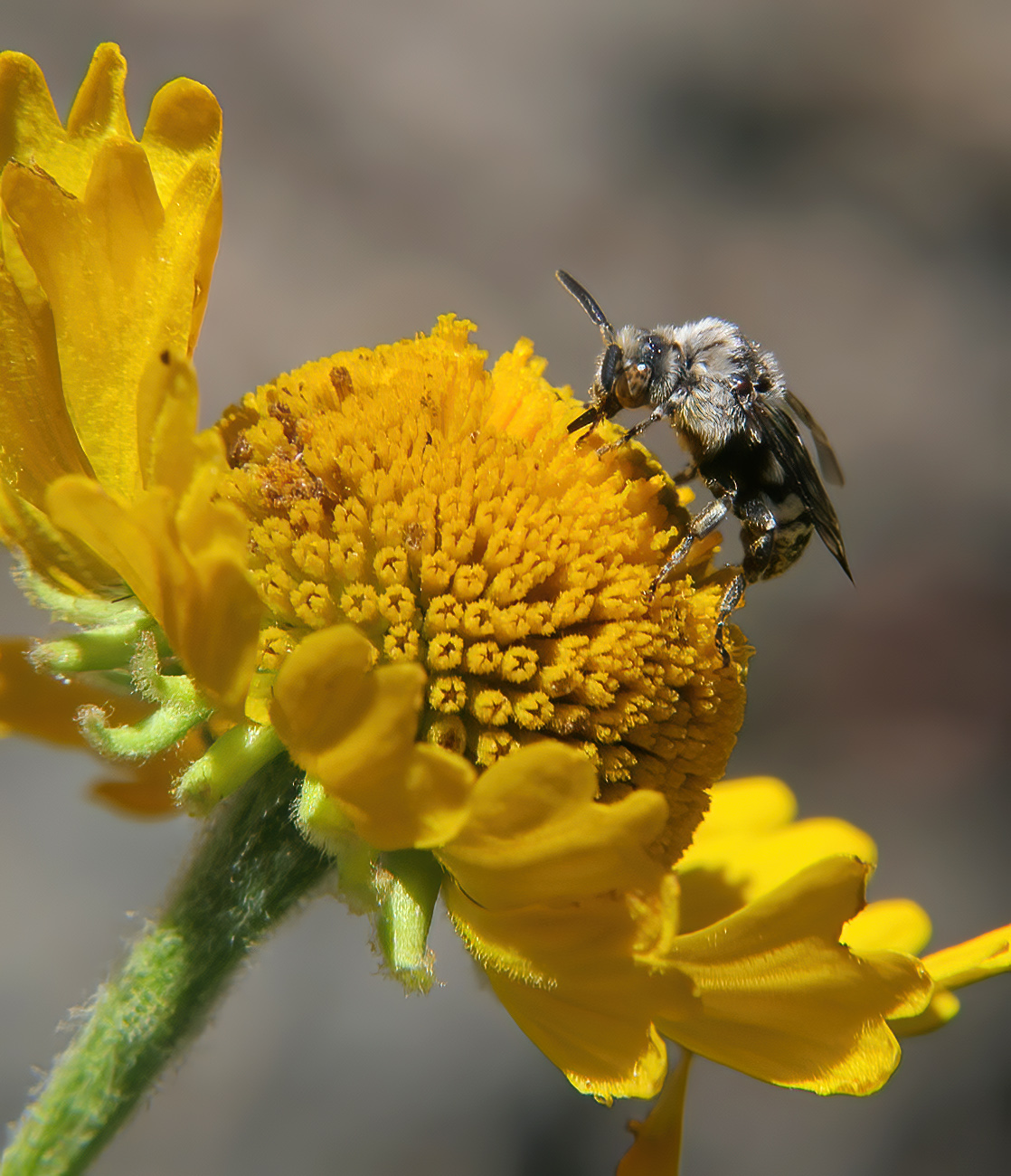
This cute bee is nectaring on tall sneezeweed (Helenium bigelovii), a southwestern Oregon species I’ve only seen in the Cascades near the Abbott Butte trailhead and at nearby Donegan Meadows.
In late June, I received an e-mail from Adam Schneider, another avid wildflower photographer, saying he was heading down to the Rogue-Umpqua Divide and did I have any suggestions for where to go. This is one of my favorite areas of the Cascades, and I used to try to get down there every year. But then I got busier with work, and every time I thought about going there was a heat wave or thunderstorms in the forecast or a nearby fire or smoke. Somehow a decade passed without a visit! Then when my old van became too untrustworthy to drive into the mountains, we got an electric vehicle. I’d been keeping an eye on charging stations, but as of summer of 2024, there still weren’t any on the east side of the Cascades that I could use to make the long trip. Adam’s e-mail prompted me to take another look, and I was thrilled to see a fast-charging station had been installed in Chemult last fall!
I wasn’t able to go until late July, but after another heat wave subsided, my husband Jim and I headed down for an overnight trip. We spent the first day at Crater Lake (my only trip to the High Cascades this year) where California tortoiseshells were flying by the tens of thousands. Sadly, they seemed to favor following the road just about car height. The numbers of dead and dying butterflies was the one thing that dampened my mood on an otherwise perfect day. I don’t usually include visits to the High Cascades in my Western Cascades blog, but above is a bonus video of the amazing butterfly show at Cloudcap Overlook on the east rim of the park.

The completely burned trailhead was unrecognizable from my past trips.
The following day, July 27th, we headed up to Abbott Butte. I hadn’t been there since July of 2011 (see Abbott Butte in Glorious Bloom), so I was very excited. When we arrived at the trailhead, I was shocked. The forest was largely gone, and in its place were blackened poles. How did I not know it had burned? Turns out the area burned back in 2017 in the Broken Lookout Fire, part of the High Cascades Complex. I was really bummed, along with being upset at myself for not having checked out the status of the trail ahead of time. As we headed north on the trail through overgrown shrubs and over fallen logs, it seemed that the trail was more or less abandoned or at least not kept up as dead trees had continued to fall during the years since the fire. Just finding the trail was difficult in places. The trail is within the Rogue-Umpqua Divide Wilderness, so the power-tool restriction makes keeping the trail clear a challenge.

Looking north from the base of the rocky ridge to the summit meadow.

Red baneberry (Actaea rubra) They were abundant before the fire. This was one of many woodland species that seemed to be thriving in spite of the lack of shade in the burned forest.
I kept thinking we’d get out of the burned area at some point. Looking around at the surrounding ridges, there was plenty of unburned forest. The individual fire had not been that large and had burned in a patchwork manner. But, unfortunately, it seemed to have hit most of the trail until the final meadow area and summit. I was pretty grumpy and feeling really bad for dragging Jim along on such an unpleasant hike (he was a trooper and never complained though). But, as we were already there, I had to make the best of it. It was a gorgeous day, and as I got over my shock and dismay, I discovered a lot of things to cheer me up.
First, it wasn’t entirely burned. There were more and more live trees as we headed toward the meadow. And the shrubs were doing great. Many of them were fruiting, so we ate lots of thimbleberries (Rubus parviflorus) and dewberries (R. ursinus). Black raspberry (R. leucodermis) canes kept grabbing us along the trail, but they weren’t ripe yet. Black huckleberries (Vaccinium membranaceum) were just starting. I don’t think I’ve ever seen so many gummy gooseberry (Ribes lobbii) plants in one place, although I remember a section of burned trail on Heckletooth Mountain being a good place to see them as well. Ribes are good pioneer species after both fire and logging. Many of the woodland species I remembered were still there in spite of the more open conditions. I was able to relocate the area below the ridge where some marbled ginger (Asarum marmoratum) grew. It was late in the season for a lot of flowers, but I was able to collect seed of oneleaf foamflower (Tiarella trifoliata) and mountain arnica (Arnica latifolia). Arnica species are great post-fire colonizers. Not surprisingly, fireweed (Chamaenerion angustifolium) was abundant and still in flower. And I was quite excited to see some black-backed woodpeckers, an uncommon species most easily spotted in burned forests.

The persistent tepals of buckwheats, including these sulphur buckwheat, often turn reddish as they age, giving them a long season of beauty.
We finally reached the open summit meadow. It was great to get out of the burned forest for a while. The sulphur buckwheat (Eriogonum umbellatum) was going out in a blaze of color. The yellow flowers turn orange and sometimes even red as they age. Some western blue flax (Linum lewisii) complimented the hot colors of the buckwheat. There was still lingering coyote mint (Monardella odoratissima) in bloom, attracting fritillaries and other butterfly species. I ditched Jim for a bit to chase butterflies and saw my first blue copper of the year and my first California hairstreak ever as well as clodius parnassians, Edith’s coppers, and dark wood nymphs.

At the time, I thought this was a sylvan hairstreak, which I see only occasionally. I now believe this is a California hairstreak, my first ever as it is most commonly found on the east side of the Cascades and farther south. The difference is the presence of orange on the forewing as well as generally brighter markings. It is nectaring on lovage (Ligusticum sp.)

Bridge’s rose grows in rocky areas near the summit.

Blue coppers can be told from blues by the prominent black veining on their brilliant blue wings. Their host food plants are buckwheats, so there was certainly plenty of food for their caterpillars in the summit meadow.
As we walked up the zigzag trail to the top, I remembered there was a special plant there that I had wondered about for many years. Back in July of 2005, I had organized a camping trip to Abbott Butte for the now-defunct Emerald Chapter (Eugene area) of the North American Rock Garden Society. There were loads of gorgeous dwarf roses in bloom—just the kind of thing rock gardeners covet. I was told they were ground rose (Rosa spithamea), a species I wasn’t familiar with at the time, having not yet discovered it grows in the Rigdon area of Lane County. Only much later did I realize that these could not be ground rose, which has glandular hips; these are glabrous. I was also interested in relocating these plants because I have been editing the treatments for the family Rosaceae for the Flora of Oregon and wanted to see as many rosaceous species as possible. Happily, in spite of them being past flowering, I was able to find a number of patches of the rose, and I collected several stems to bring home and key out using our draft treatment. It seems pretty clear to me that these are actually Sierran dwarf rose (R. bridgesii), a species that comes up from California. According to the map on the OregonFlora website (note the website hasn’t updated the name yet, it is no longer considered R. yainacensis), this is the farthest north it has been recorded so far and the only population in Douglas County.

Looking south from the summit meadow. The rocky ridge was much more evident than in pre-fire days. The trail runs along the base of it.
I remembered seeing the old dilapidated lookout from some vantage points in the meadow, but when we reached the summit, we found only burned remains. It turns out it wasn’t burned in the fire but was intentionally burned by the Forest Service a few years earlier. On that 2005 trip, the lookout was closed as it was considered too hazardous to climb, but we took a group photo in front of it, so I have fond memories of it.

Looking through the statuesque mountain larkspur to where Jim is carefully making his way across the wet meadow.

Leopard lily was just coming into bloom. Mountain larkspur and Douglas’ spiraea complimented them beautifully.
On the way to the main meadow, we had seen that there were lots of flowers still blooming in a wet meadow near the intersection of the old Cougar Butte trail (now apparently abandoned totally). On our way back, we made a detour into the meadow. It was tricky walking as the plants were so tall we couldn’t see the rocky tracks where the water flows through it earlier in the year. Jim stepped in one and fell. I tried to move very slowly, but I wasn’t about to skip seeing the one area that still had some moisture and a couple of my favorite species from the southern end of the Western Cascades. Both leopard lily (Lilium pardalinum) and mountain larkspur (Delphinium glaucum) were in full, glorious bloom, many of the larkspur were over my head! I don’t get to see them often. There was also brilliant red scarlet paintbrush (Castilleja miniata), ranger’s buttons (Sphenosciadium capitellatum), Douglas’ spiraea (Spiraea douglasii), and nettleleaf horsemint (Agastache urticifolia). All traces of grumpiness were completely washed away, and I was glad to have finally made it back to Abbott Butte, in spite of all the changes.

Looking west at the outstanding display of scarlet paintbrush growing down the sloping wet meadow
WOW!!! Great photos…and I am so impressed with your lepidoptera knowledge!!( As well as your botanical..) This is the way I’m trying my darndest to design our garden as we recreate outcroppings in our back garden. Our collection of natives is growing and seeing your photos just encourages me in our efforts. But I’ll never have a many species as you post…such great photos,,,and great hikes!!! I have tried various species, in which many do, do well..But some struggle and I reach for more knowledge of their growing conditions from various altitudes…and soil changes that make it a challenge…so it’s so wonderful seeing your photos of these beloved areas which Walt and I look for…A real gift, Tanya!!! THANK YOU!!!