Scouting Trip to Warner and Groundhog Mountains
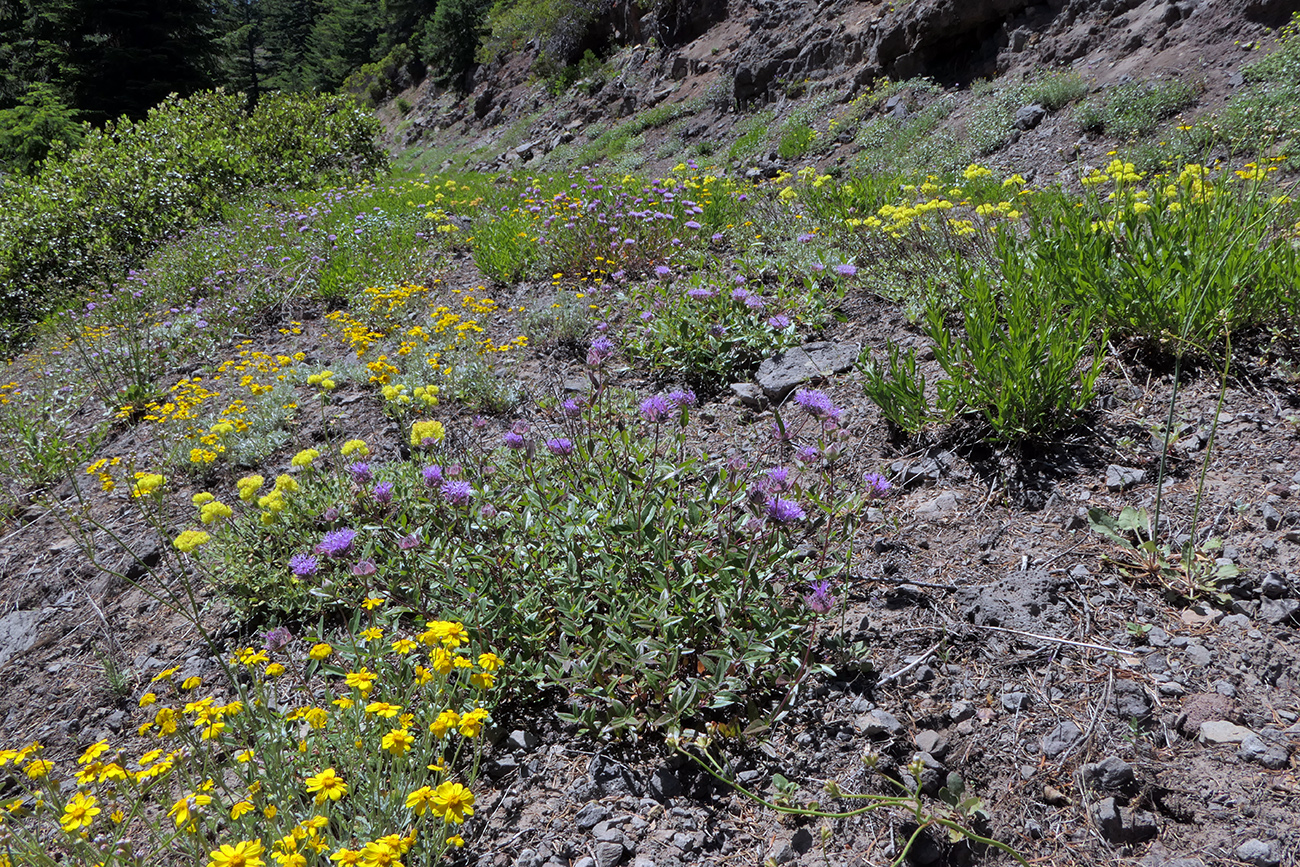
This was what I was hoping to see! The lower bank on Road 452 was awash with purple coyote mint and yellow sulphur buckwheat and Oregon sunshine. A perfect complementary color scheme.
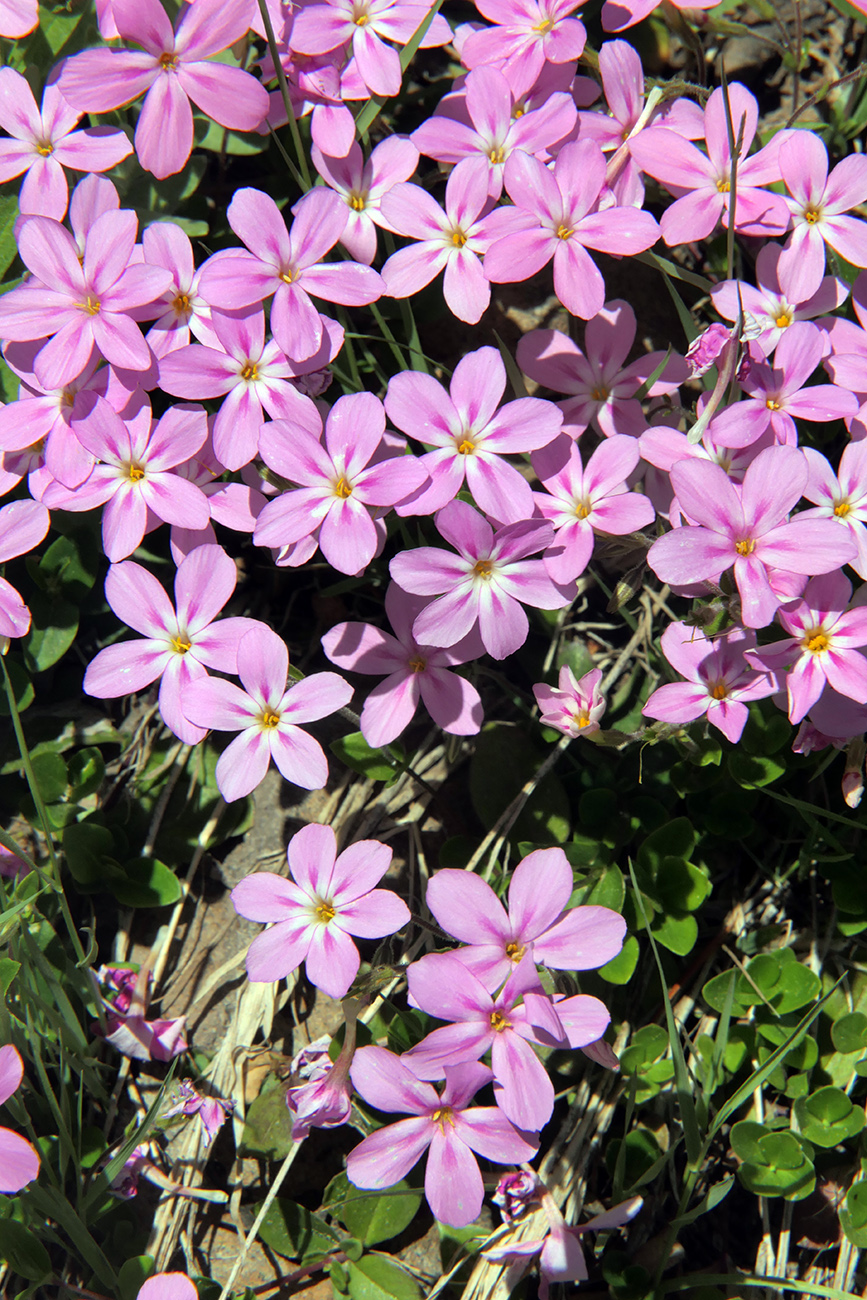
There’s one particular corner on the road between Moon Point and Warner Mountain that has a beautiful population of woodland phlox (Phlox adsurgens) growing on the roadbank.
Earlier in the year, I agreed to lead a botanizing trip for the Emerald Chapter of the Native Plant Society of Oregon sometime in the summer. I try to do one a year, but it doesn’t always happen—like last year when there were so many fires. I decided it was about time to bring people back to Groundhog Mountain. I hadn’t taken NPSO folks up there since 2008, when our chapter hosted the annual meeting. Not only is it one of my favorite botanizing (and butterfly watching) spots, it is ideal for a field trip because there are so many possible places to check out, and there will always be something blooming well. There are no trails, but there is much to see right by the road, so everyone can gather together when we find something special. The date chosen was July 12th because it was during a gap in planned activities for the group. So on July 3rd, I headed up by myself to try and figure out where I should take everyone. Having already seen how bad the section of Road 2309 was between Road 2120 and Waterdog Lake (see Another Try at Groundhog Mountain), I decided the long way around from Road 2129 past the Warner Mountain Lookout would be the easiest and safest for a caravan of vehicles.

One of the pools near a source spring of the Warner bog where it appears in the beargrass meadow.
Since I had to go past it anyway, my first stop was the Moon Point trailhead. If there were any issues getting to Groundhog Mountain, we could always go to Moon Point. But I took the NPSO group there in 2021 (see NPSO Field Trip to Moon Point), and I like to mix it up so people who don’t get out much on their own can see different places. I didn’t go very far down the trail before I hit the mosquitoes. While I’m rarely bothered by mosquitoes in the Western Cascades at any time of year, the beginning of that trail near a small wetland has always been awful. They disappear pretty soon once you pass the wetland, but I didn’t see much of real interest, so I turned around. It was too early for the gorgeous leopard lilies (Lilium pardalinum) and too late for the early-blooming glacier lilies (Erythronium grandiflorum) and the uncommon American red currant (Ribes triste) I found there a few years back.

Some areas of the extensive beargrass on Warner Mountain were already in full bloom. Looking more or less southeast, you can see the extensive burn scar of the 14,000+-acre Tumblebug Fire of 2009. Beyond that is the distinctive snowy peak of Mount Thielsen.
Next stop was the special sphagnum bog hidden in a beargrass meadow just west of the Warner Lookout. Again, it was too late for the lovely spring display of alpine laurel (Kalmia microphylla), mountain shooting star (Dodecatheon jeffreyi), and marsh marigold (Caltha leptosepala) and too early for the rare and stunning Mendocino gentian (Gentiana setigera) and Casacade grass-of-Parnassus (Parnassia cirrata). Peaking on my visit were bistort (Bistorta bistortoides) and sticky tofieldia (Triantha occidentalis). Both are good nectar plants for butterflies, but they are not as colorful as the early and late flowers are. It’s still a really cool spot, but I decided that for the NPSO hike, I’d probably leave that as an option on the way home in case some people wanted to skip it and leave early.

I doubt someone seeded the area next to the lookout on Warner Mountain, but it looks like a garden of skyrocket by the picnic area.

From the lookout area on Warner Mountain, even though it was over 2 miles away, I could see the large red drifts of skyrocket across Little Groundhog Meadow! This part of the meadow wasn’t blooming yet when I was there on my previous trip a week earlier. The large meadow is about 75 acres, so you can imagine how many acres are covered with the dazzling skyrocket (also known as scarlet gilia).
I headed up to the lookout for some lunch at the picnic table. I was disappointed that Leo, the super sweet dog of Jake, who was staffing the lookout, wasn’t there to greet me. Maybe it was Jake’s day off. I was getting a little bummed out about how things were shaping up for the NPSO hike. The garden of skyrocket (Ipomopsis aggregata) and beargrass (Xerophyllum tenax) were quite beautiful though. The main meadow seemed to be the one place that the beargrass wasn’t in bloom yet, so I had high hopes at least it would be in good bloom for the NPSO trip. There might also be some Cascade lilies (Lilium washingtonianum) in bloom, but most of them seemed to be still in early bud.

There was a beautiful display of Menzies’ larkspur (Delphinium menziesii) and Drummond’s cinquefoil (Potentilla drummondii) along the road just downhill from the intersection of 452 and 2309 at Groundhog Mountain.

This beautiful lilac-bordered copper was the first copper I’d seen this year. Coppers tend to come out a little later in the summer than many of our other species.
As I headed north to Groundhog Mountain, I was surprised to pass a small remaining snow bank by the highest of the many wetlands in the area. There were even some fresh snowmelt species, including glacier lilies and western springbeauty (Claytonia lanceolata). They would certainly be gone by the 12th, but it really helped my mood anyway. There was also lots more beargrass in bloom. For some reason, I’ve almost always missed peak beargrass bloom, so I was happy to see so much of it on this trip. Beargrass meadows aren’t very diverse, and they can be pretty boring most of the time, to be honest, but when they bloom en masse, it really makes up for it.

I was delighted to see this gorgeous Sheridan’s green hairstreak on sulphur buckwheat (Eriogonum umbellatum). Buckwheats are their host food plant as well as a favored nectar plant. A little bee was also partaking.

There were many lovely parnassians visiting the coyote mint.
No matter where else we ended up stopping, I knew I wanted to take people to the intersection of roads 452 and 2309. This is the area of highest diversity with large stretches of wetland, more mesic meadow, and wonderful rocky roadcuts. I no longer try to drive up the little-used and somewhat sketchy Road 452, but the one-mile walk up to where a long stretch of coyote mint (Monardella odoratissima) grows is easy and lined with many species of wildflowers that attract numerous butterflies and bees. It is one of very few Monardella sites in Lane County; it’s much more common just to the south in the Calapooyas. My mood really lifted as I passed many blooming flowers, and, more importantly, many that would probably be in full bloom 9 days later. When I reached the coyote mint stretch, I was elated. The steep bank below the road was in full glorious bloom and covered with butterflies! And the bank above the road hadn’t even started yet. No doubt the snowpack built up on the road, causing the bloom period to be at least a week behind the lower bank—perfect timing for my upcoming trip with NPSO! I went home feeling much better and with a good plan for the field trip. Groundhog Mountain rarely disappoints!

Before heading home, I drove a mile down Road 2135 around the north side of Logger Butte. It’s an alternate way to get back to the paved Road 21, but I knew there was a section of road that crossed a gash in the mountain. I doubted I had the guts to drive it, so I walked down from a corner where I could turn around. The road goes downhill and turns abruptly so you see nothing but open sky in front of you—giving me the “Thelma and Louise” willies. Looking down from the edge of the road, this is what you see below. Nope—no way I was going to drive this road even if it does save 5 miles of gravel!
Pretty darned EXCITING!! What gardens!!! If only we could get everyone to grow these beauties in their gardens…their bird and insect populations would be planet savers!!! Beautiful photos…and I so appreciate these jaunts you share with me…my deer just munched my Asarum marmoratum, and some other little natives I so look forward to…BUT that’s what deer do… My Coyote Mint ( Monardella odoratissima) bloomed well this year…at least my “goats” leave those alone….
THANK YOU, Tanya!!! Stay cool…