Another Try at Groundhog Mountain
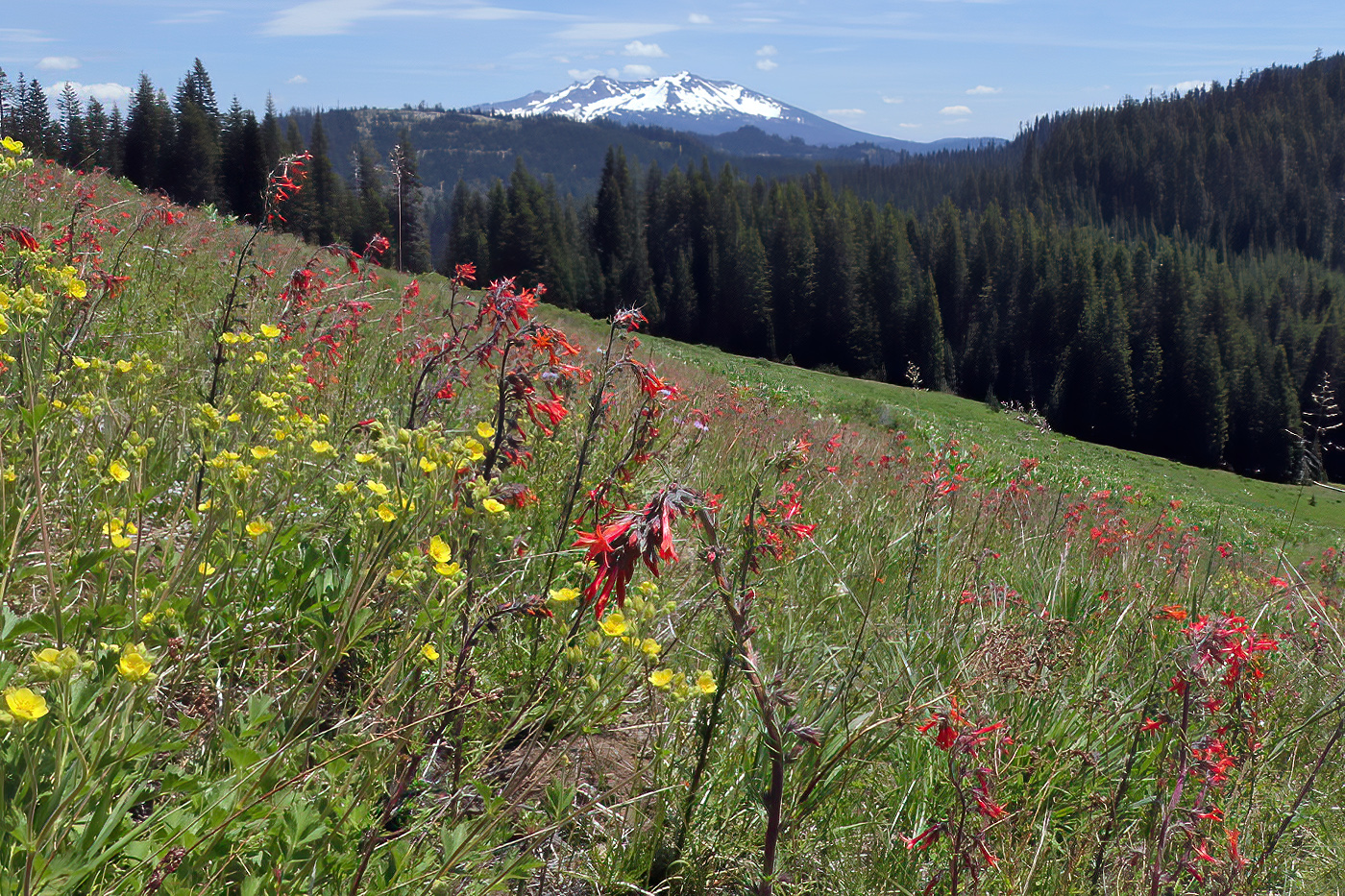
From high up on Little Groundhog meadow where the skyrocket (or scarlet gilia) and sticky cinquefoil were abundant, I got a great view of Diamond Peak to the east.
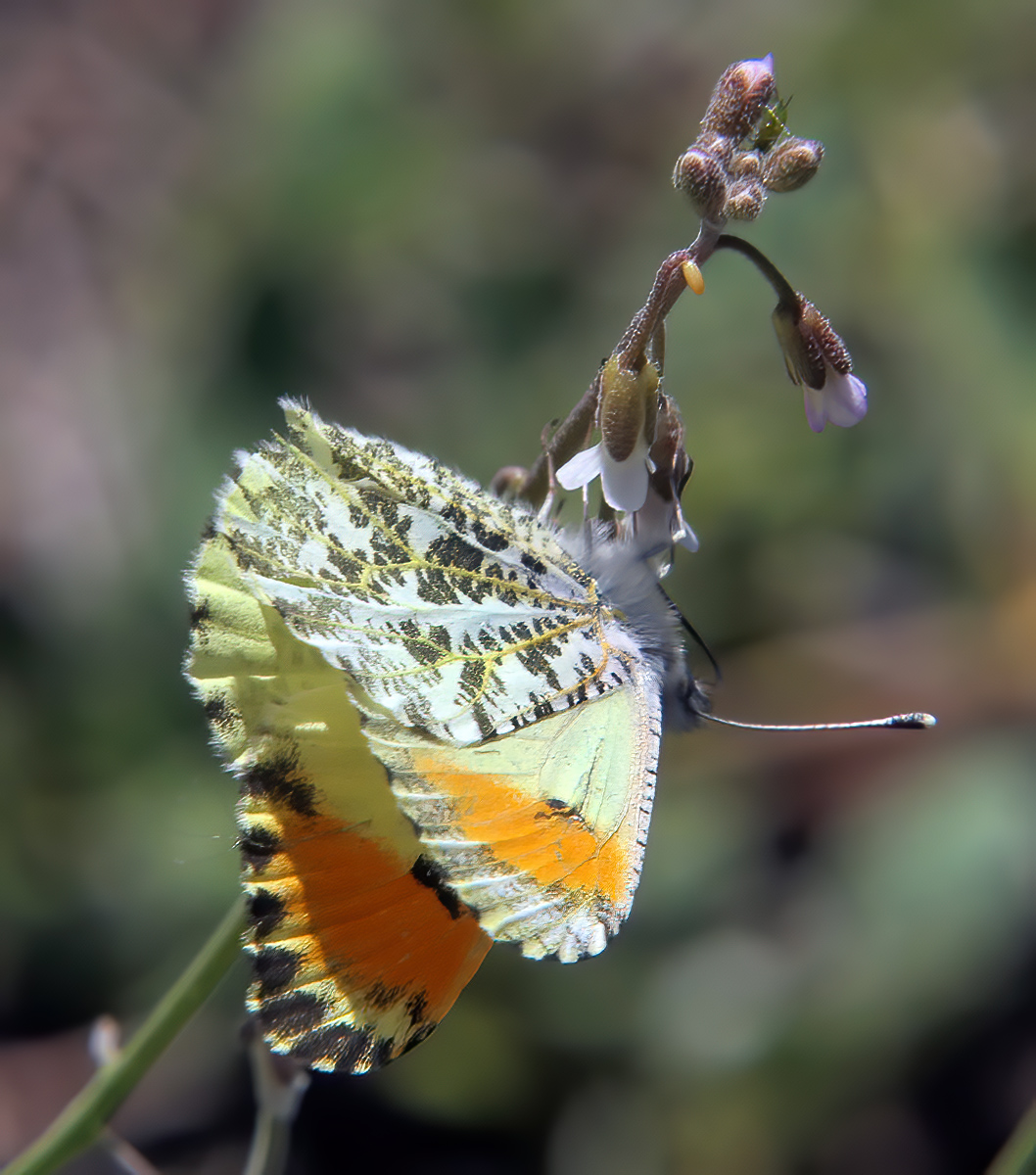
This lovely female Julia’s orangetip was nectaring on a rockcress (Boechera sp.), which might also serves as a host food plant for many whites, including orangetips.
After not reaching the wetlands at Groundhog Mountain the previous week (see Long Overdue Return to Warfield Bog and Hemlock Butte Wetland), Alan Butler, Dave Predeek, Don Wirtala, and I made another attempt on June 25th. This time, we headed in from the west starting on Road 2120, like I’ve been doing for a number of years. The first 4 or 5 miles were in good shape, and I was hopeful for a relatively easy drive up, but then we started to see lots of trees down on the road. Someone had cut some gaps, but we got out a number of times to move branches and small trees off the road. I was going to be leading a field trip for NPSO on July 12th, so I was hoping to make sure the road was clear for passenger cars. After a while, however, it became apparent that there were too many obstructions for me to get my car up this way, let alone to take a group. Having gotten most of the way up, however, Alan didn’t want to turn around and thankfully was able to slowly get his truck over, under, and around dozens of downed trees.

The receding water at Waterdog Lake had left these tadpoles in an isolated pool, so I scooped up as many as I could and moved them into the nearby open water. Hopefully, they’ll make it to adulthood. We did see little toads hopping about here and there.

Here’s one of the tiny toads in the wetland by Waterdog Lake. It’s incredibly well camouflaged on the bare soil near a melting snowbank. To be honest, this photo is somewhat staged. The tadpole didn’t want to stop near the fresh steer’s head, so Don caught him and placed it next to the flower so I could get them both in the same photo.
We finally got past the fallen trees, but then we had to cross a little snow to get to Waterdog Lake. At least that was a good sign that we’d see some more snowmelt species, and we did in fact see glacier lilies (Erythronium grandiflorum), western springbeauty (Claytonia lanceolata), and steer’s head (Dicentra uniflora) along with mountain shooting star (Dodecatheon jeffreyi) and marsh marigold (Caltha leptosepala). I tried in vain to relocate the single plant of Crater Lake currant (Ribes erythrocarpum) that I discovered on our trip together last year (see Peak Flowers at Groundhog Mountain), but for some reason, I hadn’t waypointed it. There were lots of other Ribes species in bloom though.

Don found this unfortunate black petaltail dragonfly with a damaged forewing. There’s also a bad spot on its right hindwing. I wonder if it got damaged as an adult or whether it could have emerged improperly. Poor thing won’t have much of a life.

Don is looking at a dragonfly in the patch of mountain shooting star (Dodecatheon jeffreyi). Much of the “dirt” on the snowbank was actually pollen.
Next we headed farther west along the road to the floriferous roadcut area. It was actually quite far along, and some of the buckwheat (Eriogonum compositum and E. umbellatum) was already coming into bloom. We spent a while watching all the butterflies nectaring on it. On our way back toward Waterdog Lake, I was looking to see if any of the skyrocket (Ipomopsis aggregata) was in bloom yet along the road, so we slowed down. Looking up the large meadow on the south side of Little Groundhog Mountain, I realized the tinge of red in the upper part of the meadow was a spectacular sweep of blooming skyrocket! We couldn’t resist climbing up the slope to see the show. Overall, the meadow isn’t terribly diverse, but there’s far more skyrocket there than I’ve ever seen anywhere else. It definitely felt like one of those spots to break into “The hills are alive with the sound of music,” and we hung out there for a while enjoying the scenery and pleasant weather.

While Alan and Don were enjoying the awesome show of skyrocket in the Little Groundhog meadow, I climbed higher up to where I could see Waterdog Lake where we’d been earlier in the day.
Not wanting to drive back the way we came or to the north that had been blocked by a tree the previous week, we figured we’d better head south toward the lookout. If we could reach the lookout without any obstacles, the road down to the reservoir would most likely be clear down to Hills Creek Reservoir. So instead of going to the wetlands along 2309, we headed south, first stopping at Logger Butte. It was gorgeous again, with many of the rock plants still quite fresh.

Cliff penstemon (Penstemon rupicola) is one of my favorite flowers, so I was delighted that we hit it at peak bloom on Logger Butte.

Along with cliff penstemon, other flowers growing on the fantastic rocks at Logger Butte include harsh paintbrush (Castilleja hispida) and Cascade fleabane (Erigeron cascadensis).
It was a relief to me that the road from Logger Butte to the Warner Lookout was fine (as was the rest of the way back). We were going to skip the lookout, but as we passed the access road, we noticed the gate was unlocked—a rarity—so Alan drove up to the lookout. It turns out Jake, the man staffing the lookout this summer (and last), had just arrived and was getting settled in for the summer. After his incredibly sweet dog, Leo, came down the long flight stairs to greet us each in turn, we spent a while talking to Jake and playing with Leo. Both on the way in and out, we had a little bit of excitement when a red-breasted sapsucker flew right by the truck. It was a wonderful way to end our day.

What I believe is a masked bee (Hylaeus modestus) and a couple of thrips were dining on a sticky cinquefoil (Drymocallis glandulosa) flower. Cinquefoils usually have 5 petals, but this odd one only has 4.

On our way to the Warner Lookout, we had to stop so I could show my companions the rare green wild ginger (Asarum wagneri), which grows right beside the road just east of the lookout.

Looking northeast from the lookout, we had a view of Logger Butte where we’d just been (in the upper center between the conifers in the foreground). The beargrass (Xerophyllum tenax) was in full bloom close to the lookout, but the main meadow hadn’t really started yet.
Great hike!!! Do I get redundant??? I’m so grateful for your beautiful bountiful boundings!!!! I LOVE seeing tht BUFO!!! We have not seen ours in a couple of yeras even though we have hundreds and hundreds of treefrogs…and adore each one that survives.. I think I’ve said we keep lots of water “holes” in our garden as well as the big pond down the hill from our home.. I’m also grateful that I have several specimens of Penstemen rupicola thriving here basically in troughs but quite happy. I do wish our Xerophyllum tenax would bloom….It’s bloomed once and did NOT die…so it’s a great “lily” plant for that grassy accent..Seed I bought of Castilleja hispida… never sprouted…drat..I should try more with the Penstemon next to it….’ Thank you Tanya!!! Such a wonderful hike!!! Stay cool…Happy hiking!!!