Long Overdue Return to Warfield Bog and Hemlock Butte Wetland

Warfield Bog was filled with beautiful buckbean in peak bloom. I’ve rarely had such good timing with buckbean because it blooms very early. It is also difficult to get close to as it grows in shallow water that is often quite mucky.
On June 18th, I accompanied Alan Butler, Dave Predeek, and Don Wirtala for a trip up to Groundhog Mountain. It was new for Don, and Alan was really looking forward to showing him this wonderful area of wetlands and rocky roadsides. We headed up Road 2309 from the north, Alan’s favored route, but alas, after enjoying the flowery roadcut area, we were stopped by a very large old growth tree that had fallen across the road. Alan didn’t feel like going all the way around the reservoir to come in from the west side, so we came up with a backup plan—something we should have already thought about this early in the season.
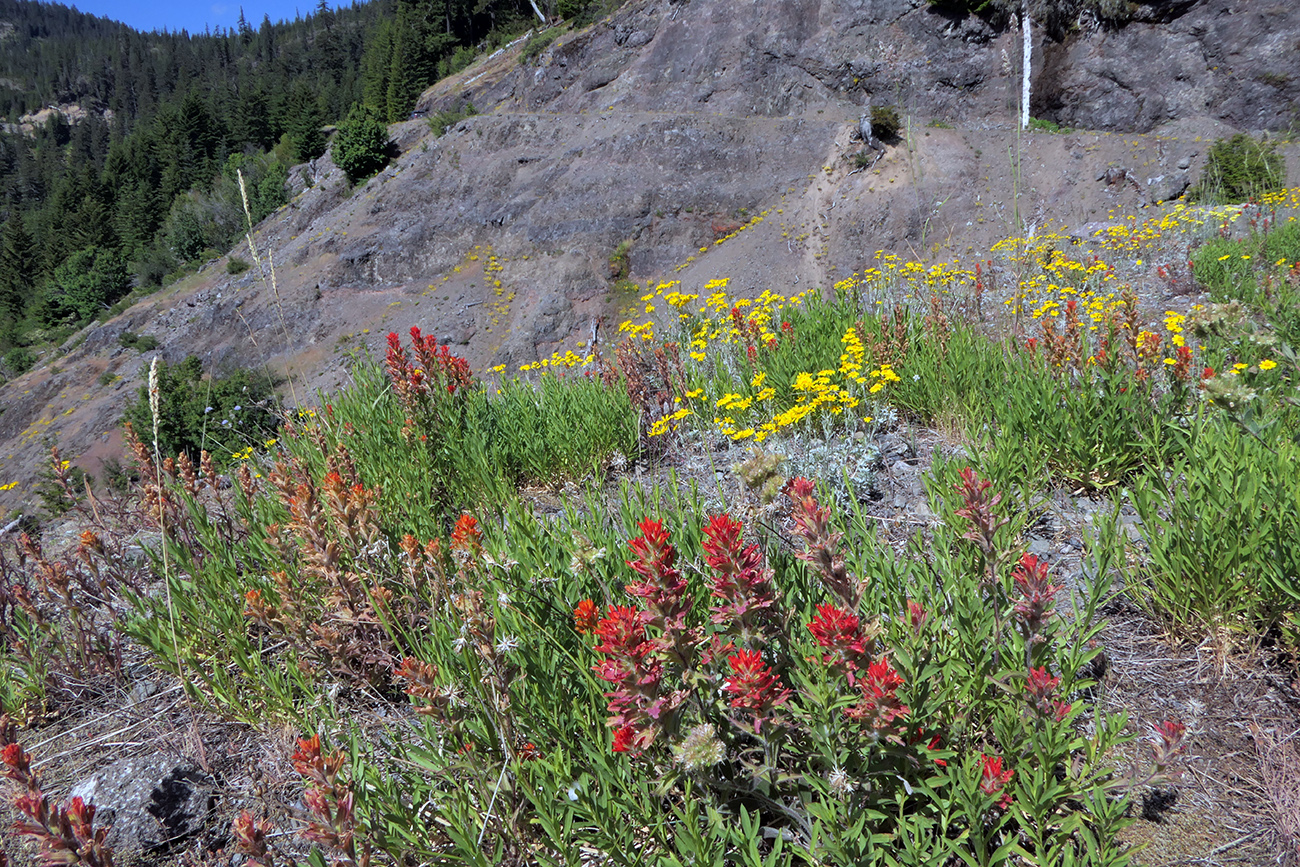
The roadcuts on 2309 on the way up to Groundhog Mountain were well along and drying out, but the harsh paintbrush (Castilleja hispida) and Oregon sunshine (Eriophyllum lanatum) were still providing a lot of color. We thought it was interesting how the Oregon sunshine on the steep banks below the road were following the cracks down the slope.

As soon as I saw rockcress (Boechera sp.) growing on top of Wolf Mountain, I checked for butterfly eggs as this is a good host food plants for whites (Pieridae), and I quickly found these two little orange eggs. These might have been laid by what was probably a western white that whipped past me.
We headed back down to Road 23 that starts on the north end of Hills Creek Reservoir, and drove up Road 2316 that rides along the ridge between 23 and Hwy 58 to see if we could get to Warfield Bog. For some reason, this interesting wetland had fallen off my radar, and I hadn’t been there in 11 years. It was a relief to find the road in great shape, and it was easy going getting to the bog. Alan had been there before but had never explored the bog itself, so we headed out there.
I had wisely brought rubber boots on the trip, but then stupidly left them in Alan’s truck as we wandered about the dry areas looking for the population of American red currant (Ribes triste) I remembered from long ago. It was right where I remembered it, but unfortunately it had finished even though all the other Ribes species were in full bloom. I was too lazy to go back and get my boots, so I eventually got wet trying to navigate my way through the bog. The trick is to stay where the huckleberries grow as the ground is usually firmer there, but that only gets you so far, and eventually there’s some wet area too wide to jump over. Although I had been here 8 times before, I’d never seen the masses of buckbean (Menyanthes trifoliata) in full bloom. It was gorgeous (worth getting wet feet to get close to!). There were also pretty purple patches of elephant’s head (Pedicularis groenlandica) growing by the buckbean.

A closer view shows the white fringed petals and reddish buds of the lovely buckbean flowers. The species name, trifoliata, refers to the large three-parted leaves.

From the road above Warfield Bog (which you can see on the near left), the view north to the far side of Highway 58 is quite impressive, but it was bittersweet for me seeing how much of the forest had burned from the recent fires, especially the devastating Cedar Creek Fire. I was relieved to see that Mount David Douglas and Verdun Rock on the right in the middle distance were unscathed. The ridge behind Mount David Douglas with the green meadow area is Bunchgrass Ridge. It had burned a number of years ago but had evidently burned again in this last fire.
Continuing east on 2316, we drove past some snowbanks alongside of the road. Thankfully they didn’t cross the road, so we were able to get to Wolf Mountain. At over 6400′, it is the highest point on the ridge, and some communication towers are located there. There was also still quite a bit of snow remaining on the north side. I had only tried to get up there once in the past but found the road too covered with loose rock and turned around. It was quite clear this time but a lot of water bars still meant slow driving. Though the summit is quite disturbed and not very diverse botanically, we did enjoy beargrass (Xerophyllum tenax) and Newberry’s knotweed (formerly Polygonum newberryi, now Koenigia davisiae) beginning to bloom along with the fabulous view, and there were several hilltopping butterflies.

There’s a terrific view from the summit of Wolf Mountain. The Three Sisters can be seen to the northeast. Again, there is lots of evidence of heavy fire damage to the north and east. The fires to the south around the Groundhog Mountain area were not as intense and left more of a mosaic of live and dead trees.

There was lots of California Jacob’s ladder (Polemonium californicum) along the road to Wolf Mountain. It is common in the area at higher elevations above about 5500′. Wild strawberries (Fragaria virginiana) added to the pretty vignette.

Checkerspots have been everywhere lately. This Hoffman’s or northern (I give up trying to tell them apart!) was nectaring on orange agoseris (Agoseris aurantiaca) by Wolf Prairie.
We headed back to 2316 and continued east until we came to the bottom of Wolf Prairie, a a large meadow on the south flank of Wolf Mountain. This had been a good stop in the past as water seeping across the road attracts lots of butterflies. Although it was pretty dry, and there was no water running down the road, the butterflies were still there in good numbers, so we enjoyed our half hour there. There were also some nice wildflowers, including lupines (Lupinus sp.), tall bluebells (Mertensia paniculata), musk monkeyflower (Erythranthe moschatus), and bronze bells (Anticlea occidentalis), which I remembered as a special plant from previous trips. I noticed on Google Earth that the meadow is a great deal larger than we could see from the road—it reaches 700′ up the mountain, so one of these days I’ll have to try to explore the rest of it.

Along the road below Wolf Prairie, the butterflies were lined up along the edge of the road. Although the water had dried up, it must have been here recently (I’d seen this in the past) and left a trail of minerals. Most of the butterflies were California tortoiseshells and checkerspots.

Don crossing through the Hemlock Butte wetland amid lovely mountain shooting star.

Trailing gooseberry (Ribes binominatum) usually has inconspicuous creamy flowers, but this individual in the Hemlock Butte wetland had attractive red-tinged flowers.
When we finally intersected with Road 23 again, we continued east a few more miles to Hemlock Butte. I was surprised to see how different the road looked after a major thinning project on the roadside. I was a bit peeved to see they dumped much of the slash right across the road from the wetland near the Hemlock Butte trailhead. This was a nice area of meadow in the past, but I guess it didn’t seem special to the loggers. At least the main wetland itself was still intact and filled with mountain shooting star (Dodecatheon jeffreyi) as well as 3 species of violets (Viola macloskeyi, V. palustris, and V. glabella). We eventually noticed the tall leaves of Pacific swamp onion (Allium validum)—an uncommon species in the Western Cascades, but it won’t bloom until later in the season. There were still snowbanks along the south edge as well as a small ephemeral pond. We didn’t have time for the lower wetland, but we did make a few short stops on our way back on Road 23 (paved but not in the best shape). We were disappointed in not getting all the way up to Groundhog Mountain, but we ended up having a great day anyway and made plans to try Groundhog again the following week.

Alan was excited to find this large bear paw print in the Hemlock Butte wetland.
Thank you!! I wonder if anyone sells BuckBean seed…Our pond which is about an acre becomes marshy…as the season progresses…and there are low lying spots that remain damp. ( Another GREAT HIKE by the way!!! Love this). I was stupid to introduce ‘parrot feather’ but our wild turtles and few koi are okay ( koi not being native…was a mistake too…but having a population of Western Pond Turtles is terrific!!).. I’m sure I’ve said but we are at 2000 feet elevation..I love that sweet Ribes…NOT thorny like my R. roezelii..And Ribes roezelii is the fort to bloom in late February in our garden..
Happy day after the Fourth..All is quiet on our front..
I think your paw print is more likely a cougar paw print. I don’t see any sign of claw marks in the photo and bears can’t retract their claws. Exciting either way.