Early Season at Echo Basin

From the meadow as we approached the wetland, we could see snow remaining on the north-facing slopes of the basin.
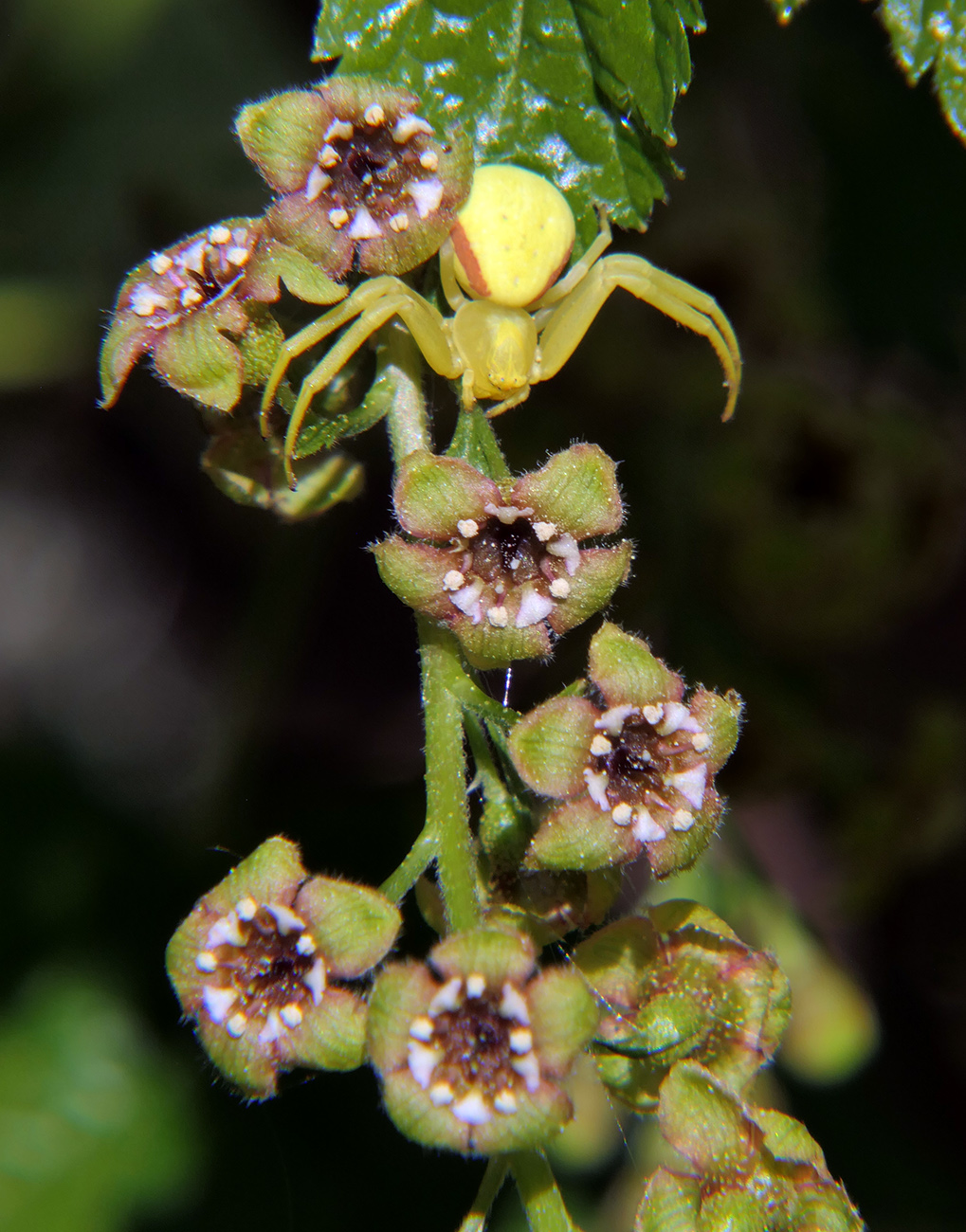
A crab spider strikes a scary pose on the inflorescence of stink currant (Ribes bracteosum).
Echo Basin, just east of Cone Peak, is one of my go-to places in late summer since its wetland and creek retain moisture for a long time, and there are lots of late-blooming wildflowers. It’s also a fairly easy trail with plenty of shade, making for a pleasant hike on a hot day. I realized last October when I went seed collecting (see Berry Collecting at Echo Basin) that it had been many years (20!) since I’d been there to see the early part of the season. When a short but unpleasant heat wave hit us in early June, I decided Echo Basin was the perfect destination for Saturday, June 7th. It wasn’t supposed to be the worst day of heat (although it was 93° when we drove through McKenzie Bridge on the way home), but it was still too hot for anything strenuous.
It turned out to be a great decision. Nancy Bray accompanied me, and we had a lovely day walking through a forest of fresh woodland flowers. Mountain shooting star (Dodecatheon jeffreyi) and skunk cabbage (Lysichiton americanus) were in full bloom and Suksdorf’s paintbrush (Castilleja suksdorfii) was getting started in the wetland. We were never far from the delightful sound of Echo Creek, flowing hard from all the melting snow. Snowbanks remained along the trail on southern part of the loop. When we emerged into the open meadow, there was a good breeze, so we never got hot. And for those who worry about early hikes in the Cascades, there were no mosquitoes, nor do I remember ever seeing any there.

Nancy and I were impressed by the abundance of bleedingheart (Dicentra formosa) under the alders, which were just leafing out and giving off of delicious resinous scent similar to that of cottonwoods.

It had been ages since I’d seen the pale purple flowers of marsh violet (Viola palustris).
For some reason, it’s not a very popular trail, but we crossed paths with two very nice nature lovers, Libby and Ian, who work at the HJ Andrews Experimental Forest during the summer. We heard about the effects on research on the forest after a majority of it burned in the Lookout Fire a couple of years ago. Those like Libby who are fascinated by fire ecology were not as affected as those who’d spent many years monitoring intact forest habitat. I can’t imagine what it would be like to have your longterm plots and equipment completely wiped out. They will undoubtedly have to make major changes in their research plans. KLCC has a short article about the challenges facing HJ Andrews as they resume research post-fire.
If you haven’t been to Echo Basin, you should check it out. Be aware that while the 2-mile gravel road is passable and mostly in good shape after recent regrading, there remains a major dip near a rocky roadcut just a short way before the trail. It is fine in my passenger car as long as I go as slow as possible, but you could also walk the last little bit. The southern half of the loop trail is also a bit overgrown with devil’s club, salmonberry, and other shrubs, and there are lots of fallen logs to traverse. If you find that daunting, just go back the way you came after reaching the wetland at the far end of the loop.

There were lots of these attractive Vancouver flower longhorn beetles (Evodinus vancouveri) visiting western trillium (Trillium ovatum). While there were lots of fresh flowers, this one is just starting to take on the pink color they develop as they age.

This handsome Cascades frog was staying cool right in the middle of creek where it crossed the trail in the wetland.

With all the showier flowers in bloom, even a wildflower lover could be forgiven for missing the tiny petalless flowers of blunt-sepaled starwort (Stellaria obtusa). It usually grows under taller meadow species. It’s more common than thought but often confused with the similar crisped starwort (S. crispa), which has 5 petals and sepals. This species has 4 sepals and some ciliate hairs at the base of its leaves.

On the way back on our counterclockwise loop, we saw lots of rosy twisted stalk (Streptopus lanceolata) growing right beside its lookalike starry false Solomon’s seal (Maianthemum stellatum). Starry false Solomon’s seal (in the front) has terminal inflorescences, which are still in bud here. The twisted stalk in the back has individual pinkish bells that dangle below the leaves. Its leaves are relatively shorter, but this is rarely noticeable unless the two are growing together, as they often are in damp woods.

Mountain buttercup (Ranunculus populago) was in peak bloom in the wetland.

The petals of small white violet (Viola macloskeyi) have a touch of chartreuse at the base of the petals here as I’ve seen in some other populations.
Thank you Thank you!!! I’m almost hiking with you!! Your photos are wet and juicy…like we like them…
The two thank yous are because our internet tromped on us the other day …and I thought we’d been totally crashed…but strangely we were back the next day..
Love the Cascade Frog!! We only have our beloved “tree frogs” here with a zillion tadpoles..The reason to have water in the garden..is not only for plants but all our tiny critters …including our Western Pond Turtles… Love that brilliant crab spider…Long Horn Beetle…beautiful,,, We have also a vast palnting of Dicentra formosa…that has spread hugely in the twenty some years …always loved…
Here’s to your next exciting hike!! Thanks for taking me along…
Nice little adventure, Tanya. I’ve been on the scout for Rosy Twisted Stalk ever since finding the clasping yellow flower version. One of those sort of peculiar flowering strategies. And in spring, violets are always a pleasure to find.
I love your photographs and your reports.