Mistmaiden Meadow and Elk Camp Round 2
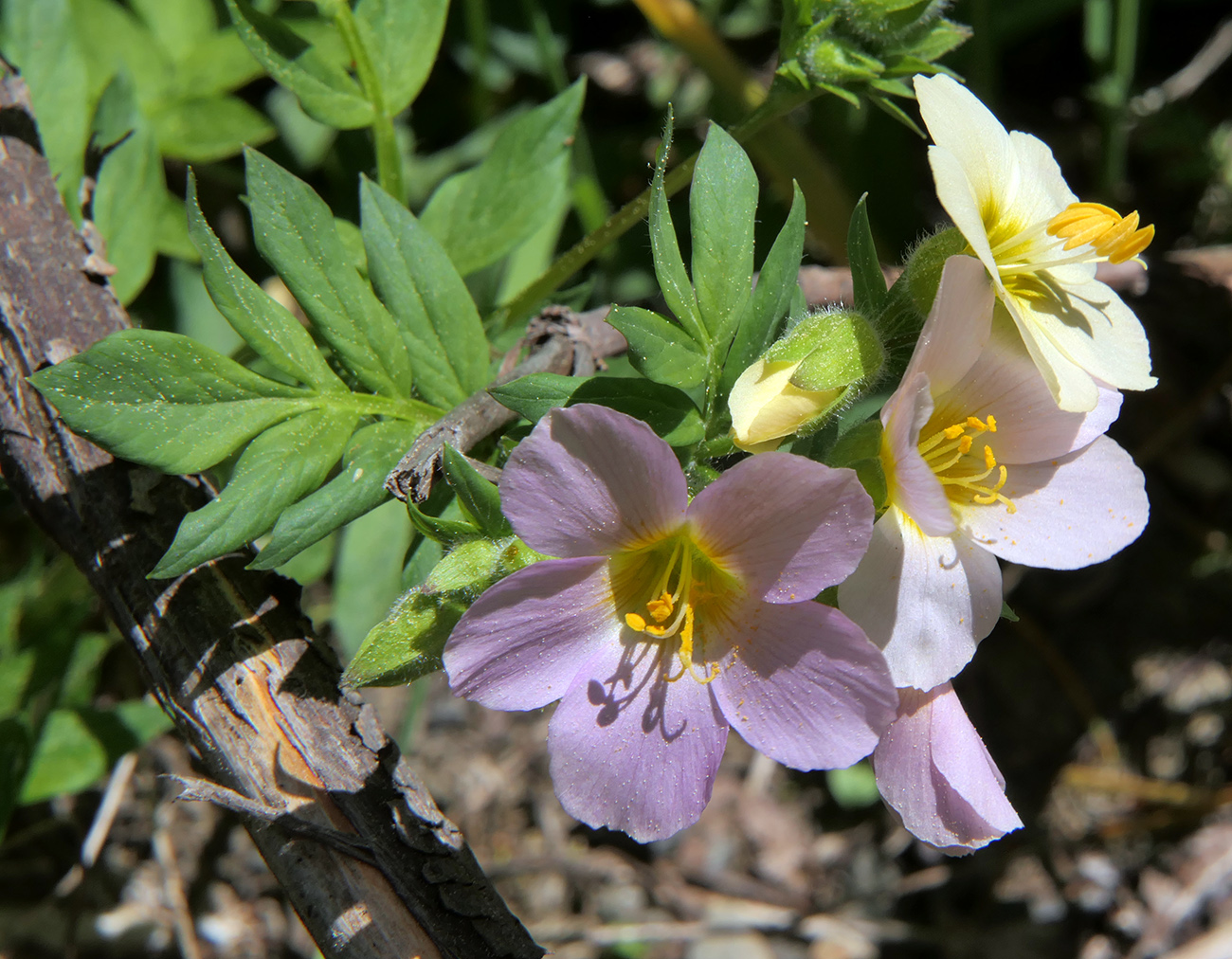
Without a doubt, one of the stars of the day was the gorgeous great polemonium (Polemonium carneum). It grows profusely at both Mistmaiden Meadow and Nevergo Meadow. While many polemoniums (also known as Jacob’s ladder) are in shades of blue, this species shifts from pale yellow through peach and lavender to pinky purple. You can see the progression in this photo from the yellowish bud to the pale yellow flower in the upper right, still fresh with undehisced stamens, to the pale purple flower in the middle with dehiscing stamens, and finally to the darker flowest in the front.
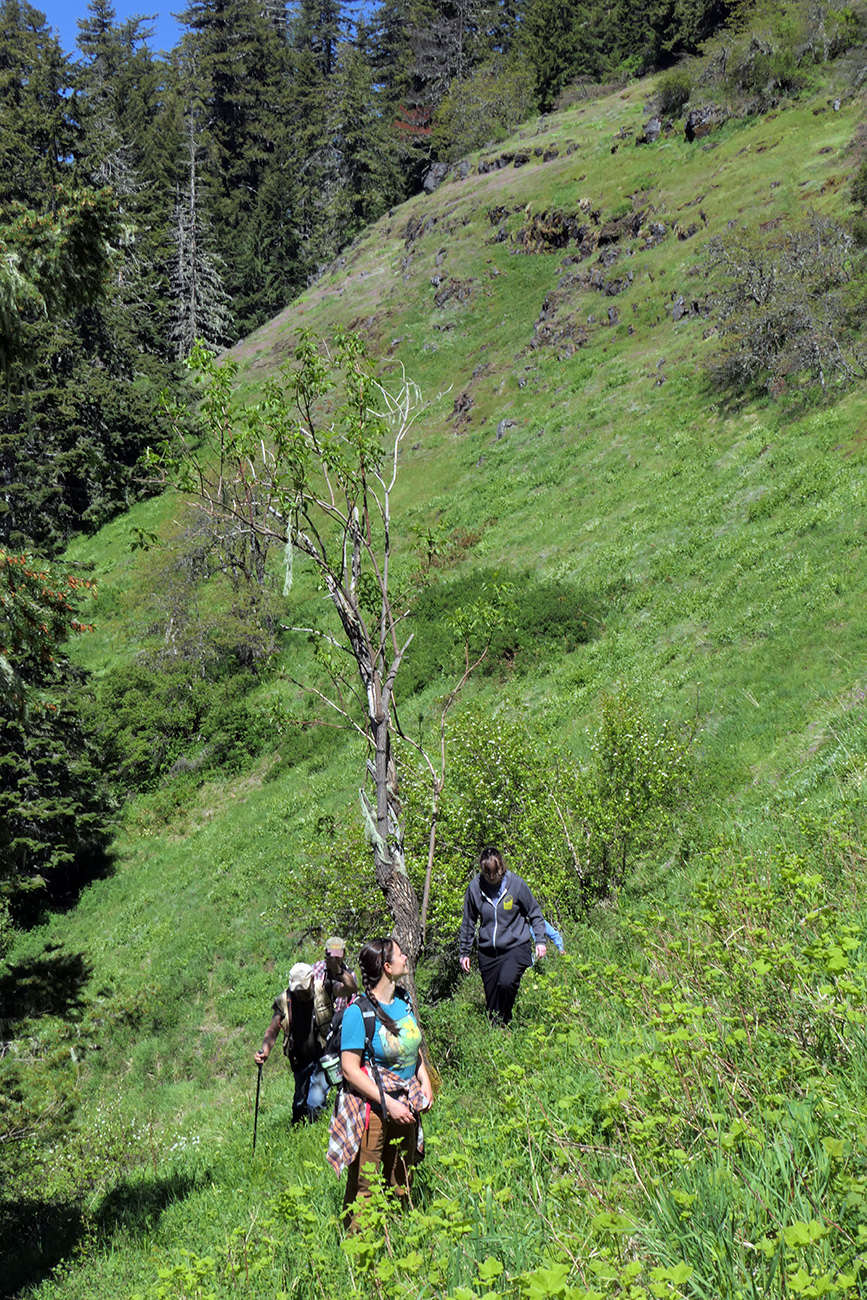
Traversing Mistmaiden Meadow
After successfully reaching Mistmaiden Meadow and Elk Camp and Nevergo Meadow the previous weekend (see last post, Early Spring Bloom Begins at Elk Camp and Mistmaiden Meadow), I felt comfortable inviting people who said they were interested in seeing Mistmaiden Meadow. So on May 31st, I was joined by Linda Hardison, my boss at OregonFlora, Denny Albert, an ecologist who has contributed to the Flora of Oregon, Leela Hickman, botanist in the district, and Sol Ziegert and his partner Hattie.
It was a beautiful sunny but cool day—perfect for a day of botanizing. Since Mistmaiden Meadow was what people were most interested in exploring, we went there first. It was lovely as always. The Thompson’s mistmaiden (Romanzoffia thompsonii) was finishing, but there was still enough to show everyone this adorable Cascade endemic. Better still, its lookalike, Nuttall’s saxifrage (Cascadia nuttallii) was now blooming, so we were able to look at them side by side. The rosy plecritis (Plectritis congesta) was coming along and starting to form swaths of pink in the meadow. Along with the annuals, perennials including western waterleaf (Hydrophyllum occidentale), Hooker’s fairybells (Prosartes hookeri), and fern-leaved biscuitroot (Lomatium dissectum) and shrubs like Douglas’ hawthorn (Crataegus gaylussacia) were in bloom. There was still plenty of moisture fueling the lush vegetation.

Naked broomrape (Aphyllon purpurea, formerly Orobanche uniflora) is always a favorite. Here it is parasitizing wholeleaf saxifrage (Micranthes rufidula), while Thompson’s mistmaiden’s even tinier flowers peek out.
We carefully traversed the meadow along the middle, coming back across the top. The interesting plants near the bottom hadn’t started blooming yet. Although we did find a flower or two of narrowleaf mule’s ears (Wyethia angustifolia), the big display won’t happen for quite a while yet, so we didn’t want to exhaust ourselves going all the way down and back up the steep slope.

Denny and Linda heading back up Mistmaiden Meadow through the rosy plectritis.

The group enjoyed the spectacular spring show of marsh marigold and shooting star at Elk Camp.

Oregon bluebells (Mertensia bella) is one of my favorite early spring flowers. In Oregon, it is only found in a few places outside a limited area of the Western Cascades from northern Lane County to Marion County, so I don’t see it as often as I’d like.
After lunching near the top of Mistmaiden meadow, we drove the 4 miles over to Elk Camp. The marsh marigold (Caltha leptosepala), mountain shooting star (Dodecatheon jeffreyi), and Oregon bluebells (Mertensia bella) were still blooming well, and now the alpine laurel (Kalmia microphylla) was in full bloom. The snowmelt species were mostly gone, but we did manage to find a few fresh western springbeauty (Claytonia lanceolata) and glacier lilies (Erythronium grandiflorum) where the last snow banks were on my previous trip.
I relocated the spot along the east edge of the wetland where I found the small-flowered Nevada lewisia several years ago (see Relaxing Day at Elk Camp Shelter), but I simply couldn’t find any of the larger-flowered ones that grow near the Umpqua frasera (Frasera umpquaensis). The little ones looked like they might be in bloom, but we were too late in the day to see the open flowers. In the Flora of Oregon draft treatment of Lewisia, Aaron Liston, the primary author, has decided to lump Lewisia nevadensis as a variety of the similar pygmy lewisia (L. pygmaea) because the two intergrade so much in Oregon. The main differences are in flower size and sepals. That would mean that both varieties grow at Elk Camp. The patch that has small flowers with some glands on truncate sepals is L. pygmaea var. pygmaea, while the plants with large flowers and irregular, non-glandular teeth on more acute sepals are now L. pygmaea var. nevadensis. Sometimes plants just don’t make it easy to give them a name!

Like many Lewisia, pygmy lewisia closes in the afternoon on sunny days, so what look like white buds may actually have been open in the morning. With the lack of rain this spring, everything was covered with pollen.

You have to get out early to see the unusual and exquisite flowers of alpine laurel. We looked carefully for fresh flowers that still had stamens tucked in the little pockets. After an insect lands on them, the stamens spring up, dousing the insect with pollen–very clever!
Sol, Hattie, and Leela headed home early soon after we arrived at nearby Nevergo Meadow, but not before I got a chance to show them the rare fungus that grows in the anthers of the heartleaf springbeauty (Claytonia cordifolia) there (see Shooting Stars are Stars of a Great Day for more about this). Linda, Denny, and I spent a little more time admiring the pretty wetland and the narrow but deep creek that runs down the center of it along with the colorful show of great polemonium along the roadside.
On the way back, we made a short stop to look at the beargrass (Xerophyllum tenax) and big deervetch (Hosackia crassifolia) coming into bloom along Road 140, but it was still early in the season there and there weren’t any butterflies flying yet. For our final quick stop, we went down to the devil’s club swamp along Road 1912 that I’d discovered the week before and found a large stretch of blooming long-tailed ginger (Asarum caudatum). So many different plants and different habitats to look at. I hope my companions enjoyed it as much as I did. I was really glad to have had the chance to spend a great day among beautiful flowers and good friends.

Greenish blues are common in Cascade wetlands where longstalk clover (Trifolium longipes) grows. It’s undoubtedly a host plant, for its caterpillars and also a favorite nectar plant.
HEY TANYA!!!!! Fabulous hike…and GREAT company!! I am so delighted to see one of my favorite plants..what we’ve been calling Orobanche uniflora ( now Aphyllon purpurea) in your photos!! This wonderful little “parasite” grow abundantly i amongst all my Sedums…and that’s how it “invaded” our wild garden..I TREASURE IT..
All your jewels were appreciated here…I would love to grow Mertensia bella…and also the little Kalmia. I lost my Kalmiopsis leacheana to 111F last year that I’d had for fifteen years…tragic!!! But mu Asarum marmoratum is getting healthier and happier!!
Thank you for this special hike with wonderful photos..