Early Spring Bloom Begins at Elk Camp and Mistmaiden Meadow
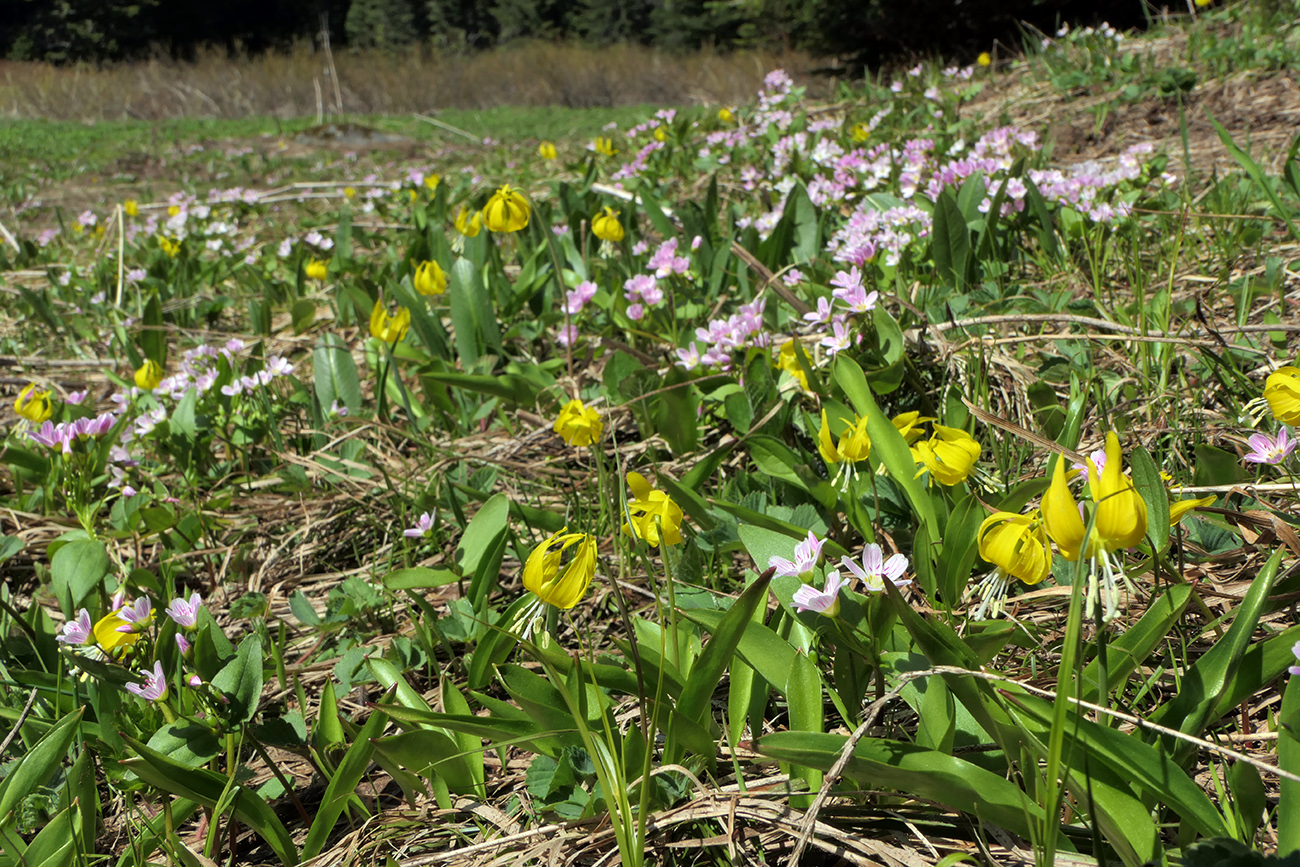
Western springbeauty (Claytonia lanceolata) and glacier lilies (Erythronium grandiflorum) were following the melting snowbanks along the edge of the wetland at Elk Camp. Well worth the many miles of gravel road to see this gorgeous display!
On Saturday, May 24th, I finally got up into the mountains. So far this spring, I’d gone down to the Siskiyous, up to the Columbia Gorge, and made a few trips out to Rigdon. I had yet to get up high or drive on any real gravel roads. As dry as it has been in April and May, I really wanted to go somewhere fresh and moist. Elk Camp is only 4400′, but it feels higher and is level enough to retain lots of snow. I wasn’t sure I would make it there this early in the season, but Mistmaiden Meadow is right on the way, and if I couldn’t even get there, I figured I’d go to Tire Mountain—always a worthwhile trip. I knew that the roads would be clear up to Tire Mountain and Road 1912 as far as the intersection of Road 140 because mountain bikers can get on the extremely popular Alpine Trail there, and the outfit that drives shuttles of bikers up was advertising daily trips there. In fact, I think I saw 5 vans along the road. I normally would have avoided going up there on a weekend—and a holiday weekend at that—but the weather was gorgeous, and I didn’t want to wait any longer.

This garter snake and chorus frog were just a few yards apart in the swampy spot on the edge of Road 1912. Odd that the only animals I saw all day would be so close to a road.
Just before the intersection of Road 140, I stopped at the small devil’s club (Oplopanax horridus) spot along the road I’d discovered a couple of years ago. There isn’t much devil’s club in the Middle Fork District, so it is always worth noting. I also had to pee, so I ducked into the forest downhill to get safely out of view of the shuttle vans. I already knew there were a few more devil’s club plants in the woods there, but I was really surprised to see a bunch of skunk cabbage (Lysichiton americanus) leading to a large swamp filled with devil’s club (43.8478 N, -122.4697 W if you’re interested in bushwhacking in swamps). I had to check the whole place out, and my “quick stop” lasted almost an hour and a half.

Brewer’s bittercress (Cardamine breweri) is a mustard family species that is usually found where it is very wet, often growing right in running creeks. It was coming into bloom in the swamp.
The skunk cabbage was mostly finished blooming, but the devil’s club hadn’t leafed out yet. This was fortunate because I was able to sneak right through the middle of the patch without brushing against too many spines. I discovered that in spite of the upright nature of the upper stems, much of the shrub was creeping along the ground. I would think I was safely avoiding some prickly stems, but then I would step on a prone stem, and it would slap the top of the shrub against me. I wised up and decided to circumnavigate the swamp in the open woods rather than risk getting stuck by the devilish spines. I got stabbed once on O’Leary Mountain where the abandoned trail is covered with them, and it hurt for a long time.
I followed the swamp to where it narrowed down and more or less disappeared, a small creek running on either edge of it rather than down the middle. From the map on my phone, I could tell it was finally running into the creek that crossed under Road 140 that I had explored on past trips. These are both part of the headwaters of the South Fork of Winberry Creek. I recorded a plant list, noting lots of salmonberry (Rubus spectabilis) and its best friend stink currant (Ribes bracteosum), both coming into bloom. The herbaceous layer was filled with oxalis—probably O. trillifolia as there is lots of that along the other creek, and it likes its feet wet. Speaking of that, I’d forgotten to bring rubber boots with me, but I was able to step carefully to not get my feet wet—yet. There was also quite a bit of false bugbane (Trautvetteria caroliniensis), which should be quite pretty later on. Tiny-flowered mitreworts (Pectiantia pentandra and P. ovalis) were blooming but hard to spot among the many shrubs.

The neat hidden swamp southwest of the intersection of Roads 1912 and 140.

The treacherous stems of devil’s club are much easier to see before the leaves have unfurled.
Really thrilled at having discovered a new botanically interesting spot, I was much more relaxed about whatever the rest of the day would bring. I headed a little farther up 1912 and turned west onto Road 140. Immediately I came across a small tree all the way across the road. Others had evidently driven across it, but I don’t want to risk popping a tire, so I pulled out my hand saw and disposed of it. I made many more stops to clear off branches and small tree tips. Thankfully, someone had taken care of all the large trees and branches to make the road passable. But since I plan to return again at least once or twice and with other folks, I took the time make the road more suitable for passenger cars. There was one major obstruction just before my pull off to Mistmaiden Meadow. A passageway had been cut through a large tree but with very little leeway. Thankfully my Hyundai Kona EV has a bird’s eye camera—something I had really, really wanted for mountain driving. It came in handy as I very slowly threaded the narrow opening—the car giving me lots of angry beeps about how close I was to bumping into something. Later in the day on my way home, I was getting back into my car from Mistmaiden Meadow just as three vehicles came south on the road. I heard them come to a halt at the fallen tree and figured I’d go see how they managed it since a couple of their vehicles were larger than mine. One of them got out and guided them all through. He also kindly helped me through so I didn’t have to rely on my camera.

Threading the needle. I really appreciate the person(s) who cleared the roads, but couldn’t they just make those openings a foot larger!

When I first spotted one of these on the trail at Elk Camp, I thought someone had thrown out their orange peel. It turns out that there were lots of these well-named snowbank or spring orange peel fungus (Caloscypha fulgens) beautifully catching the light.
After more branch cutting and making a wrong turn (my own directions were wrong, but I’ve fixed them!), I finally made it to Elk Camp at 1:45 pm, where there was still a patch of snow on the side of the road—a very good sign. I continued the half mile to Nevergo Meadow where there were lots of blooming skunk cabbage and gorgeous marsh marigold (Caltha leptosepala) as well as early mountain shooting star (Dodecatheon jeffreyi) and Oregon bluebells (Mertensia bella). One of the main reasons I wanted to get to this area was to see fresh western springbeauty since I have been working on an illustration of it for Volume 3 of the Flora of Oregon this last week. I have taken plenty of photos of this gorgeous snowmelt species, but I’d never seen the bulb. I collected a couple from the edge of the meadow where they were in perfect bloom. When I finish my drawing, I’ll press these plants and give them to the OSU herbarium. There were even more near the snowbanks at Elk Camp, so I spent quite a while examining and photographing them—very happy to see them and to successfully accomplish my task (so I guess you could call this a “work” trip!). I also looked for the related Nevada lewisia (Lewisia nevadensis) at Elk Camp, but only found a little in early bud. The alpine laurel (Kalmia microphylla) was also just beginning to bloom. More reasons to come back soon. And remember the rubber boots! My feet got soaked traversing the wetland.

The bulb of this large, multi-stemmed western springbeauty was tricky to dig as it was pretty deep and tangled in other roots, but the other one was much smaller, and its bulb was very close to the surface. The white and pink parts of the stems were underground. The bulbs probably go deeper as they age the way fawn lilies (Erythronium spp.) do. Many floras mention basal leaves that may disappear early, but I’ve never seen any and couldn’t find any at either wetland. Maybe Western Cascade populations don’t have basal leaves as it is a variable species. Ours seem to have wider cauline leaves than many photos I’ve looked at.

These emerging Umpqua frasera (Frasera umpquaensis) at Elk Camp were already developing flower buds, so it looks like it will be a good bloom year. They usually seem to bloom only every other year.

Thompson’s mistmaiden’s tiny flowers growing alongside common cryptantha (Cryptantha intermedia)
I didn’t get to Mistmaiden Meadow until 4 pm, so I just walked along the upper reaches of the steep meadow. It was slow going as usual as it is not only steep, but it was still quite wet. In spite of the dry weather, the melting snow from up above on Sourgrass Mountain seems to percolate through here for a long time—one of the reasons this is such a special place to me. The flowering season was farther along than at Elk Camp, even though it is only a couple of hundred feet lower. The steepness of the slope collects far less snow. But it was still early season with large areas of Thompson’s mistmaiden (Romanzoffia thompsonii), the tiny flower that inspired me to name this hidden wonderland “Mistmaiden Meadow.” The gorgeous beautiful shooting star (Dodecatheon pulchellum) was getting started, and there were many other things budding up, so I’ll make up for the short visit by coming back very soon.

A chocolate lily (Fritillaria affinis) was trying to get noticed among the beautiful shooting star in a seep at Mistmaiden Meadow.

Harsh paintbrush (Castilleja hispida) was coming into bloom on the rocky slope of Mistmaiden Meadow
Thank you for the revisits to these special places for some beautiful floral memories.
What a lovely trip description. Thanks so much.
BOY!! Happy Memorial Day!!! Exquisite photos!!! So much like the gardens we love!!!
Love that wonderful RED garter Snake…ours is the Usual…and we had a Racer vist yesterday, whilw watched our fence Swifts play This is absolutely beautiful…So grateful you did this wonderful hike! And that rock garden with the Castilleja..is a perfect rock garden!! I’ve wanted to create a bog with Lysichton…some day….
Many Thanks!!!
Leigh