Long-awaited Return to McCord Creek Falls
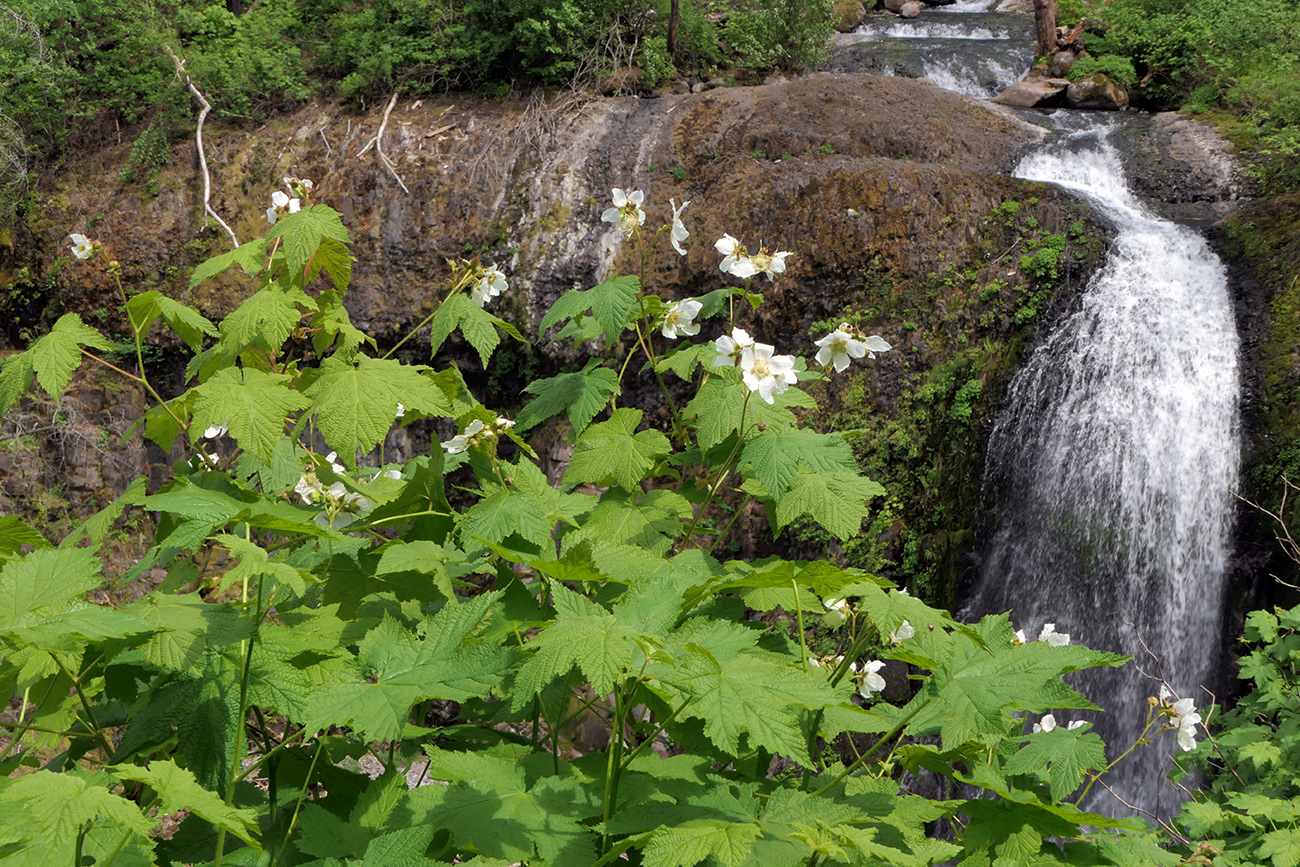
Thimbleberries blooming in front of McCord Creek Falls
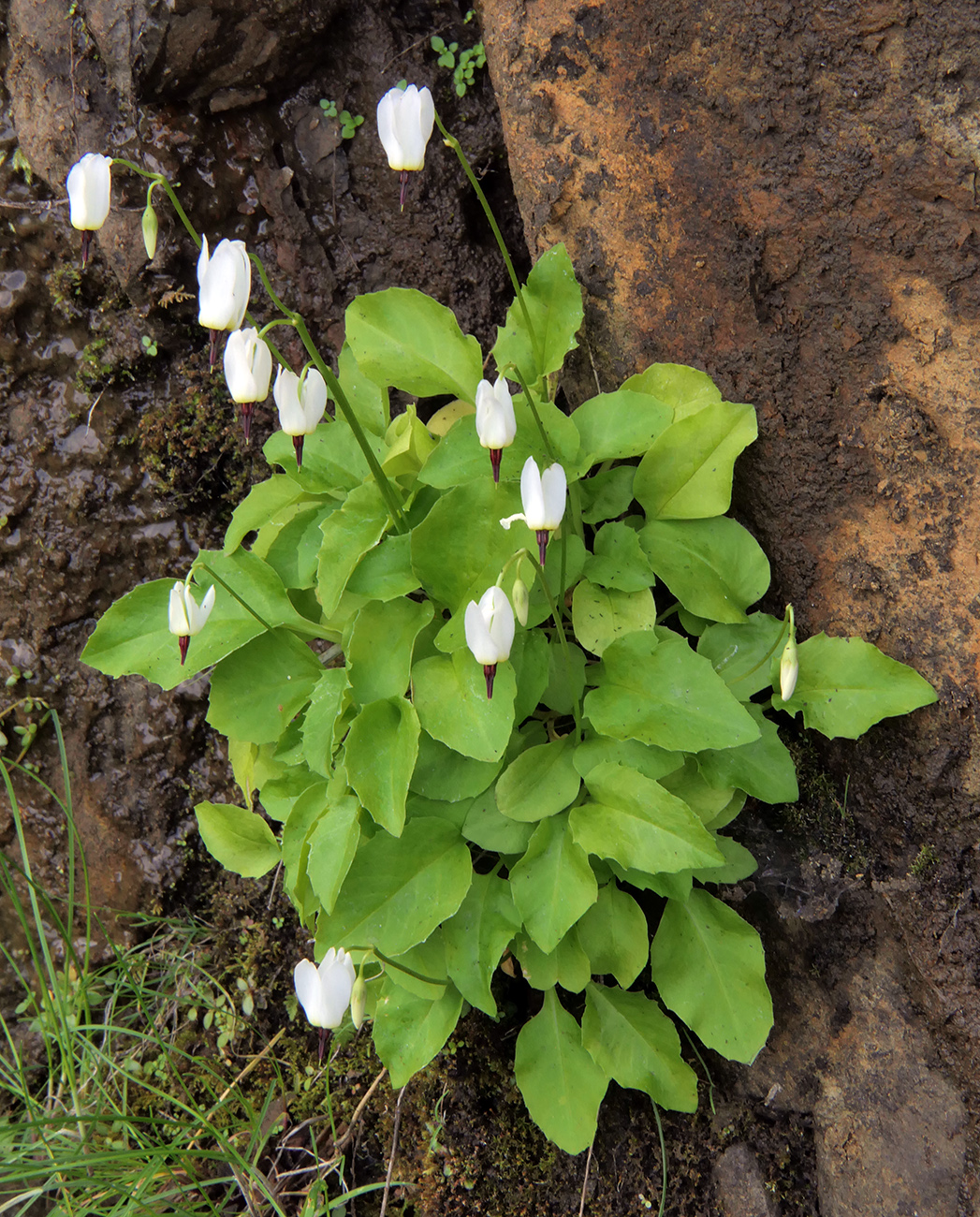
White shootingstar was in perfect bloom in the damp areas of the cliff.
My first visit to McCord Creek Falls was on a trip led by Russ Jolley, the author of the classic field guide, Wildflowers of the Columbia Gorge. It was way back in 1997, on a field trip organized by the now-defunct Emerald Chapter of the North American Rock Garden Society. I immediately fell in love with the place because part of the trail is cut into one of those amazing vertical cliffs that grace the Oregon side of the Columbia River Gorge. While I have a lot of favorites, plants that have adapted to survive the brutal conditions of life in rock crevices have to be my favorite favorites. You have to respect anything that tough. And the contrast of the colorfully flowered and delicate-looking plants with the hard and craggy rocks appeals to the artist in me. Over the next 13 years, I made the long trip north 10 more times. But somehow it just dropped off my radar. I guess I got too busy to drive all the way up there because my last trip there was in 2010 (see Late Bloom at McCord Creek Falls).

The lower part of the trail was almost unrecognizable to me after the fire.
This coming weekend is the annual meeting of the Native Plant Society of Oregon, which will take place up in the Gorge. I had planned on attending, but procrastinated so much that by the time I decided to sign up, it was already full. But with all the dry weather we’ve had lately and nothing specific on our schedules, Jim and I decided to head up to the Gorge ourselves last week for a quick overnight. After 15 years, a visit to the Gorge was long overdue. Our first day, May 7, we headed to McCord Creek Falls.

The rare Howell’s fleabane (Erigeron howellii) was just starting to bloom.
As we passed Multnomah Falls and saw all the burned forest, I was reminded that there had been a horrific fire in the Gorge. This was the Eagle Creek Fire in the fall of 2017 when a teenager threw a lit firecracker into the dry forest, burning about 50,000 acres. Incredible stupidity leading to incredible destruction. With all the fires of late in Lane County, I had forgotten all about this. My mood really dropped as we reached the trailhead of McCord Creek Falls and saw the blackened remains of the forest. But I figured that the cliff plants might have been unaffected, and—as depressing as it is going through burned forest—it is fascinating to see which plants survive and how they recover.

There’s a great view from the cliffside trail, but it is nerve-wracking if you have any fear of heights. Seeing cliff paintbrush and other flowers up close makes it worth it, however.

Jim looking down at the top of Elowah Falls from the cliffside section of the trail

The bright blue rockslide larkspur (Delphinium glareosum) is a species I rarely see as its current range only goes as far south as Marion County. William Baker apparently collected it on Fairview Mountain in Lane County in 1947, but I don’t see any records that far south since then.
Sadly, the conifers were mostly dead—some were still alive but only sparsely clothed in needles. The bigleaf maples (Acer macrophyllum) had burned completely but were resprouting well, looking more like shrubs than the tall trees they once were. Many shrubs were responding very favorably to postfire conditions, probably as a result of the extra light and abundance of nutrients in the soil. I have never seen such a show of thimbleberries (Rubus parviflorus) in perfect flower. Ceanothus are pioneer species that come in quickly after a fire, and in this area, it was redstem ceanothus (Ceanothus sanguineus) whose creamy flowers were filling in all the gaps between the dead trees. Chokecherry (Prunus virginianus) was also in bloom, and mockorange (Philadelphus lewisii) was covered in buds. On the down side, the infestation of stinky Bob (Geranium robertianum) was as awful as I remembered it, and the poison oak (Toxicodendron diversilobum) was way worse than I remembered. I was relieved to be rash-free when I returned home, considering how much poison oak was reaching out into the trail, and we hadn’t thought to bring any Tecnu with us.

A crab spider is hoping someone smaller than me is interested in the beautiful flowers of western corydalis.

The trail ends along McCord Creek above the falls. This western corydalis proved how much it loves wet areas by blooming right in the middle of the creek.
As I had hoped, the rock plants seemed largely unaffected by the fire. Growing as they were on a more or less north-facing cliff, they weren’t as shocked by the removal of the forest as woodland plants might have been, and it is unlikely the cliffs themselves actually burned much. My beloved cliff paintbrush (Castilleja rupicola) was in perfect bloom right by the trail. White shooting star (Dodecatheon dentatum) is a plant I’ve grown in my garden but rarely get to see in the wild as its mostly southerly population is in Marion County at Silver Falls State Park. It was just coming into bloom in damp spots. Another lovely plant that also loves wet areas and also grows at Silver Falls State Park is western corydalis (Corydalis scouleri). It was putting on a lovely show along the trail between the cliffs and the creek above the falls where the trail ends. One species I am concerned about was the early blooming Columbia kittentails (Synthyris missurica var. stellata), a very special plant I’ve only seen there. I only spotted one plant, but it is possible that out of bloom, it was hard to spot. That was one of the highlights of early season trips.

I was surprised to see this checkerspot caterpillar chewing on Cascade penstemon (Penstemon serrulatus) along the trail down to Elowah Falls.

Elowah Falls itself is still impressive, but with the surrounding forest mostly gone, it just doesn’t have the same lush feeling it used to. Looking on the bright side, you can see the falls from much farther away.
I guess it wasn’t surprising that with the NPSO annual meeting only a week or so away, we ran into a fellow NPSO member scouting the trail. David Anderson was planning to lead a trip to McCord Creek Falls for the meeting, so we chatted quite a bit about the plants and crossed paths a number of times. We saw him again as we headed to the adjoining trail that leads down to Elowah Falls. The trail itself had suffered greatly from the fire and was falling apart in a number of places. He quickly decided it was not a good place to bring a bunch of largely older folks. We managed to get down near the base of the falls, but the old bridge had fallen apart (but not burned?), and the only patch of white shooting star I found wasn’t in bloom yet, so we didn’t stay long. I remember that being abundant downstream of the waterfall. I hope the NPSO meeting goes well. The Gorge certainly is a special place for botanizing, and I’ll try not to wait another 15 years to get back!
Thank you…I totally feel the anguish of seeing this burned over countryside. This will renovate over the years and your photos are beautiful despite the loss of the trees. We drive our back roads behind Trail, and I think the clear cuts bother me more. I love the rocky cliffs you “shot” with the licorice ferns spangling this wonderful rocks..I am so grateful tha MOM Nature eventually reestablishes her domain…we find beauty everywhere…Nature will SURVIVE!!! That White Shooting Star was wonderful…and the Delphiniums are so brilliant…Our D. nuttallii have just finished…and I marked the spots where they bloomed to catch some seed and a couple of weeks…I know …so common..My Phlox adsurgens is peeping out..on the ‘cliff’ we designed and constructed several years ago.. HAPPY DAY TO YOU TANYA!!!