Another Great Wildlife Day at Hills Peak
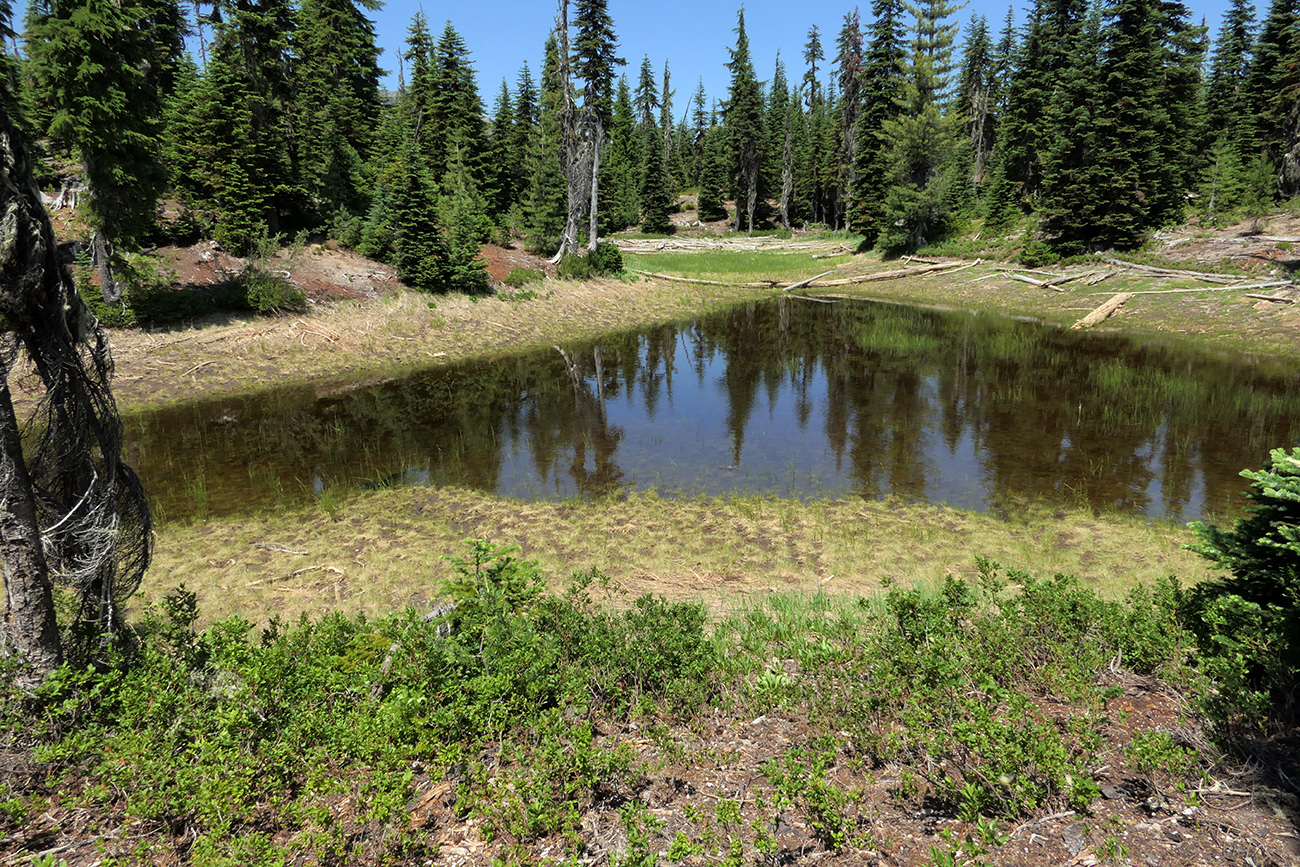
This shallow pond disappears fairly soon after the snow melts, so this was probably only the second time I’d seen it with any water in it. It might not look like it at first glance, but it was teeming with life.

I was hoping to see the tiny flowers lesser bladderwort (Utricularia minor), a rare carnivorous plant, but I only turned up one of them.
On July 14, I braved another hot day to head back up to Hills Peak, where I had just been a week and a half before (see Exploring a New Wetland Near Hills Peak). Accompanying me were Angela Soto and her partner Daniel. As on the previous trip, I wanted to go somewhere that would be reasonably easy and close to water, given the heat. The area around Hills Peak is the perfect place for relaxing exploration and is a great place for wildlife as well as plants.
I also really wanted to see and photograph the flowers of little elephant’s head (Pedicularis attollens), an east-side species that is rare on the west side of the Cascades. It hadn’t started blooming in time for my first trip, but I hoped it would be out by now. And since it was the first time Angela or Daniel had been to this interesting area, I wanted to show them a number of the easily accessed wetlands along with the rocky crags of Hills Peak itself.

Most of the half-mile old road to the lake is fairly dry and boring. But in the one damp stretch, we passed a beautiful spread of Suksdorf’s paintbrush (Castilleja suksdorfii) and probably also scarlet paintbrush (C. miniata). On our way back from the lake, we tried to get a look at some hummingbirds we could hear buzzing about in the willows—probably waiting for us to leave so they could nectar on the paintbrush.
We started the day with a walk to the lake a mile east of Hills Peak. It is the largest of the shallow lakes that dot the area and the most diverse botanically. While I almost always make it part of my trip here, I had skipped it last time to allow for more time exploring the new wetland. We missed the gorgeous spring bloom, probably in part from the heat wave moving things along more quickly than usual, but it is still a wonderful place to explore.

A fierce looking dragonfly larva in a shallow pool of water

Happily, the little elephant’s head flowers were in full bloom in the wetland on the north side of Road 2153. A bumblebee was enjoying unusual flowers, which are similar but much smaller than the more common elephant’s head (Pedicularis groenlandica).
The most interesting spot turned out to be one I hadn’t even planned on checking. Since there is no real trail to the lake once the road peters out, I always end up getting there and back along a slightly different route. Occasionally, I’ve passed a small depression that forms a temporary body of water briefly in the spring. After it dries out in the summer, it fills with grasses, but other than a population of unusually low-growing asters (Symphyotrichum spathulatum?), it is not terribly interesting botanically. You wouldn’t even know it had been a pond supporting lots of wildlife.
Luckily, when we came upon it, there was still a decent-sized pool of water. It was filled with tadpoles. We watched them for quite a while and circumnavigated their little refuge. I have no idea how many tadpoles there were, but though there was enough room for them to spread out, there were numerous dense gatherings where hundreds of them were packed together like sardines. We wondered why they do that. Is there safety in numbers? It would seem hard to get any food in such a crushing congregation. Looking into that on the web, it appears that one of the differences between the tadpoles of toads and frogs is that the baby toads gather in these large groups; it’s called shoaling. Frogs don’t. There were plenty of other tadpoles wriggling about in loose groups. Whether they were claustrophobic toads or actually frogs, I’m not sure. We did see some adult Cascades frogs, so it is certainly a possibility.

This bear’s foot was much bigger than mine!
In addition to the amphibians, there were several garter snakes swimming around the tadpoles. Apparently, they are a frequent predator of Cascades frogs. We noticed one watching the tadpoles intently and several others undulating through the water, sometimes even right through a group of seemingly disinterested tadpoles. The tadpoles seemed like an easy and tasty dinner for a snake, but we never saw a snake go after a single one. I can’t imagine our presence interfered with them in any way, but maybe they weren’t hungry at the moment and in no hurry with so much dinner swimming around them. Someone else had obviously also found the pond and its inhabitants of interest as there were several well preserved paw prints in the drying mud along the edge of the pond—a very large bear!
After returning to the car, we drove west to the wetland and bog next to a small lake. There were still plenty of flowers and insects to hold our interest during our short visit. I had also made a brief stop there on my previous trip and was happy to see the great arctics I’d seen in the back of the bog on that trip were still out and about along with a number of other butterflies, as well as moths, dragonflies, and bees.

According to Seek, this is a Hudsonian whiteface. One of these days, I’ll try to learn some dragonflies!

I’ve been impressed with the construction prowess of caddisfly larvae since I was a child. They build their mobile homes with whatever is available, little sticks in this case. There were quite a few of them in the little creek in the easternmost wetland.
We also spent a little while at the meadow not far from the quarry, where I was very happy to see the little elephant’s head was indeed in bloom. I spent a while photographing it while Angela and Daniel did some more exploring. The meadow was filled with tall lupines (Lupinus polyphyllus) and lovage (Ligusticum sp.) as well as low-growing plants like primrose monkeyflower (Erythranthe primuloides). Plenty of insects were active, and we had fun watching a large longhorn beetle on the lovage.

After I removed some of the rotted vegetation on my previous trip, someone had started refilling this perennial pika cache! Compare this to the photo in Exploring a New Wetland Near Hills Peak.
Our final stop was to the old quarry on the north side of Hills Peak. Daniel and I made the climb up the remnant of road to get closer to the cliffs and admire all the flowers near the top of the road. Angela stayed below to see if she could see any pikas. As on my last trip, we didn’t see or hear any, but it was probably still too hot during the day for them to be active. I was relieved to see someone had cached some vegetation under a large rock, so at least I know there are some pikas still in the area.

The Merriam’s alumroot was in full bloom way up on the cliff above the quarry.
I love your photography!!! So many wonderful “critters”!!! LOVE them all!! That RED Dragonfly was new to me…We haven’t seen that one here on our ponds…I will hope…
THANK YOU SO MUCH…I really appreciate you happy, Happy Holidays!!