Peak Flowers at Groundhog Mountain

The road banks along 2309 are about 1000′ lower than the highest section of the road, so the flowering season was much farther along. Lots of vibrant Oregon sunshine (Eriophyllum lanatum) and harsh paintbrush (Castilleja hispida) grew among the softer colored annuals, rosy plectritis (Plectritis congesta) and bluefield gilia (Gilia capitata).
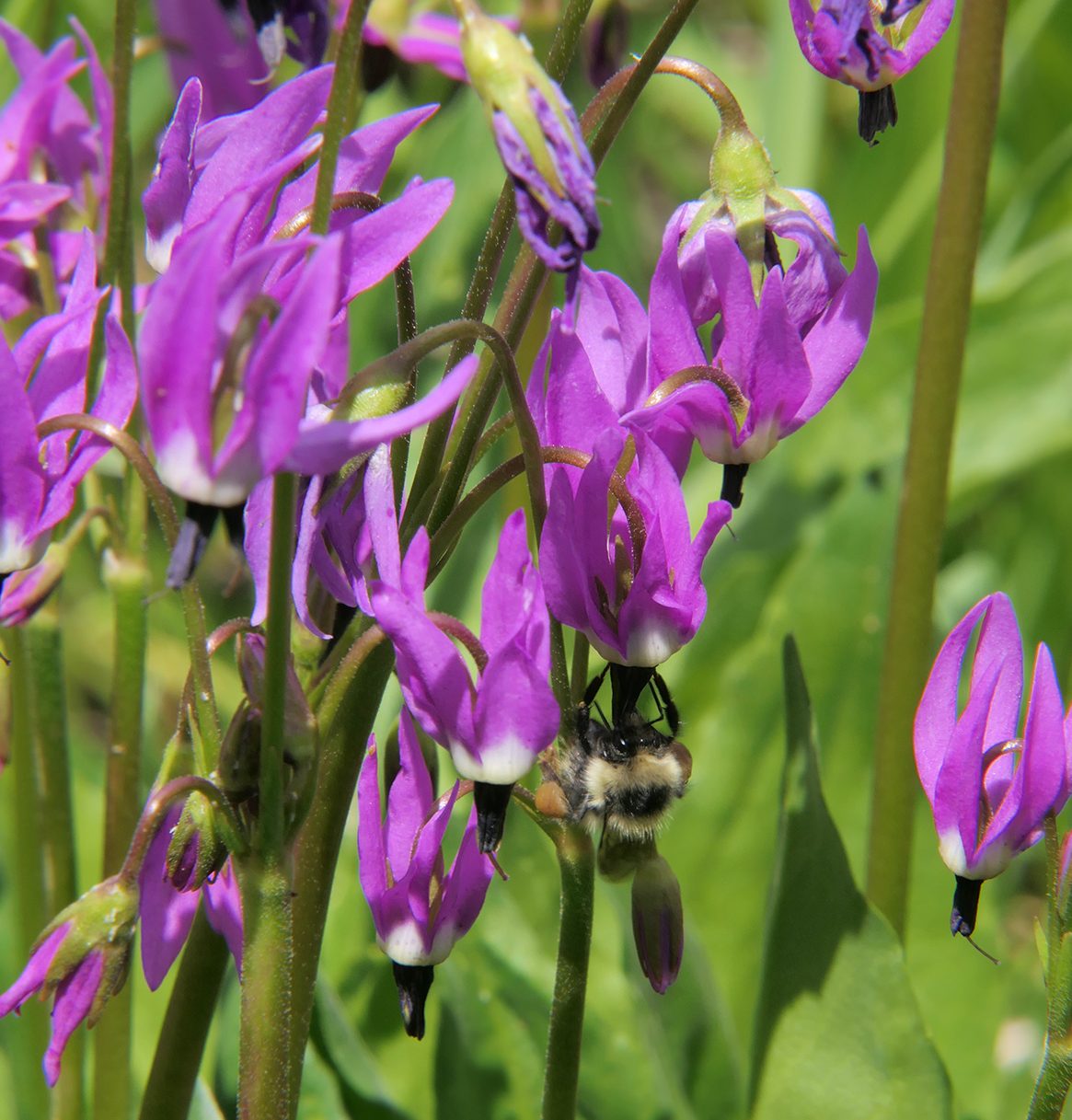
The reflexed petals of tall mountain shooting star are designed for bumblebees, and the bees are happy in any wetland filled with these beauties.
After we had such a great time at Groundhog Mountain and Logger Butte two years ago (see Wonderful Day at Groundhog Mountain and Logger Butte), NPSO buddies Dave Predeek and Alan Butler were as anxious as I was to get back up there this year. We all had the day free on June 30th, so Alan drove us up there for another excellent day of botanizing. As on the previous trip together, we headed up there from the north so we could pass by the floriferous roadcuts of Road 2309. They were still colorful, so we made multiple stops along the road. There was so much to see that Dave and I walked along the road while Alan moved the truck up the road a bit at a time. What a luxury to have someone else drive so I can focus on botanizing, taking photographs, and chasing butterflies!

Alan spotted these voracious larvae devastating a number of Sierra gooseberries (Ribes roezlii var. cruentum) growing on the slope below Road 2309. I’ve never seen these before. Anyone know what they are?

I was very excited to spot a Milbert’s tortoiseshell along the roadside. Unfortunately, it didn’t sit still for more than a minute or two before sailing off down into the valley below. I’ve only seen a handful in the Western Cascades, so it was one of the highlights of the day for me.

What I had been looking forward to the most in the “new” wetland was the elephant’s head. I had seen so many dead stalks of it last September. How wonderful to have hit it at its peak! After some pondering, I decided to call it “Pink Elephant Meadow.”
Late last year, I discovered a large wetland just out of sight off the road (see Right Back to Groundhog and Warner Mountains), so that was our next stop. It was very exciting to see it at the height of the season as I had only been able to imagine how pretty it would look in bloom when I was there last fall. It did not disappoint! The tall mountain shooting star (Dodecatheon jeffreyi) and elephant’s head (Pedicularis groenlandica) were in perfect bloom, and I spent much too long trying to photograph all the busy bumble bees visiting them both.

Alan and Dave enjoy the view and the beautiful day from the summit of Logger Butte.

On last year’s trip to Logger Butte we discovered the Sierra arnica (Arnica nevadensis), but they were almost finished. I was glad we made it in time this year to see some in good bloom.
Back to rock habitat, our next destination was lunch on the summit of Logger Butte with its fabulous view and lots of butterflies and flowers. From the top, you can see down to the large wetland just to the north. Along where Noisy Creek runs through it, there is a large thicket of willows and some nice boggy area. Neither Alan nor Dave had been there, and I hadn’t checked in out in many years, so we drove down there next and wandered around for a while. The flowers were farther along than those in the wetland we’d already been to, but there were pretty blue-flowered California jacob’s ladder (Polemonium californicum), which we hadn’t seen yet.
One of Alan’s favorite spots is an old quarry on the next ridge north of this wetland. I was really interested in exploring it since I’d never gone up there. Unfortunately, we were stopped by a very large tree across the road on our way there. There was still some snow in the ditches there and along some of the other roads we passed, so the upper roads hadn’t been open very long, and no one with a chain saw had gotten up there yet. Maybe next year I’ll get to see it.

Cascade fleabane (Erigeron cascadensis) blooms in the rocks beside the bench on the summit of Logger Butte. From here, there’s a vertiginous view of the Noisy Creek meadow 600′ below.

Had I not seen the telltale orange flowers of Crater Lake currant, I might have again missed this plant near Waterdog Lake. It is an uncommon Cascade endemic that is occasional in the nearby Calapooyas to the south, but a species I’d never seen in the area near Groundhog Mountain.
Off to Waterdog Lake next, we were happy to see how full the shallow lake was. We poked around for a bit, and I had my biggest surprise of the day when I came across a stretch of Crater Lake currant (Ribes erythrocarpum) just north of the lake. I’d been here dozens of times and enjoyed the many species of Ribes in the area, but I had never seen this plant. I could only find one plant trailing along the ground, but it was large enough that it must have been here on my last half dozen visits at least. It never ceases to amaze me how many things I discover in places where I would have thought I’d seen everything.
From there, we continued down Road 451 past the bottom of the giant meadow on the south slope of Little Groundhog Mountain. The roadcuts here were also spectacular. It’s too bad the road itself is in such bad shape. We spent a while photographing wildflowers, watching butterflies, and discussing the unusual population of oaks up there at over 5300′. I had passed the small trees growing on the downhill side of the road many times over the years, but I had never noticed there were even more oaks on the uphill side that were quite dwarfed. Alas, that was all we had time for, but we had had a wonderful day, so I was more than satisfied. I hope we can make it an annual tradition!

The Road 451 road banks west of Waterdog Lake had a diverse array of beautiful species including large-flowered Blue-eyed Mary (Collinsia grandiflora), western columbine (Aquilegia formosa), Menzies’ larkspur (Delphiinium menziesii), and sticky cinquefoil (Drymocallis glandulosa).
Love your newsletters!
So VIBRANT!! Wonderful photos…No..I have no idea what the larva are…I’m sort of glad they’re not on my Ribes roezelii!!! Yikes…I better go check!! Wonderful storm last night…and hopefully you got rain too..
Happy DAY!!! Thank you..I enjoyed this wonderful glorious hike!!!